

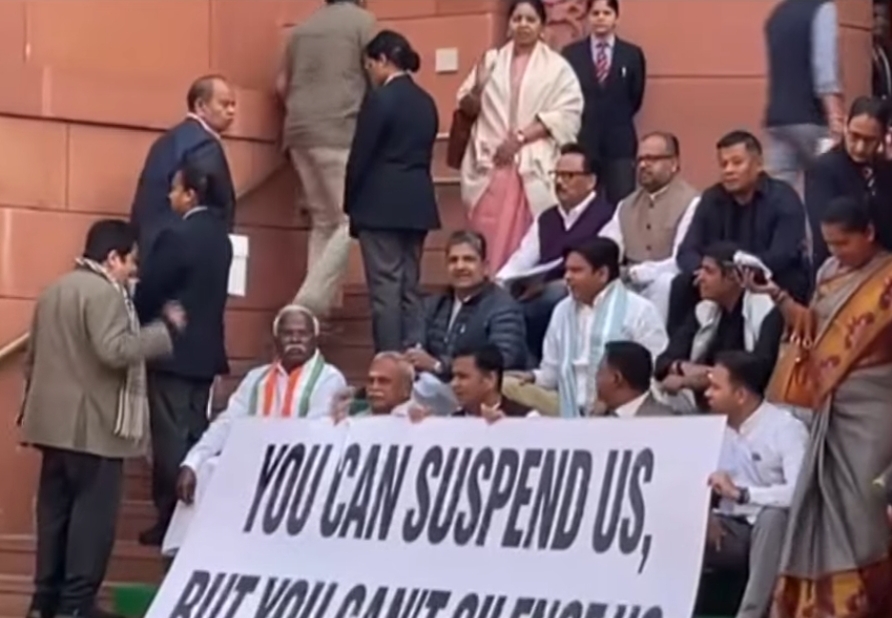
In a parliamentary democracy, the floor of the House is not merely a stage for rhetoric; it is the altar of accountability. The Prime Minister is not a sovereign ruler but the first among equals, tethered to the legislature by an umbilical cord of constitutional responsibility. When that bond is frayed by absenteeism or bypassed through security pretexts, the very foundation of the Republic trembles.
Recent events in the Lok Sabha have set a chilling precedent. For the first time in India’s parliamentary history, a Motion of Thanks to the President’s address was passed without the customary concluding reply from the Prime Minister. The justification? A suggestion by the Speaker that the Prime Minister’s physical safety was at risk within the chamber.
The Security Pretext: A Paradox of Power
The claim that the Prime Minister of India—guarded by the elite Special Protection Group (SPG) and layers of specialized security—is unsafe within the well of the House is a narrative that collapses under its own weight. If the most protected individual in the nation cannot be secured within the inner sanctum of our democracy, what does it say about the state of law and order for the 140 crore citizens outside those walls?
To cite “aggressive movement” or “threatening language” from the Opposition as a reason for the Head of Government to skip a constitutional duty is more than a security concern; it is a tactical withdrawal from scrutiny. Security forces are trained to neutralize physical threats, but they cannot—and should not—shield a leader from political discomfort or the necessity of answering to the people’s representatives.
Diplomacy as an Alibi
The trend of scheduling high-profile foreign tours to coincide with Parliament sessions has moved from a scheduling quirk to a systemic avoidance. While diplomacy is a vital executive function, it cannot be used as an escape hatch.
While Article 101(4) of the Constitution only penalizes absence after sixty consecutive days, democracy is not governed by the letter of the law alone, but by its spirit. There is no legal penalty for missing a debate, but there is a profound democratic cost. When the executive treats Parliament as an inconvenience rather than a requirement, it signals to the voter that their mandate ends the moment the ballots are counted.
The Erosion of Parliamentary Norms
The Prime Minister’s reply to the President’s address is not a courtesy; it is a vital mechanism of the Westminster model. It is the moment where the government justifies its agenda and addresses the grievances raised by the Opposition. By allowing this motion to pass in absentia, the House has signaled that the executive is no longer “responsible” to the House in the literal sense.
Parliament is the only arena where the government is compelled to look its critics in the eye. When a leader chooses to be absent, they are not just ignoring the Opposition; they are ignoring the millions of citizens those MPs represent.
Accountability Cannot Be Outsourced
A leader’s courage is measured not by the strength of their security detail, but by their willingness to engage with dissent. To treat the temple of democracy as a “threat zone” denigrates the institution and weakens the public’s trust in the state’s stability.
We must ask: Is the Prime Minister’s absence a matter of safety, or a matter of strategy? If we accept the former, we admit a catastrophic failure of the state. If we accept the latter, we acknowledge a deliberate erosion of democratic norms. In either scenario, the loser is the Indian citizen, whose vote is taken for granted the moment the doors of the Parliament are closed to the one person most obligated to be there.
~Hasnain Naqvi is a former member of the history faculty at St. Xavier’s College, Mumbai

~Hasnain Naqvi is a former member of the history faculty at St. Xavier’s College, Mumbai….
The opinions expressed here are solely those of the author.