

A Directive That Reopens Old Wounds
The recent directive of the Union Ministry of Home Affairs mandating the recitation of all six stanzas of Vande Mataram before the National Anthem at public functions marks a decisive and troubling moment in India’s constitutional journey. What may appear, at first glance, as a gesture of cultural pride is in fact a measure laden with constitutional, historical, and moral consequences.
India has long recognised Vande Mataram as the national song, but never at the cost of its constitutional equilibrium. The new protocol, by insisting that the entire text be rendered and by placing it ahead of the National Anthem, unsettles a carefully negotiated balance achieved during the freedom struggle and affirmed at the birth of the Republic.
Patriotism, in a democracy, is meant to inspire—not to coerce.
The Historical Settlement of 1937
Vande Mataram, composed by Bankim Chandra Chattopadhyay and included in his 1882 novel *Anandamath*,emerged as a rallying cry during the anti-colonial movement, particularly in Bengal. Its opening stanzas evoke the beauty and fertility of the motherland. However, later verses explicitly personify the nation as the goddess Durga and invoke imagery rooted in Hindu devotional tradition.
Recognising India’s plural character, the Congress Working Committee in 1937 resolved to adopt only the first two stanzas for public and political use. This decision was neither arbitrary nor apologetic. It was statesmanship. Leaders including Jawaharlal Nehru, Sardar Vallabhbhai Patel, Maulana Abul Kalam Azad and Rajendra Prasad understood that symbolism in a diverse society must unite rather than divide.
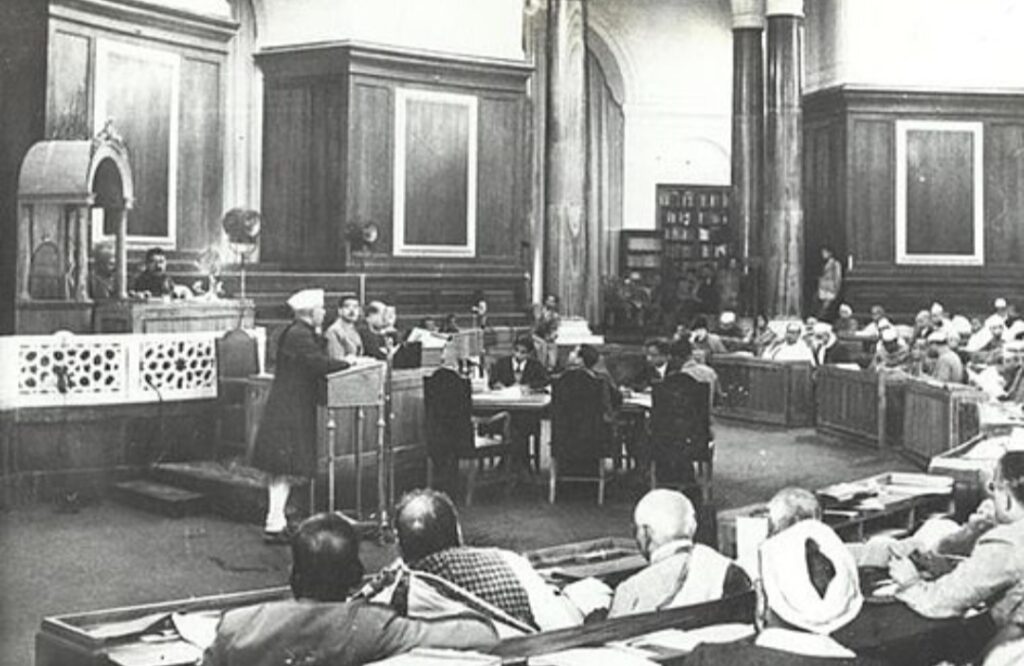
The Constituent Assembly, on January 24, 1950, adopted Jana Gana Mana—written by Rabindranath Tagore—as the National Anthem. On the same day, it accorded Vande Mataram an honoured but distinct status as the national song. That settlement was deliberate: one song would serve as the constitutional anthem of the Republic; the other would remain a revered historical hymn of the freedom struggle.
To alter that equilibrium through executive fiat is to reopen a question the freedom movement resolved with care.
Article 25 and the Question of Conscience
Article 25 of the Constitution guarantees freedom of conscience and the right freely to profess, practise and propagate religion. Compelling individuals to sing verses that personify the nation as a deity places many citizens—Muslims, Christians, and even reformist Hindu traditions such as the Arya Samaj—in a moral dilemma.
The Supreme Court has consistently affirmed that patriotism cannot be compelled in ways that violate conscience. In Bijoe Emmanuel v. State of Kerala (1986), the Court protected Jehovah’s Witness students who stood respectfully but declined to sing the National Anthem on religious grounds. The judgment made clear that constitutional patriotism rests on voluntary allegiance, not enforced uniformity.
To insist upon recitation of all six stanzas, including explicitly devotional imagery, risks contravening that principle.
Senior constitutional voices have warned that such measures amount to executive overreach. The Constitution does not prescribe ritualistic hierarchies between the national song and the national anthem. Those norms evolved through political consensus, not administrative circulars.
Literature, Context and the Politics of Revival
No fair reading of Bankim Chandra Chattopadhyay can ignore the historical milieu in which he wrote. *Anandamath* is set during the Sannyasi rebellion and depicts ascetic warriors fighting Muslim rulers. Scholars have noted that the novel’s narrative contains sectarian undertones reflective of 19th-century Bengal’s anxieties.
The historian R.C. Majumdar acknowledged the song’s nationalist energy but also its context-bound character. Sri Aurobindo, who translated Vande Mataram into English, viewed it as a stirring hymn of resistance in Bengal, not necessarily as a constitutional anthem for a multi-religious republic.
The Congress leadership in 1937 understood this distinction. Their decision to retain only the inclusive stanzas was an exercise in accommodation, not mutilation.
Jana Gana Mana and the Idea of India
Jana Gana Mana was chosen precisely because of its geographic sweep and spiritual abstraction. It invokes no deity of a particular tradition. It names regions, rivers and peoples, evoking a composite civilisation rather than a singular religious metaphor.
Critics once alleged that Tagore’s song praised the British monarch—an interpretation the poet himself dismissed. Historians have long debunked the claim, affirming that the “Dispenser of India’s destiny” was a metaphysical invocation, not imperial flattery.
The framers of the Republic selected the anthem for its brevity, inclusiveness and suitability for solemn occasions. Elevating the national song in precedence or duration risks symbolically diminishing the anthem’s centrality.
Constitutional Patriotism vs. Cultural Nationalism
The Indian Constitution embodies what legal scholars describe as “constitutional patriotism”—loyalty to shared civic values rather than to a singular cultural identity. B.R. Ambedkar repeatedly warned that hero-worship and symbolic absolutism could threaten democratic balance.
The present directive must therefore be seen not in isolation but as part of a broader reorientation of state symbolism. When the state appears to privilege a civilisational narrative over constitutional neutrality, minorities understandably perceive vulnerability.
Patriotism measured by the length of a recital or the duration of standing transforms civic pride into ritual compliance. Elderly citizens, persons with disabilities, or those guided by theological conviction should not find their nationalism questioned because they hesitate before devotional metaphors.
The Deeper Question
No one disputes the historical significance of Vande Mataram. It inspired countless freedom fighters. It remains part of India’s cultural heritage. But reverence cannot be legislated without consequence.
The Republic’s strength lies not in uniform expression but in shared belonging. The freedom movement’s leaders balanced reverence for tradition with sensitivity to diversity. They chose consensus over coercion.
If patriotism must endure, it must remain voluntary. A song that once stirred resistance against colonial rule should not become an instrument of compulsion within a constitutional democracy.
For nations endure not by enforcing devotion, but by nurturing trust.
~Hasnain Naqvi is a former member of the history faculty at St. Xavier’s College, Mumbai

~Hasnain Naqvi is a former member of the history faculty at St. Xavier’s College, Mumbai….
The opinions expressed here are solely those of the author.

