

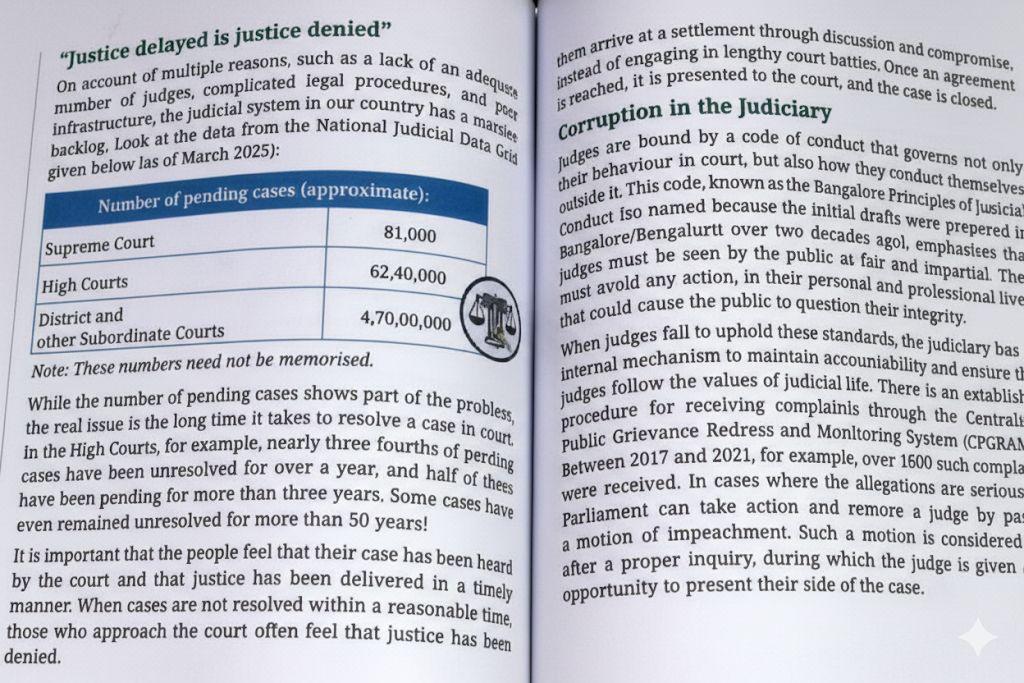
The classroom has long been a space for idealism, often presenting the pillars of democracy as flawless monoliths. However, the National Council of Educational Research and Training (NCERT) has recently pivoted toward a more “realist” pedagogical approach. The new Social Science curriculum for Class 8 now explicitly addresses the “shadows” of the Indian legal system—specifically judicial corruption and the staggering backlog of over five crore cases.
While some may fear this introduces “cynicism” too early, a closer look suggests it may be the very spark needed to ignite genuine critical thinking in young citizens.
From Idealism to Realism: The Merit of Transparency
For decades, the judiciary was taught as an abstract concept—an independent arbiter of truth. The new curriculum breaks this third wall by presenting hard data: 81,000 pending cases in the Supreme Court and a crushing 4.7 crore in subordinate courts.
Pedagogically, this shift is significant. By moving beyond “how a law is made” to “why a law might fail to be served,” the NCERT is fostering legal literacy. Introducing students to concepts like the Code of Conduct for judges and the impeachment process provides a balanced view: it acknowledges the flaw but simultaneously explains the institutional remedy. This builds trust not through blind faith, but through an understanding of accountability.
The “Overburden” Argument: Information vs. Insight
Critics often argue that 13-year-olds are at a “tender age,” and that inundating them with systemic failures adds unnecessary cognitive load. However, the “overburdening” of a student rarely comes from the complexity of a topic, but rather from the method of delivery.
The inclusion of contemporary milestones—such as the striking down of Electoral Bonds and the Information Technology Act rulings—serves as a vital “active learning” tool. These aren’t just dry facts to be memorized; they are narratives of constitutional checks and balances in action. By asking students why the Supreme Court acted in these instances, the curriculum shifts from rote memorization to evaluative reasoning.
The Critical Thinking Catalyst
The hallmark of a mature democracy is the ability of its citizens to critique its institutions without seeking to dismantle them. By citing Justice B.R. Gavai’s 2025 remarks on the “erosion of public confidence,” the textbook invites students into a national conversation.
* Demerits: There is a slight risk that without skilled teaching, students might walk away with a purely negative view of the judiciary.
* Merits: It prepares students for the “messiness” of the real world. It teaches them that justice is not a static gift from the state, but a dynamic process requiring constant vigilance and reform.
A Necessary Evolution
NCERT’s decision to air the judiciary’s “dirty laundry” is a bold pedagogical gamble that aligns with the National Education Policy (NEP) 2020’s goal of creating “global citizens.” Far from overburdening students, these changes provide the intellectual scaffolding necessary to understand the world they actually inhabit, rather than the sterilized version found in older texts.
If we want the next generation to solve the “massive backlog” or “systemic corruption,” we must first give them the permission to acknowledge that these problems exist.
~Hasnain Naqvi is a former member of the history faculty at St. Xavier’s College, Mumbai

~Hasnain Naqvi is a former member of the history faculty at St. Xavier’s College, Mumbai….
The opinions expressed here are solely those of the author.