

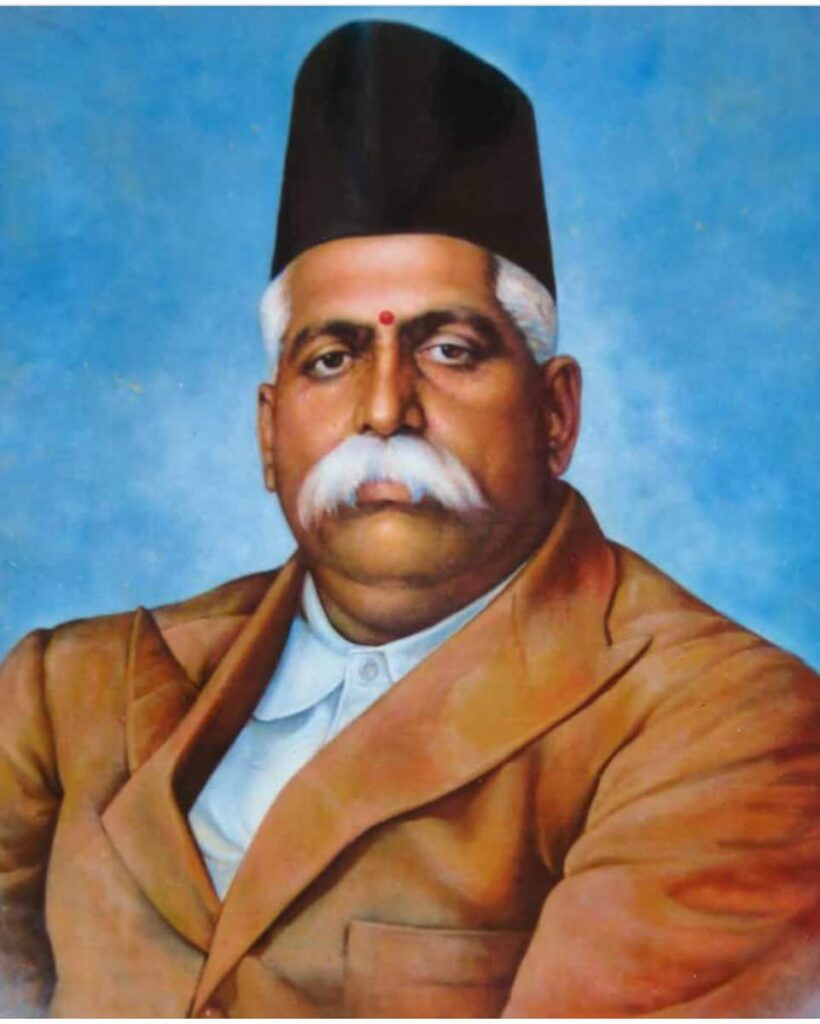
On the anniversary of his birth, the legacy of Dr. Keshav Baliram Hedgewar remains one of the most consequential, yet deeply polarizing, chapters in modern Indian history. As the founding Sarsanghchalak of the Rashtriya Swayamsevak Sangh (RSS) in 1925, “Doctorji” did more than just establish an organization; he engineered a fundamental shift in the Indian sociopolitical psyche—one that prioritized cultural nationalism over the inclusive, pluralistic vision of the anti-colonial struggle.
While his hagiographies paint a picture of a selfless patriot, a critical journalistic examination of his formative years and ideological moorings reveals a more complex reality: the systematic sowing of the seeds of the Hindu-Muslim communal divide during a period when national unity was most precarious.
From Congress to Communalism
Hedgewar’s early involvement in the freedom struggle was through the Indian National Congress and revolutionary circles like the Anushilan Samiti. However, the early 1920s marked a sharp departure. Scholarly works, including P.V. Sahasrabuddhe’s biography and Rakesh Sinha’s accounts, suggest that the failure of the Non-Cooperation Movement and the subsequent Khilafat Movement left Hedgewar disillusioned.
Under the profound influence of his mentor, Dr. B.S. Moonje, Hedgewar began to view the “Muslim threat” as more existential than British colonialism. Moonje, a staunch militarist who later met with Mussolini to study fascist youth organization, provided the ideological scaffold for Hedgewar’s mission. Together, they concluded that Hindus were “disorganized” and “weak,” leading to a worldview where Indian identity was synonymous only with Hindu identity.
The 1925 Pivot: Building the ‘Hindu Rashtra’
The founding of the RSS in Nagpur on Vijayadashami, 1925, was not an accidental response to local riots; it was a calculated move to institutionalize the “Hindu Sangathan” (Hindu Organization). Hedgewar’s brilliance lay in his rejection of traditional political agitation in favour of shakhas—daily meetings focused on physical training and ideological indoctrination.
Critical historians argue that this “cultural” work was inherently exclusionary. By defining the nation as Pitribhu (fatherland) and Punyabhu (holy land), Hedgewar—echoing the sentiments of V.D. Savarkar—effectively positioned Muslims and Christians as “internal threats” whose primary loyalties lay outside the borders of India.
The Mentorship of Moonje and the Spread of Discord
The role of B.S. Moonje in shaping Hedgewar’s legacy cannot be overstated. It was Moonje who pushed for the militarization of Hindu youth, a concept Hedgewar operationalized through the RSS. During the 1920s and 30s, as the freedom movement sought a united front against the British, Hedgewar and Moonje’s rhetoric often redirected Hindu anxieties toward their neighbours.
While the Congress was navigating the difficult waters of communal harmony, Hedgewar’s RSS remained largely aloof from the Civil Disobedience and Quit India movements. His focus remained singular: building a disciplined cadre that viewed the internal “other” as the primary obstacle to a glorious Hindu future. This strategic silence during the struggle against the British allowed the organization to grow, but it also ensured that its energy was preserved for domestic communal friction.
The Cost of a Monolithic Nationhood
The aftermath of Hedgewar’s divisive legacy is etched into the blood-soaked pages of Partition and the recurring communal frictions of post-independence India. By moving the goalpost from territorial nationalism (where everyone born in India is Indian) to cultural nationalism (where Indianness is defined by Hindu culture), Hedgewar created a permanent fault line in the subcontinent.
Today, the RSS stands as the ideological fountainhead of the Indian political establishment, proving the enduring efficacy of Hedgewar’s organizational model.
However, the “Doctor’s” prescription for national strength came at a heavy cost:
* The Normalization of Exclusion: The idea that religious minorities must “assimilate” or live as second-class citizens.
* The Erosion of Pluralism: A shift in the national discourse where secularism is often derided as “appeasement.”
* Social Polarization: A legacy of suspicion that continues to flare up in the form of communal riots and social boycotts.
Dr. K.B. Hedgewar was undoubtedly a master of grassroots mobilization. Yet, a dispassionate look at history suggests that his primary achievement was the construction of a rigid identity politics that thrived on the “us versus them” binary.
As we reflect on his life, we must ask whether the “unity” he sought for one community has become the very instrument of division for a diverse nation. His legacy is not just a footnote in history; it is a living, breathing tension that continues to define the soul of modern India.
Picture credit social media

~Hasnain Naqvi is a former member of the history faculty at St. Xavier’s College, Mumbai….
The opinions expressed here are solely those of the author.