

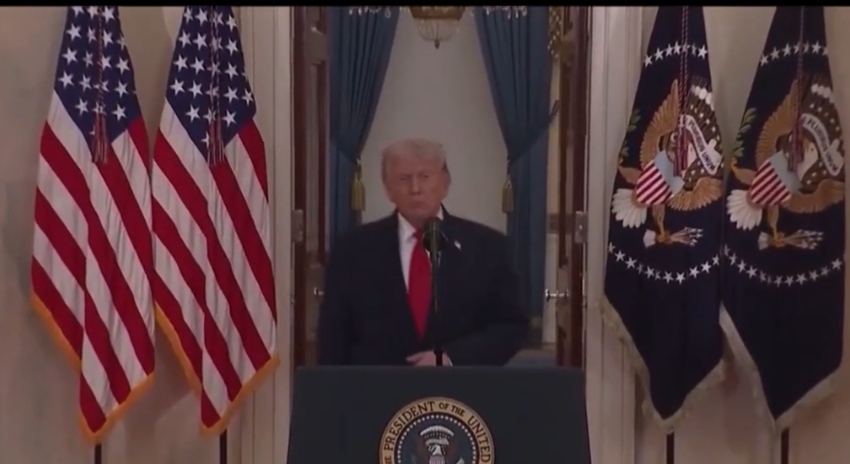
In a prime-time address from the Cross Hall on Wednesday night, President Donald Trump declared the five-week-old “Operation Epic Fury” a “swift and decisive victory.” Yet, as the smoke clears over Tehran, a stark disconnect remains between the White House’s triumphalist rhetoric and the messy reality of a region in chaos. The President’s speech, laden with superlatives and sweeping declarations, appears less like a mission-accomplished report and more like an attempt to build a rhetorical bridge for an “honourable exit” from a conflict that is already fracturing global alliances and destabilizing world markets.
Here is a threadbare analysis of the President’s claims versus the ground reality.
*The Nuclear Standoff and the Leadership Vacuum*
*The Claim*: “We will not allow Iran to become a nuclear power. All of Iran’s leaders have been killed.”
*The Facts*: While it is true that the initial February 28 strikes killed Supreme Leader Ali Khamenei and several top-tier officials, the claim that all leaders are gone is a gross oversimplification. Regional reports indicate that mid-level commanders and various political figures have retreated to hardened underground facilities. Furthermore, while the U.S. has targeted nuclear sites in Isfahan and Natanz, intelligence officials warn that Iran’s nuclear knowledge remains intact, and the “dead and crippled” state of the government has actually increased the risk of loose-cannon nuclear proliferation.
*The Oil Independence Myth*
*The Claim*: “The United States does not import any oil from the Strait of Hormuz. We have no need for it.”
*The Facts*: This is a classic Trumpian pivot. While the U.S. has achieved high levels of domestic production, oil is a global fungible commodity. The closure of the Strait of Hormuz—which Iran’s remaining naval assets still threaten—sent crude oil futures spiking by over 5% immediately following the President’s speech. Even if the U.S. doesn’t “need” the physical barrels, American consumers are already feeling the “short-term” gas price hikes the President blamed on Iranian sabotage earlier in the day.
*The “Two-Week” Timeline*
*The Claim*: “The operation is proceeding well; we will take significant action against Iran within two to three weeks.”
*The Facts*: This timeline mirrors the “two-week” promises often seen during his first term regarding healthcare and infrastructure. By promising a massive surge followed by an exit, the President is attempting to set a deadline for a victory he has not yet fully secured. Military analysts suggest that “significant action” usually precedes a long-term quagmire, not a clean withdrawal.
*Declaring Victory Mid-Conflict*
*The Claim*: “The U.S. military has achieved a swift and decisive victory in Iran.”
*The Facts*: Victory is defined by the achievement of strategic objectives. While the U.S. and Israel have successfully “degraded” Iranian infrastructure, the war is currently in its fifth week with no clear replacement government in sight and asymmetric retaliations against Israel continuing. Calling it “decisive” while simultaneously planning “significant action” for the next month is a logical contradiction.
*The State of the Iranian Military*
*The Claim*: “Iran’s navy has been completely annihilated, its air force has been destroyed, and the leadership of the IRGC has been all but eliminated…”
*The Facts*: “Decimated” is a more accurate term than “annihilated.” While the Iranian Navy’s surface fleet took heavy losses, their “mosquito fleet” of fast-attack craft and midget submarines remains a potent threat in the Persian Gulf. Similarly, while the IRGC’s top brass was hit on day one, the organization’s decentralized structure was designed specifically to survive such “decapitation” strikes.
*A Historical Superlative*
*The Claim*: “Never before in the history of warfare has an adversary suffered such clear, devastating, and comprehensive damage within the span of just a few weeks.”
*The Facts*: This hyperbole ignores the 1991 Gulf War, where the “Air Campaign” neutralized the world’s fourth-largest army in roughly the same timeframe, or the 1967 Six-Day War. By framing this as the greatest military feat in history, the President is likely trying to satisfy a domestic base wary of “forever wars” by insisting the job is already “perfectly” done.
*The Strategy of the Bluff*
President Trump’s address suggests a shift in strategy: Declare victory and depart. By painting a picture of total Iranian collapse, he provides himself the political cover to withdraw troops before the high costs of occupation and domestic inflation become untenable. However, the world watches with bated breath. If the Strait of Hormuz remains closed and the “annihilated” IRGC continues to launch drone swarms, this “honourable exit” may look a lot more like a hasty retreat from a fire the administration is no longer interested in fighting.
Picture credit social media

~Hasnain Naqvi is a former member of the history faculty at St. Xavier’s College, Mumbai….
The opinions expressed here are solely those of the author.

