
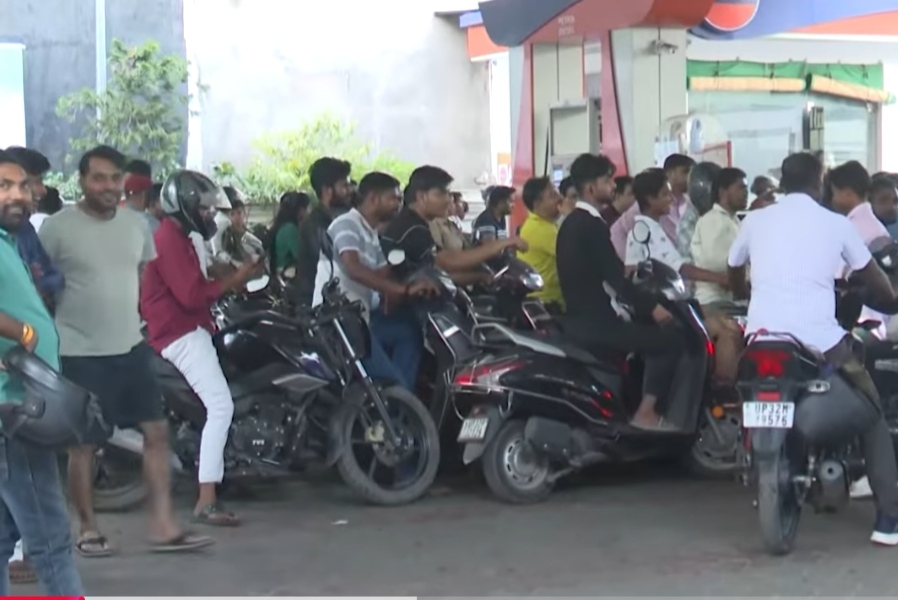
NEW DELHI ,4 April 2026: India imports 88% of its crude. Why then is it not seeing massive price hikes for fuel and LPG? Inside the unique strategy it’s following.
Gas prices in Europe have surged by nearly 70% amid the West Asian crisis, intensifying volatility in global energy markets. Compounding this, Russia imposed a gasoline export ban effective April 1.
Since the Iran war, energy markets have been acutely destabilised. Eurozone inflation rose to 2.5% from 1.9%, driven largely by energy inflation at 4.9% year-on-year. A ₹74 surge in crude, a near-blockade of the Strait of Hormuz, and collapsing Gulf LPG flows should have triggered a domestic spiral across many countries. However, India has managed to contain the retail impact so far.
India’s structural exposure was significant. Its crude import dependence stands at 88%, while LPG imports accounted for 60% of consumption, of which roughly 90% transits through Hormuz. With over 100 million households under the Pradhan Mantri Ujjwala Yojana reliant on subsidised LPG, this dependence has direct implications.
Early indicators pointed to stress: LPG imports fell from 3,22,000 metric tonnes to 2,65,000 metric tonnes, while the Gulf’s share in it dropped from around 60% to 34%. Under standard transmission dynamics, such a shock would have led to a sharp retail price increase.
Yet, unlike most economies, India prevented a full pass-through. Petrol and diesel prices remained largely unchanged, and LPG saw only a limited increase. Moreover, the government claims that it has stabilised LPG prices after having secured an eased supply of it.
The puzzle is, why did such exposure not translate into domestic price instability?
Where India Is Getting Its Supplies From
India’s first line of response lay in supply-side adaptation specifically: a rapid but structural diversification of import sources. Crucially, this was not an ad hoc adjustment but an extension of pre-existing procurement strategies that provided options under crisis conditions.
The United States emerged as a key marginal supplier of LPG, backed by pre-contracted volumes of approximately 2.2 million tonnes per annum, about 10% of India’s import basket. This contractual baseline enabled scaling up without delays owing to renegotiation.
The key insight is that India’s resilience did not come from post-crisis improvisation, but from a diversified import portfolio that could be reweighted under stress, including the incorporation of non-traditional suppliers like Argentina.
This supply diversification was complemented by maritime and strategic interventions.
With disruptions extending to both Hormuz and the Red Sea, shipping routes were reconfigured around the Cape of Good Hope. This has historically increased transit times by approximately 30% and freight costs by 40-60%, alongside a spike in insurance premiums.
To mitigate these risks, India deployed naval and diplomatic tools. Under Operation Sankalp, Indian naval escorts ensured safer passage for critical energy shipments. Concurrently, selective access through Hormuz was maintained via diplomatic channels, reducing the probability of extreme supply disruptions.
The payoff was clear: while costs increased, physical supply continuity was preserved.
Domestic buffers further strengthened this resilience. LPG production increased by 28%, while piped natural gas (PNG) connections expanded by nearly 2.9 lakh, partially substituting LPG demand at the margin. Strategic petroleum reserves, covering roughly 74 days of consumption, provided an additional cushion.
However, even with supply secured, global price escalation remained unavoidable. Herein lay the most decisive intervention.
India’s second and arguably more consequential policy response was to decouple global price shocks from domestic retail prices through a combination of fiscal absorption and administrative controls.
The divergence between input costs and retail prices was stark.
Analysts suggest that under full pass-through of global price shocks, the increase could be significantly higher, given the sharp rise in international LPG benchmarks. In reality, prices rose by only about ₹60 (roughly 7%). This gap was bridged through a layered absorption architecture. Oil Marketing Companies (OMCs) bore under-recoveries estimated at ₹40,000 crore, while the government provided compensation of around ₹30,000 crore. Targeted subsidies under PMUY further insulated vulnerable households. The net effect was that most of the price shock was absorbed upstream by public sector balance sheets rather than being transmitted to consumers.
The containment strategy was even more pronounced in petrol and diesel pricing. The government implemented excise duty cuts of ₹10 per litre on both fuels, reduced diesel duties effectively to zero, and imposed export levies to redirect supply towards the domestic market. As a result, retail prices remained largely stable despite elevated global crude prices.
Picture credit social media

We are a multimedia news network. Website : www.7xnews.com Based in New Delhi (India)
Youtube : umakantlakheraspeaks@gmail.com