

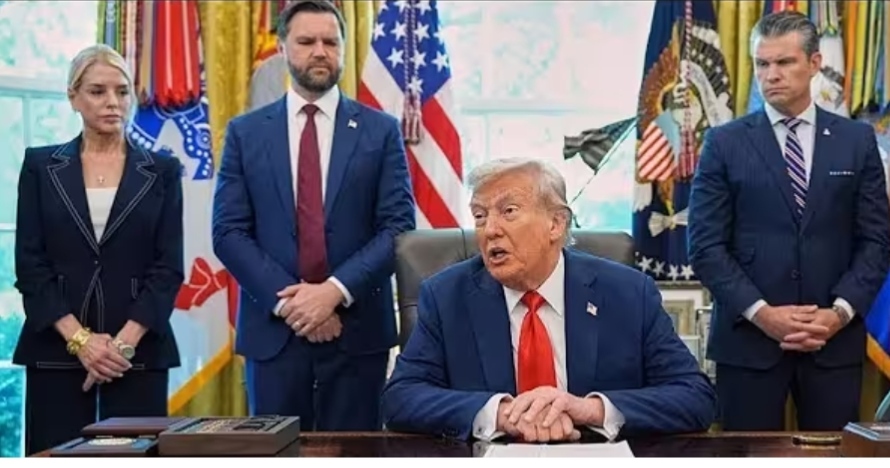
In modern conflict, words often travel faster than weapons, shaping perceptions before realities can catch up. In the unfolding confrontation between the United States and Iran, the rhetoric of Donald Trump has become a central theatre of war in itself—erratic, contradictory, and deeply consequential.
A close reading of Trump’s statements from early March to early April reveals not just inconsistency, but a pattern of dramatic oscillation. Within days—and sometimes hours—he moves from declaring total victory to threatening escalation, from seeking allied support to dismissing it outright, from issuing ultimatums to claiming diplomatic breakthroughs. This is not merely a communications problem; it raises a fundamental question about the nature of American strategy in this conflict: is this calculated unpredictability, or a troubling absence of coherence?
Declaring Victory, Rewriting Reality
Trump’s repeated assertions—“We won the war,” “We defeated Iran,” and even the claim that victory was achieved “in the first hour”—reflect a familiar instinct to seize the narrative before facts settle. Yet these declarations are quickly diluted by caveats: “we haven’t won completely yet,” or renewed calls for military action.
Such premature triumphalism recalls the early overconfidence surrounding the Iraq War, where declarations of success obscured the long and costly reality that followed. In the case of Iran, a far more complex and regionally embedded adversary, the gap between rhetoric and reality is even more stark.
Allies: From Partners to Pawns
Equally revealing is Trump’s fluctuating stance toward NATO. In rapid succession, he appeals for assistance, issues veiled threats, dismisses the need for support, and then questions the very value of the alliance.
This inconsistency undermines the credibility of long-standing partnerships. Alliances are built not only on shared interests but on predictability. When signals shift so abruptly, allies are left uncertain whether they are being courted, coerced, or cast aside.
The confusion extends to critical geopolitical flashpoints such as the Strait of Hormuz. At one moment, its reopening is framed as a collective global necessity; at another, it is dismissed as irrelevant to American interests. Given that this narrow passage carries a significant portion of the world’s oil supply, such ambiguity reverberates far beyond the region, unsettling markets and strategic calculations alike.
The “Madman” Gambit—or Strategic Drift?
Some analysts argue that this volatility is deliberate. Trump’s approach is often linked to the so-called “madman theory,” associated with Richard Nixon—the idea that projecting unpredictability can pressure adversaries into concessions.
Seen this way, Trump’s alternating threats and overtures—“make a deal or face destruction” followed by claims of “productive talks”—could be an attempt to keep Iran strategically off balance. By appearing capable of anything, the argument goes, he seeks to extract maximum leverage.
Yet such a strategy depends fundamentally on credibility. When contradictions become too frequent or too extreme, unpredictability risks mutating into incoherence. Adversaries may stop fearing irrationality and instead begin discounting it as noise.
Markets, Messaging, and Manufactured Volatility
Beyond diplomacy, Trump’s rhetoric operates in another powerful arena: global markets. Statements about military escalation, oil chokepoints, and impending deals have immediate effects on energy prices and investor sentiment.
The repeated invocation of the Strait of Hormuz—alternately as a strategic priority and a non-issue—creates cycles of alarm and reassurance. Whether intentional or incidental, this pattern generates volatility at a time of economic fragility, raising questions about the intersection of geopolitical signalling and financial consequences.
Negotiation Through Noise
Another recurring pattern is the oscillation between ultimatum and engagement. Deadlines are imposed—48 hours to comply—only to be followed by claims of imminent agreements. Threats of continued strikes are paired with assertions that a deal is “very close.”
This approach reflects Trump’s broader negotiation style: escalate rhetorically, create pressure, then pivot to declare progress. But diplomacy conducted in this manner carries risks. Public ultimatums can harden positions rather than soften them, making compromise politically costly for all sides.
A Superpower Without a Script
Ultimately, the central question persists: is there a coherent strategy guiding this torrent of contradictions?
If there is, it is a high-stakes gamble—one that relies on psychological pressure, narrative control, and economic signalling to achieve strategic ends. But if this is strategy, it is one that demands discipline and consistency behind the scenes—qualities not readily apparent in the public domain.
The alternative explanation is more unsettling: that the United States is navigating a volatile conflict without a stable strategic compass, its messaging shaped as much by impulse as by intent.
The Risks of Rhetorical Warfare
In a region as combustible as West Asia, words are not merely symbolic—they are operational. Mixed signals can embolden adversaries, unsettle allies, and increase the risk of miscalculation.
Trump’s rhetoric, veering from triumph to threat to negotiation within days, blurs the line between calculated ambiguity and strategic confusion. For a global power, that distinction is not academic—it is consequential.
Whether this approach reflects a deliberate doctrine or an evolving improvisation, its impact is already visible: a deepening sense of uncertainty at a moment when clarity is most needed.
In the end, wars are not won by declarations alone. And when the narrative of victory changes by the day, it is not strength that is projected—but doubt.
picture credit social media

~Hasnain Naqvi is a former member of the history faculty at St. Xavier’s College, Mumbai….
The opinions expressed here are solely those of the author.