
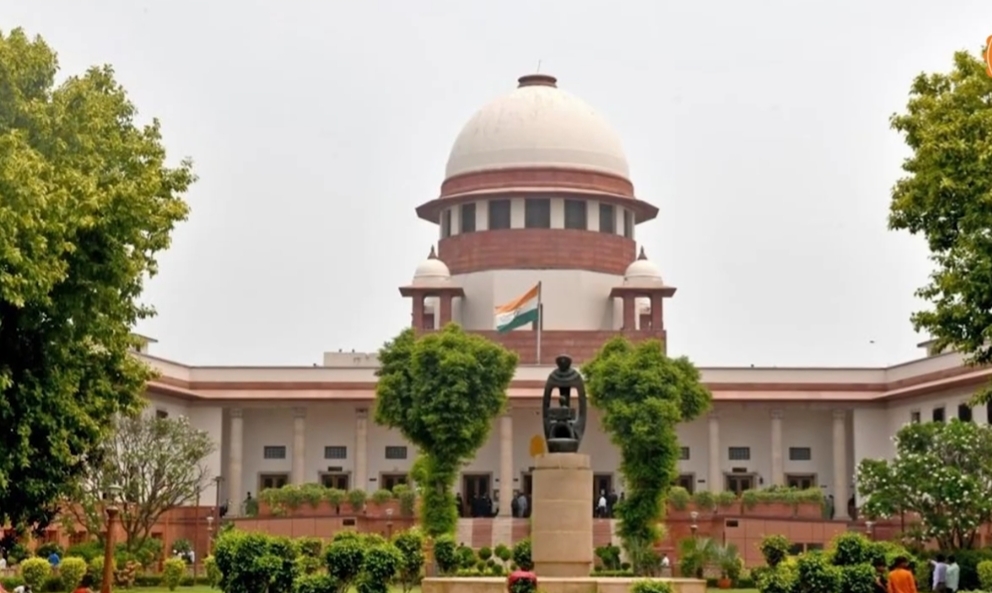
New Delhi, 9April2026 : The Centre on Wednesday told a nine-judge Constitution Bench of the Supreme Court that courts do not have the jurisdiction or the knowledge and understanding of religion to decide issues arising from religious beliefs, practices and even superstition, while strongly questioning reliance on the “vague” concept of “constitutional morality” in deciding such matters.
Appearing for the Union government, Solicitor General Tushar Mehta argued that questions of social reform in religion must be left to the legislature, and the judiciary should adopt a hands-off approach.
“The courts do not have jurisdiction or knowledge of religion to decide such issues. At best, every one of us has some knowledge of religion, but it may be just one percent of the entirety of religion,” Mehta submitted.
The Bench, led by Chief Justice Surya Kant and comprising Justices B.V. Nagarathna, M.M. Sundresh, Ahsanuddin Amanullah, Aravind Kumar, Augustine George Masih, Prasanna B. Varale, R. Mahadevan and Joymalya Bagchi, is examining key constitutional questions on freedom of religion, essential religious practices, and the interplay between Articles 25, 26 and 14.
The reference arises from the review of the September 28, 2018 judgment that allowed entry of women aged 10 to 50 into the Sabarimala Ayyappa temple. The outcome is expected to have a bearing on several similar disputes involving religious practices.
Singling out the use of “constitutional morality” in the adjudication of complex social and religious issues, Mehta termed it a “vague concept” with no clear foundation in the Constitution. He argued that courts cannot rely on it to adjudicate complex issues of faith.
Reading out extracts from the 2018 Sabarimala judgment and the September 6, 2018 verdict decriminalising consensual same-sex relations, Mehta urged the Bench to reconsider how constitutional morality had been invoked in those rulings.
“Constitutional morality is a sentiment. It is not a doctrine to test religious practices,” he said.
He further questioned the maintainability of Public Interest Litigations filed by persons not directly affected, referring to the Sabarimala case initiated by the Indian Young Lawyers Association.
In response, the Bench expressed reservations about a complete exclusion of judicial review in matters involving religion.
Justice Ahsanuddin Amanullah described the Centre’s position as “too simplistic”, observing that courts can examine whether a practice is superstitious, even if the legislature decides the manner of reform.
Justice Joymalya Bagchi referred to the example of witchcraft being claimed as a religious practice and asked whether courts could step in if the legislature remains silent. He asked whether the court could use the principle of an unoccupied field to issue directions to prohibit such a practice, keeping in mind grounds like health, morality and public order.
Justice M.M. Sundresh pointed out that religious belief and practice cannot be artificially separated. He noted that courts must be cautious not to test practices in isolation without understanding the underlying belief.
Justice B.V. Nagarathna, meanwhile, indicated that ideally, only an aggrieved party should approach the court, even in PIL jurisdiction.
Chief Justice Surya Kant added that courts have, in recent years, evolved strict parameters to scrutinise PILs and ensure that only genuine causes are entertained.
The hearing will continue on Thursday with senior advocate C.S. Vaidyanathan, followed by Abhishek Manu Singhvi and Rajeev Dhawan advancing their arguments.
Picture credit social media

Pramod kumar is a Senior Journalist, Covering Supreem Court of India