

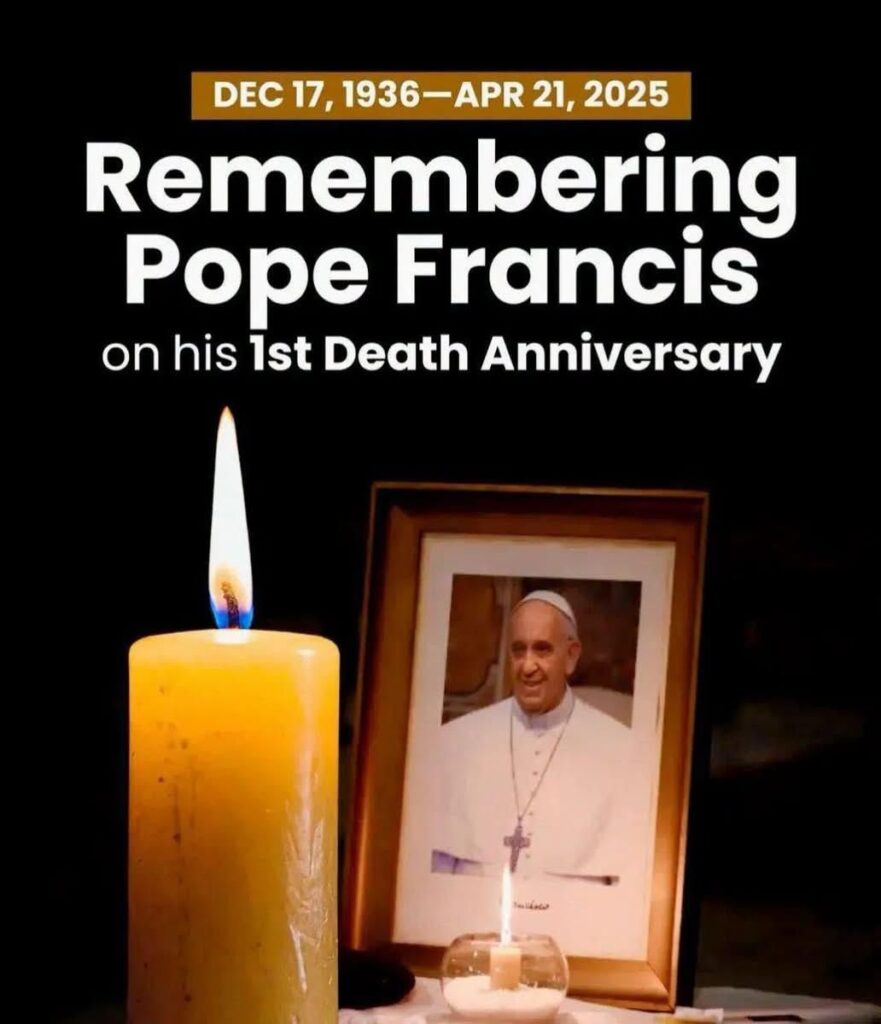
One year ago on April 21, the bells of St. Peter’s Basilica tolled not just for a Sovereign of the Vatican City State, but for a man who had successfully stripped the papacy of its imperial velvet. When Pope Francis passed away on April 21, 2025, at the age of 88, he left behind a global flock of 1.4 billion and a world that had grown accustomed to a “pope of firsts.”
The first Latin American pontiff, the first Jesuit, and the first to take the name of the Poverello of Assisi, Jorge Mario Bergoglio’s twelve-year tenure was less a traditional reign and more a prolonged exercise in radical empathy. On this first anniversary of his death, the “Francis Effect” remains the definitive yardstick for the modern Church’s relevance in a fractured world.
The Field Hospital in a Fractured World
From the moment he stepped onto the balcony of St. Peter’s in 2013—bowing to the crowd and asking for *their* blessing before giving his own—Francis signaled a shift from dogma to dialogue. He famously envisioned the Church as a “field hospital after battle,” arguing that it was fruitless to ask a seriously injured person about their cholesterol; one must first heal the wounds.
This pastoral pragmatism was most evident in his landmark 2016 apostolic exhortation, *Amoris Laetitia*. By opening doors for divorced and remarried Catholics, he signaled that the Church’s mission was to accompany the “imperfect” rather than police the pious. His 2013 rhetorical question regarding gay priests—“Who am I to judge?”—became the defining mantra of a papacy that sought to replace the culture of exclusion with what he called a “culture of encounter.”
A Moral Compass for the Global Commons
While his predecessors often focused on internal theological debates, Francis projected the Papacy onto the global stage as a voice for the voiceless. He did not merely talk about the poor; he went to them. His first journey outside Rome was to the island of Lampedusa, where he decried the “globalization of indifference” regarding the migrant crisis.
His 2015 encyclical, *Laudato Si’ (On Care for Our Common Home)*, remains a foundational text of the 21st century. By framing climate change not just as a scientific challenge but as a moral and spiritual crisis, he bridged the gap between faith and environmental activism, directly influencing the Paris Climate Agreement.
Even in his final year, despite deteriorating health following a 38-day hospitalization for pneumonia, his voice did not waver on the necessity of peace. His final Easter *Urbi et Orbi* blessing in 2024, calling for a ceasefire in Gaza and an end to the “senselessness of war” in Ukraine, served as a poignant coda to a life spent in the pursuit of “Human Fraternity”—a concept he codified alongside the Grand Imam of Al-Azhar in their historic 2019 joint declaration.
Reform and Resistance: The Internal Crucible
Francis’s path was never without friction. To his critics, particularly the traditionalist wings in North America and Europe, his emphasis on mercy felt like a dilution of doctrine. He faced unprecedented public “corrections” and accusations of theological ambiguity. Yet, he pushed forward with structural reforms that were decades overdue.
He dismantled the “glass house” of Vatican finances, subjecting the Institute for the Works of Religion (the Vatican Bank) to external audits for the first time in over a century. He aggressively attacked “clericalism”—the elitist culture of the priesthood—and elevated voices from the “peripheries,” appointing cardinals from nations like Tonga, Myanmar, and Guatemala. By the time of his death, he had appointed the vast majority of the men who would eventually choose his successor, ensuring his vision of a global, de-centralized Church would endure.
The Final Act of Humility
Francis’s death, triggered by a stroke following a final appearance in St. Peter’s Square, was met with a global outpouring of grief that transcended religious lines. In keeping with his lifelong rejection of pomp, his will requested a simple wooden coffin and burial in the Basilica of Santa Maria Maggiore, rather than the traditional papal crypts beneath St. Peter’s. It was a final nod to his devotion to the *Salus Populi Romani* (Protectress of the Roman People) and his identity as a simple pastor.
As we reflect on this first anniversary, the Church finds itself at a crossroads. The “Papal Interregnum” may have passed, but the questions Francis raised remain: Can a 2,000-year-old institution truly be “poor and for the poor”? Can mercy coexist with ancient law?
Pope Francis did not provide all the answers, but he gave the world something more vital: a permission to ask. He was a man who carried his own briefcase, washed the feet of prisoners, and reminded a cynical world that the greatest power is service. The humanity is indeed poorer without this great humanist, but his legacy remains a map for a more compassionate future.

~Hasnain Naqvi is a former member of the history faculty at St. Xavier’s College, Mumbai….
The opinions expressed here are solely those of the author.