

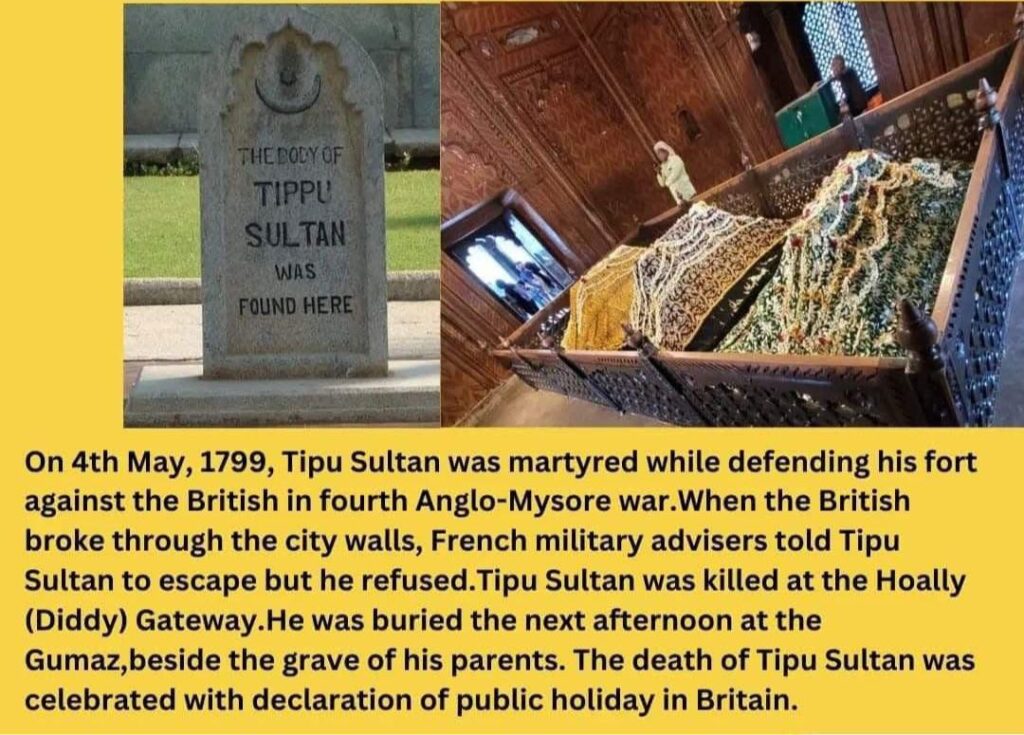
On May 4, 1799, the air above Seringapatam (Srirangapatna) was thick with the sulfurous smoke of rocket fire and the desperate cries of a kingdom in its death throes. As the British breach party surged through the walls of the island fortress, Sultan Fateh Ali Sahab Tipu—known to history as the ‘Tiger of Mysore’—did not seek the safety of his inner sanctum or a negotiated surrender. Instead, he rushed toward the fray, meeting his end not as a captured monarch, but as a soldier at the water-gate.
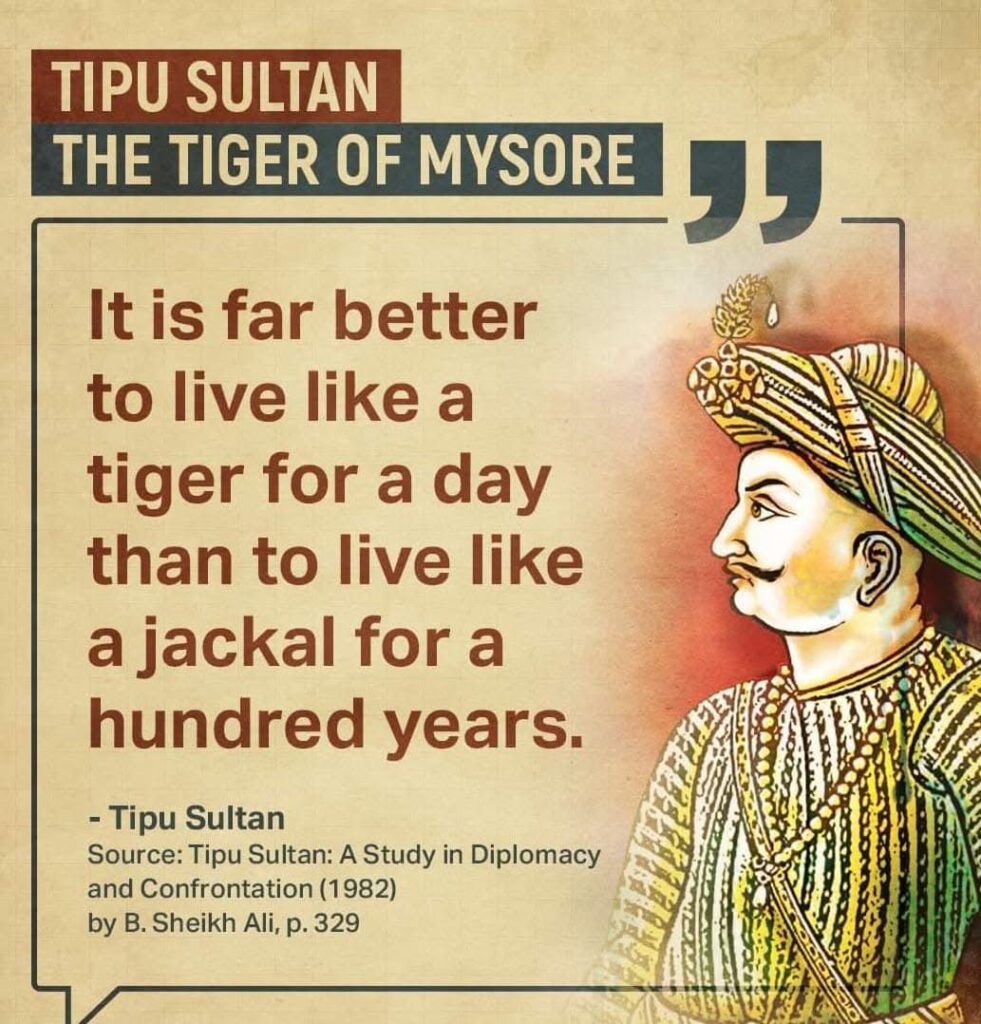
His death marked more than the fall of a dynasty; it signalled the removal of the most formidable indigenous barrier to British hegemony in the Indian subcontinent. It was the fulfillment of his own famous maxim: *”To live like a lion for a day is far better than to live for a hundred years like a jackal.”*
Beyond the Colonial Caricature
The historical assessment of Tipu Sultan has long been a casualty of colonial polemics. As noted by the prominent historian Professor Mohibbul Hasan in his seminal work, *History of Tipu Sultan*, British historiography of the 19th century was frequently motivated by the need to justify the aggressive expansionism of the East India Company. By painting Tipu as a “cruel tyrant,” the colonial administration sought to legitimize a war that was, in reality, a pre-emptive strike against a modernizing state that dared to seek parity with European powers.
Far from being a medieval holdover, Tipu was a ruler of the Enlightenment. Influenced by his father Hyder Ali’s pragmatic military reforms, Tipu integrated French tactical discipline with local ingenuity. His development of iron-cased Mysorean rockets—the precursors to modern rocket artillery—stunned British forces at the Battle of Pollilur in 1780. These were not mere curiosities; as documented in the military manual *Fathul Mujahidin*, they were a sophisticated weapon system that eventually inspired the Congreve rockets used by the British themselves.
The Administrative Architect
Scholars like B.Sheikh Ali (*Tipu Sultan: A Crusader for Change*) have highlighted Tipu’s role as an economic pioneer. He understood that military strength was inseparable from economic self-reliance. He introduced a new coinage system, a reformed calendar, and a revolutionary land revenue system that bypassed oppressive intermediaries to deal directly with the peasantry.
Perhaps his most enduring economic legacy was the birth of the Mysore silk industry. By importing silkworm eggs and inviting experts from afar, he transformed the agrarian landscape into a proto-industrial hub. His state-led trade policies and the establishment of manufacturing “factories” across his domain showed a ruler who was looking toward a future of global trade and industrialization.
Global Vision
Tipu Sultan was perhaps the first Indian prince to recognize the global dimensions of the struggle against colonialism. His embassies to the Ottoman Empire and Revolutionary France were sophisticated diplomatic manoeuvres aimed at creating an international coalition to check British power. His membership in the Jacobin Club and the “Tree of Liberty” he planted at Seringapatam (Srirangapatna) were not merely symbolic; they represented his engagement with the radical political shifts occurring globally.
While modern political narratives often attempt to view Tipu through a narrow communal lens, historians point to a more complex reality. His patronage of the Sringeri Math and his correspondence with its Jagadguru reveal a sovereign who understood the necessity of internal religious harmony for the stability of his state. As Professor Hasan argues, Tipu’s harshest measures were usually reserved for those—regardless of faith—whom he perceived as collaborators with the British or the Marathas.
The Heroic End
The Siege of Seringapatam (Srirangapatna) in 1799 saw 30,000 defenders matched against 50,000 British and allied troops. Despite the overwhelming odds and internal betrayals, Tipu refused to flee. When his body was discovered beneath a pile of fallen soldiers, it signalled the end of an era. Upon hearing of the Sultan’s death, General Harris reportedly declared, *”Today, India is ours.”* It was a chilling acknowledgment that with the Tiger gone, the last great challenge to the Raj had vanished.
Today, as we commemorate the anniversary of his passing, it is essential to look past the modern political distortions. Tipu Sultan remains a multifaceted figure: a pioneer of science, a brilliant strategist, and a ruler who chose a hero’s death over the indignity of vassalage. He remains a reminder of an era when an Indian state stood tall, matching the global powers of its time in vision, innovation, and courage.

~Hasnain Naqvi is a former member of the history faculty at St. Xavier’s College, Mumbai….
The opinions expressed here are solely those of the author.