

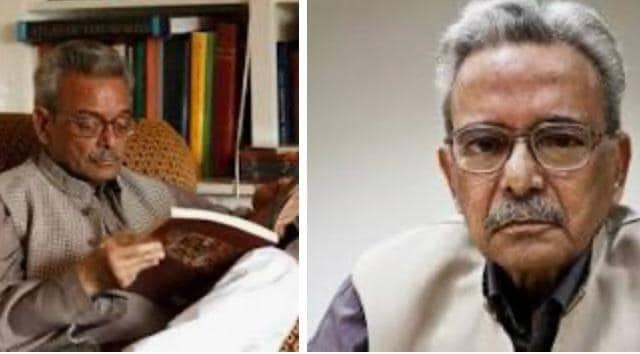
Shamsur Rahman Faruqi (1935–2020), the towering Indian Urdu poet, author, critic, and theorist, reshaped Urdu literature by infusing it with modernism. On this fifth anniversary of his passing on December 25, his legacy endures as a bridge between tradition and innovation.
Pioneering Criticism and Literary Revival
Faruqi formulated fresh models of literary appreciation, blending Western critical principles with aesthetics rooted in Arabic, Persian, and Urdu traditions. An expert in classical prosody and *‘ilm-e bayan* (the science of poetic discourse), he contributed rare profundity to modern Urdu criticism. Often hailed as “the century’s most iconic figure in Urdu literature” or the T.S. Eliot of Urdu, he positioned himself as an outsider challenging the Urdu establishment’s progressive hegemony.
His magazine *Shabkhoon* (transl. *Ambush at Night*), founded and edited by him from 1966 to 2006, championed modernist voices aiming to dismantle incumbent dominance. Notable works include *Sher-e-Shor Angez* (1996), a four-volume study of 18th-century poet Mir Taqi Mir; *Ka’i Chand The Sar-e Asman* (2006); *Tafheem-e-Ghalib*, a commentary on Mirza Ghalib; and *Tanqidi Afkar*, which earned him the Sahitya Akademi Award in 1986.
Honours, Career, and Progressive Stance
Faruqi launched his writing career in 1960 and served as a Postmaster General and Postal Services Board member until retiring in 1994. He later became a visiting professor at the University of Pennsylvania’s South Asia Regional Studies Center. His accolades include the Padma Shri in 2009 and the Saraswati Samman for *Sher-e-Shor Angez* in 1996.
A progressive iconoclast, Faruqi critiqued conservative symbols like the burqa, hijab, and skull cap, while urging minority communities to assert identity within democracies. He lamented language’s reduction to a tool of “ownership and hegemony” rather than a cultural binder, declaring in an interview: “It is sad that language has become a tool of ownership and hegemony; not the thread that binds people together.” Through his writings, he vividly captured the Indian-Muslim way of life in the 18th and 19th centuries.
Novels in Translation and Dastangoi Revival
Faruqi translated key works into English, broadening their reach. His 2006 Urdu novel *Ka’i Chand The Sar-e Asman* became *The Mirror of Beauty* (2013), chronicling Wazir Khanum—mother of poet Daagh Dehlvi—in 19th-century Delhi and shortlisted for the DSC Prize for South Asian Literature. *The Sun That Rose from the Earth* (2014) depicted the vibrant Urdu literary scenes in Delhi and Lucknow amid the 1857 Rebellion.
Beyond prose, he revived *Dastangoi*, the 16th-century Urdu oral storytelling form. Collaborating with nephew Mahmood Farooqui from 2004, he modernized it for 21st-century audiences in India, Pakistan, and the US.
Weighing Mir Against Ghalib
Faruqi’s nuanced views on Urdu poetry’s giants shine in *Sher-e-Shor Angez* (Vol. 1, 1997 ed., pp. 26-61). Debating Mir Taqi Mir’s supremacy over Mirza Ghalib, he argued: “In variety of language, extent of experience of life, and universality of temperament, Mir’s rank is higher than Ghalib’s. Only in intelligence and abstraction [*tajrīd*] and ‘delicacy of thought’ is Ghalib’s level higher than Mir’s. There’s a difference in their imaginations, but the power of imagination is equal in both. That is, both are unlimited in theme-creation. Ghalib’s imagination is soaring, and Mir’s imagination is earthy—that is, one is more abstract and one more concrete. In meaning-creation both are equal.Indeed, Mir has one quality, mood, in a way that is very rare in Ghalib. Another excellence of Mir’s is that along with meaning-creation he creates mood as well. Both have many tumult-arousing verses. Both have a limitless interest in wordplay.”
~Hasnain Naqvi is a former member of the history faculty at St. Xavier’s College, Mumbai

~Hasnain Naqvi is a former member of the history faculty at St. Xavier’s College, Mumbai