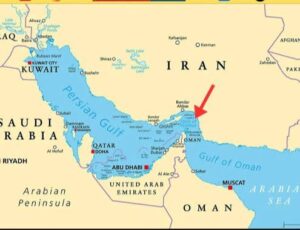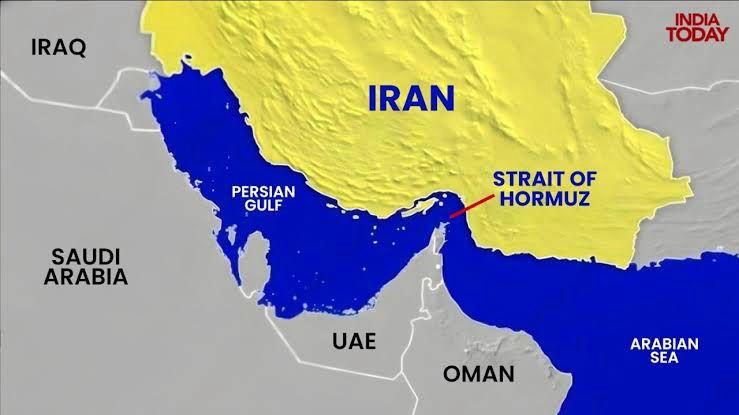
The confrontation between the United States, Israel, and Iran has pushed one of the most vital arteries of global commerce to the brink of paralysis. In the aftermath of the assassination of Iran’s Supreme Leader Ali Khamenei and the retaliatory escalation that followed, the strategic waters of the Strait of Hormuz have effectively become a maritime battlefield.
Although Tehran has not issued a formal legal declaration of blockade, a series of military incidents, warnings to commercial vessels, and the suspension of shipping by major global carriers have created what maritime analysts increasingly describe as a “de facto closure” of the world’s most critical energy chokepoint. The implications of this disruption reach far beyond the Gulf, threatening global energy security, financial stability, and geopolitical equilibrium.
A Maritime Crisis in the Wake of War
The latest phase of the crisis began after U.S.-Israeli strikes on Iranian targets triggered a sweeping retaliatory campaign by Tehran across the Gulf region. Iranian missiles and drones targeted American assets hosted by several Gulf states, widening the theatre of confrontation. 
In parallel, Iran’s Islamic Revolutionary Guard Corps (IRGC) reportedly warned vessels approaching the Strait that “no ship is allowed to pass,” effectively turning the narrow shipping lane into a high-risk zone for commercial navigation. 
The result has been a dramatic slowdown in maritime traffic. Ship-tracking data show tankers turning away from the passage and clustering in nearby waters as insurers and shipping companies reassess the security situation. 
Major carriers such as Maersk and Hapag-Lloyd have suspended transits through the corridor, reflecting the scale of uncertainty now gripping the global shipping industry. 
Attacks on Tankers and Escalation at Sea
The crisis intensified when multiple vessels came under attack in the vicinity of the Strait and the Gulf of Oman. Maritime security agencies confirmed that several ships were struck by projectiles, with fires reported on board at least two vessels. 
One of the most widely reported incidents involved the oil tanker Skylight, flying the flag of Palau, which was targeted near the Omani port of Khasab. Authorities confirmed that the entire crew of twenty—comprising fifteen Indian nationals and five Iranians—was evacuated, though four members suffered injuries. 
Other tankers have also been struck or forced to alter course amid the escalating maritime confrontation. In one incident, a vessel was hit by an unidentified projectile north of Oman’s capital, Muscat, according to the United Kingdom Maritime Trade Operations (UKMTO) monitoring agency. 
Such attacks have transformed the Strait from a busy commercial corridor into a volatile security zone, prompting shipping insurers to reassess coverage and driving up war-risk premiums.
The Global Energy Lifeline
Few waterways possess the strategic importance of the Strait of Hormuz. Each day, roughly one-fifth of the world’s oil supply and around a quarter of global liquefied natural gas shipments pass through this narrow channel linking the Persian Gulf to the Arabian Sea. 
Energy exports from Saudi Arabia, Iraq, Kuwait, and the United Arab Emirates depend heavily on uninterrupted transit through these waters.
When this corridor falters, the repercussions ripple instantly across global markets.
Already, oil prices have surged sharply amid fears that a prolonged disruption could choke off a major portion of global supply. Analysts warn that crude prices could climb toward or beyond $100 per barrel if the disruption persists. 
Strategic Ambiguity: Closed in Practice, Open in Law
Despite the near-halt in commercial traffic, the United States has insisted that the Strait remains technically open. American military officials argue that freedom of navigation must be maintained and that commercial vessels should not be obstructed.
Yet the reality at sea suggests otherwise. The combination of missile strikes, drone attacks, and electronic interference with navigation systems has created conditions that effectively deter commercial transit. Shipping companies, insurers, and energy traders are acting accordingly.
In modern maritime trade, a chokepoint does not need a formal blockade to cease functioning. Risk alone can close it.
The Strategic Calculus for Iran
For Tehran, the Strait represents both leverage and peril. Its proximity to Iran’s coastline grants the country significant capacity to threaten maritime traffic through drones, missiles, and fast-attack naval craft.
At the same time, closing the passage outright would risk provoking a direct naval confrontation with the United States and its allies. The U.S. Navy’s Fifth Fleet, headquartered in Bahrain, maintains substantial forces in the region precisely to safeguard freedom of navigation.
Iran therefore appears to be pursuing a strategy of controlled disruption—raising the cost of maritime transit without necessarily declaring an official blockade.
Such ambiguity complicates the diplomatic landscape while amplifying economic pressure on adversaries.
Asia’s Energy Security at Stake
The disruption has profound implications for Asia’s energy-dependent economies.
Countries such as India, China, Japan, and South Korea rely heavily on Gulf oil shipments that pass through the Strait.
For India in particular, the stakes are significant. The country imports the vast majority of its crude oil requirements, and a sustained surge in energy prices would strain fiscal balances, fuel inflation, and pressure economic growth.
Beyond energy, the disruption also threatens broader trade flows through the Arabian Sea, potentially affecting supply chains and shipping routes across Asia.
A Narrow Passage with Global Consequences
From a cartographic perspective, the Strait of Hormuz appears as a slender maritime channel separating Iran from the Arabian Peninsula. In strategic terms, however, it represents one of the most critical pressure points in the global system.
The assassination of Ali Khamenei, the escalation of hostilities between Iran and the United States-Israel alliance, and the subsequent disruption of shipping have transformed the Strait into the epicentre of a global geopolitical crisis.
Whether this maritime standoff escalates into direct naval confrontation or eventually yields to diplomatic de-escalation will shape not only the future of the Gulf but also the trajectory of the global economy.
For now, the world’s most vital energy corridor remains suspended between war and diplomacy—its waters reflecting the fragile balance of power in a deeply interconnected world.

~Hasnain Naqvi is a former member of the history faculty at St. Xavier’s College, Mumbai