

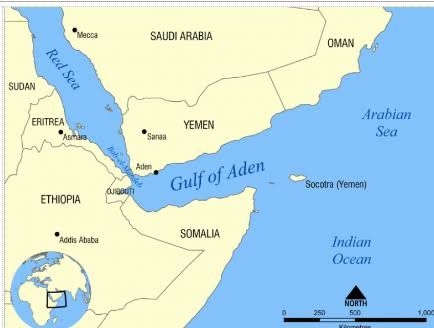
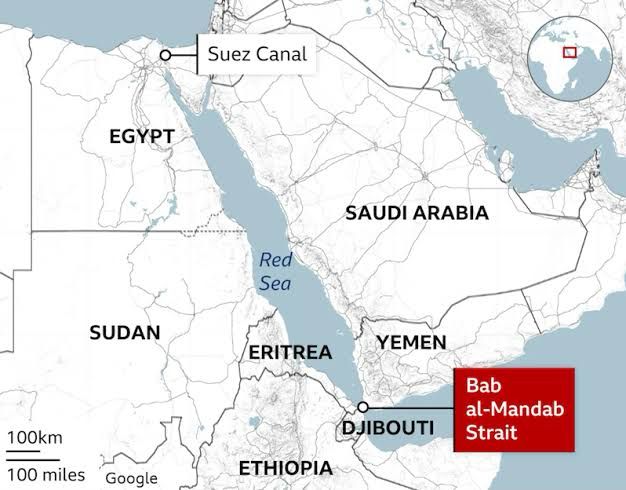
In the lexicon of maritime geography, few names are as hauntingly prophetic as the Bab el-Mandeb. Translated from Arabic as the “Gate of Tears,” this narrow strait—separating the jagged coastline of Yemen from the Horn of Africa—has transitioned from a vital artery of commerce into the primary detonator of a global economic crisis.
As of March 27, 2026, the spectre of a total blockade by Houthi forces, acting in strategic concert with Tehran, no longer belongs to the realm of “war gaming.” Following the Iranian-led closure of the Strait of Hormuz in the Persian Gulf, the world now faces the terrifying prospect of a “dual-chokepoint” strangulation. If the Bab el-Mandeb falls, the global economy will not merely stumble; it may witness a systemic collapse of the post-Cold War maritime order.
The Geography of Vulnerability
The strategic significance of the Bab el-Mandeb cannot be overstated. At its narrowest point, the strait is only 18 miles wide, a distance easily covered by the sophisticated shore-to-ship missiles and loitering munitions that Iran has funnelled to Houthi militants over the last decade.
This narrow passage is the southern sentinel of the Suez Canal. For the 12% of total global trade and 30% of global container traffic that traverses these waters, there is no easy detour. A vessel traveling from Singapore to Rotterdam must either pass through this 18-mile gauntlet or commit to a 3,500-mile detour around the Cape of Good Hope. Such a diversion adds nearly 15 days to a voyage, incinerating millions of dollars in extra fuel and skyrocketing insurance premiums that are eventually passed on to the consumer.
The Energy Armageddon
While container ships carry the world’s gadgets and garments, the true gravity of a blockade lies in energy. Approximately 8.8 million barrels of oil and massive quantities of Liquefied Natural Gas (LNG) transit the strait daily.
If the Houthis execute their threat to fully close the route—timed to coincide with the ongoing Iranian blockade of Hormuz—the result would be a synchronized “energy blackout” for Western markets. Analysts warn that a total disruption could send crude oil prices surging toward $150 per barrel. For Europe, already reeling from the loss of Russian energy, the severance of the Red Sea route would represent an existential threat to industrial stability and domestic heating.
A New Era of Asymmetric Siege
What makes the current crisis unprecedented is the nature of the belligerents. The Houthis are not a traditional state navy; they are a non-state actor employing “asymmetric siege” tactics. By using low-cost drones to threaten multi-billion dollar tankers, they have inverted the cost-exchange ratio of modern warfare.
The Houthis’ recent rhetoric suggests they are waiting for a “trigger moment”—a definitive escalation in the U.S.-Israel-Iran conflict—to move from sporadic harassment to a total kinetic blockade. Should this happen, the “Gate of Tears” would become a graveyard for the principle of “Freedom of Navigation,” a cornerstone of international law since the 17th century.
The Commercial Ripple Effect
The implications extend far beyond the gas pump. The global supply chain operates on a “just-in-time” inventory model. When major shipping giants like Maersk and MSC reroute their fleets, the delay creates a bullwhip effect: ports in Hamburg and New Jersey face congestion, manufacturing plants in the Midwest face parts shortages, and inflationary pressures become entrenched.
Furthermore, the regional impact on Egypt cannot be ignored. The Suez Canal provides Egypt with nearly $10 billion in annual revenue. A Houthi blockade of the Bab el-Mandeb effectively renders the Suez Canal a dead-end street, potentially destabilizing the Egyptian economy and triggering a new wave of migration and unrest across the Mediterranean.
The Military Dilemma
The U.S.-led “Operation Prosperity Guardian” has attempted to provide a security umbrella, but naval escorts are a temporary salve for a structural wound. A full blockade would likely force the West into a direct, large-scale military intervention on Yemeni soil—a scenario that Tehran likely welcomes as a means to bog down Western resources in a protracted regional quagmire.
The crisis at the Bab el-Mandeb is a stark reminder that the “flat world” of global trade is, in reality, precariously dependent on a few miles of turbulent water. If the Gate of Tears is closed, the tears will not just be Yemen’s; they will be felt in every boardroom, supermarket, and petrol station across the globe. The era of secure, invisible maritime trade is over; the era of the chokepoint has begun.
Picture credit social media

~Hasnain Naqvi is a former member of the history faculty at St. Xavier’s College, Mumbai