

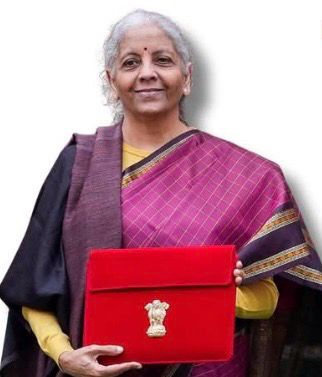
Big Vision, Small Relief — When Growth Ignores the Household Economy Finance Minister Nirmala Sitharaman, is unapologetically a Budget of intent rather than impact. Anchored in high capital expenditure, fiscal restraint and long-term industrial ambition, it speaks fluently to bond markets, credit rating agencies and global investors. But for the vast majority of Indians — grappling with stubborn inflation, stagnant real wages and chronic employment insecurity — it offers reassurance without relief.
At a moment when economic anxiety has seeped into everyday life, the Budget chooses credibility over compassion, discipline over demand, and tomorrow’s growth over today’s distress.
Capex Fetishism and the Limits of Trickle-Down Economics
The centrepiece of Budget 2026–27 is a record ₹12.2 lakh crore allocation to capital expenditure, continuing the government’s infrastructure-first growth strategy. Roads, railways, high-speed corridors, waterways and logistics networks dominate the fiscal imagination.
While no serious economist disputes the long-term multiplier effects of public investment, the assumption that capex alone can revive a slowing consumption economy is increasingly tenuous. Infrastructure creates value over time, but it does not automatically raise household incomes, especially in an economy where informal employment still dominates and wage growth remains anaemic.
The Budget’s heavy reliance on capex betrays a persistent faith in trickle-down growth, even as evidence suggests that benefits are uneven, delayed and often bypass those at the bottom and middle of the income pyramid.
A Middle Class Ignored, Not Empowered
Perhaps the most glaring omission in Budget 2026–27 is the absence of meaningful income-tax relief. Despite repeated appeals from salaried taxpayers, no revision of tax slabs, no increase in standard deductions and no inflation-adjusted exemptions were announced.
For a middle class squeezed by rising food prices, housing costs, healthcare expenses and education fees, this silence is telling. The Budget offers procedural ease — rationalised TDS, simplified compliance, safe-harbour norms — but avoids putting real money back into people’s pockets.
In effect, the government has chosen fiscal orthodoxy over consumption revival, ignoring the fact that weak demand is now a structural problem, not a temporary aberration.
Rural India: Productivity Without Purchasing Power
In rural and agricultural policy, the Budget speaks the language of efficiency, technology and productivity, but remains hesitant on income security. There is no significant expansion of direct income support, no bold intervention to arrest rural wage stagnation, and no fresh push to stimulate village-level demand.
By privileging long-term productivity gains over immediate income support, the Budget risks misreading the rural crisis. Productivity without purchasing power does little to revive local economies or absorb surplus labour. Rural distress, already visible in falling consumption and migration pressures, is addressed indirectly, cautiously, and inadequately.
Jobs: Promises Without Numbers
Employment generation is framed through future-facing sectors — semiconductors, electronics, biopharma, AVGC, tourism, healthcare and education. Skill alignment committees, SME funds and credit facilitation mechanisms are presented as pathways to job creation.
Yet the Budget avoids concrete employment targets, time-bound hiring commitments or large-scale public employment programmes. For India’s millions of young job seekers, particularly first-generation graduates and informal workers, this is cold comfort.
The reliance on private investment to generate jobs — without corresponding wage protections or labour-intensive guarantees — reflects a familiar pattern: jobs as an outcome of growth, never as a policy priority in themselves.
Inflation: Structural Fixes, No Immediate Relief
Inflation control in the Budget rests almost entirely on supply-side interventions — better logistics, agricultural productivity, infrastructure efficiency and market integration. While necessary, these measures operate on long timelines.
There is little acknowledgment of the immediate pain caused by food inflation, fuel costs and service-sector price increases. With no targeted price-stabilisation mechanisms or consumption buffers, households are left to absorb shocks largely on their own.
The Budget treats inflation as a technical problem to be managed eventually, rather than a lived reality shaping everyday economic insecurity.
Fiscal Prudence for Markets, Austerity for People
Maintaining the fiscal deficit at around 4.3 per cent of GDP is presented as an achievement — and from a macroeconomic standpoint, it is. But fiscal prudence has a political economy dimension: restraint for the state often translates into austerity for citizens.
Higher borrowings, increased securities transaction taxes on derivatives, and a non-populist stance may reassure investors, but they also reinforce the perception that economic policy is increasingly market-centric rather than citizen-centric.
A Budget That Looks Past the Present
Budget 2026–27 is not without merit. Its industrial strategy is coherent, its fiscal discipline deliberate, and its long-term vision unmistakable. But it is also a Budget that looks past the present, postponing relief in the hope that growth will eventually deliver it.
For the common Indian — the salaried worker, the small trader, the rural household, the unemployed graduate — this Budget asks for patience without offering protection. It speaks confidently of India’s future, while remaining curiously detached from its present anxieties.
In choosing ambition over alleviation, Budget 2026–27 may preserve macroeconomic stability — but it risks deepening the disconnect between economic policy and everyday life.
~Hasnain Naqvi is a former member of the history faculty at St. Xavier’s College, Mumbai