

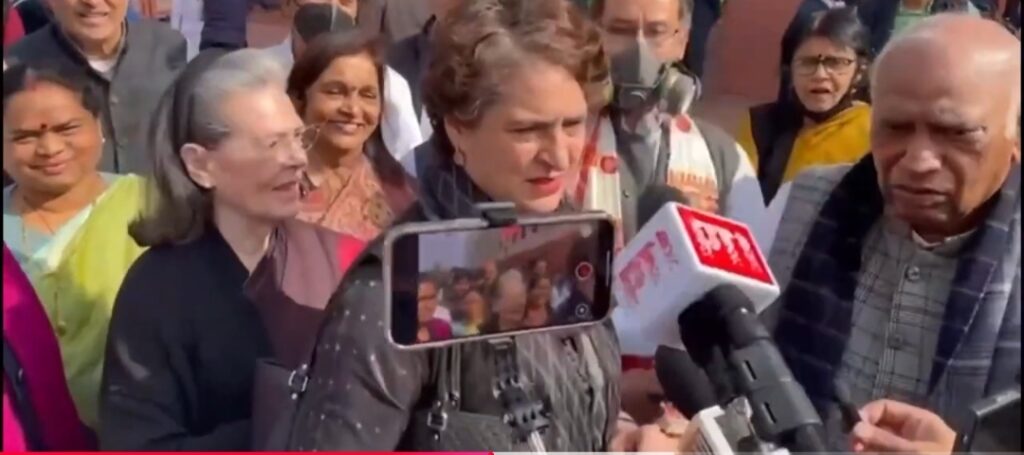
NEW DELHI, January 17, 2026: With its tally in the Lok Sabha reduced to 140 as of December 28, 2025, the Indian National Congress is confronting the cumulative impact of long-term institutional erosion, organisational drift and strategic uncertainty. Recent remarks by senior Congress leader Digvijaya Singh, in which he acknowledged the superior organisational strength of the Bharatiya Janata Party (BJP) and its ideological mentor, the Rashtriya Swayamsevak Sangh (RSS), have reignited a wider debate over the roots of the Congress’s sustained decline.
However, any serious assessment must begin by recognising a fundamental reality: the Congress and the BJP are structurally dissimilar political formations. Treating them as comparable entities obscures the deeper reasons behind the Congress’s weakening position in Indian politics.
The BJP operates within an expansive ideological and institutional ecosystem anchored firmly by the RSS. This ecosystem provides the ruling party with a continuous supply of trained cadres, ideological coherence, and a permanent mobilisation apparatus that functions irrespective of electoral cycles. The RSS and its affiliated organisations play a decisive role in shaping narratives, managing elections, and ensuring booth-level coordination, often long before formal campaigns begin.
This symbiotic arrangement gives the BJP an organisational depth unmatched by any other political party in India. Its cadre base is not merely electoral but cultural and ideological, ensuring sustained engagement with society at multiple levels. As a result, electoral setbacks for the BJP rarely translate into organisational collapse.
In contrast, the Congress remains a mass-based but non-cadre party, historically reliant on charismatic leadership, social coalitions, and electoral momentum rather than disciplined organisational structures. Over decades, the erosion of internal democracy, weakening of grassroots units, and excessive centralisation of decision-making have hollowed out its organisational core.
The absence of trained workers at the district, block and booth levels has left the Congress ill-equipped to counter the BJP’s highly decentralised and disciplined machinery. In many states, local units exist largely on paper, becoming active only during elections and often lacking clarity of command or ideological direction.
Compounding the problem is the Congress’s ambiguous ideological positioning. While the party continues to invoke its legacy as the architect of India’s freedom struggle and constitutional democracy, it has struggled to articulate a contemporary ideological narrative that resonates with younger voters and emerging social groups. This vacuum has allowed the BJP to dominate the political discourse, framing elections around nationalism, identity and welfare delivery.
Internal factionalism has further weakened the party. Leadership transitions are frequently contested, state units remain divided, and organisational revamps are announced but rarely implemented with consistency. The result is a party that reacts to political developments rather than shaping them.
Yet, political observers caution against writing off the Congress entirely. Its nationwide presence, historical credibility, and role as a pivot in opposition alliances still give it relevance in a fragmented political landscape. Moreover, growing concerns over centralisation of power and institutional autonomy may create political space for a revived opposition.
For the Congress, however, revival will require more than rhetorical acknowledgment of the BJP-RSS model. It demands a fundamental organisational overhaul, investment in grassroots cadre-building, decentralisation of authority, and a clear ideological articulation suited to contemporary India.
Without such structural reforms, the Congress’s decline may continue to deepen—turning what is currently a cause for worry into a prolonged crisis for India’s principal opposition party.
Picture credit social media