

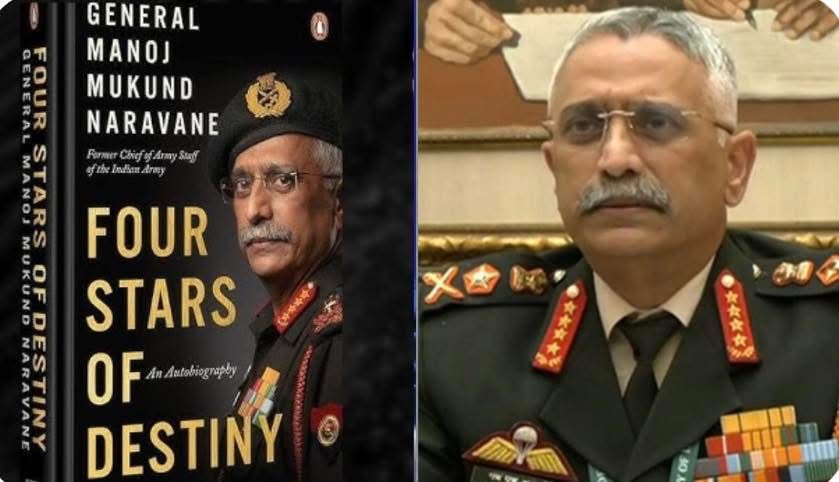
Has a General Been Silenced to Shield the Prime Minister?The Real Scandal Lies Beyond the BookHussain Naqvi The controversy surrounding General M.M. Naravane’s unpublished memoir is not about whether a book should see the light of day. It is about the Modi government’s palpable alarm at the mere emergence of its excerpts—and the general’s conspicuous refusal to address them.In a democracy, questioning the actions of those in power is not disloyalty; it is the very essence of accountability. Yet supporters of the regime have been conditioned to equate scrutiny with betrayal, a tactic that stifles legitimate debate and erodes the foundations of constitutional governance.
Explosive Excerpts That Demand Answers
According to excerpts attributed to General Naravane, the then Prime Minister handed him a “hot potato” and issued vague instructions: “Jo uchit samjho, woh karo” (Do what you think is appropriate). These are not casual remarks. They suggest a troubling delegation of responsibility in a matter of grave national security, where clarity and documented orders are non-negotiable.
In the Indian constitutional framework, the Prime Minister cannot issue ambiguous, deniable directives and later disclaim accountability. The Chief of the Army Staff, in turn, cannot act on verbal nudges or personal interpretation in such high-stakes situations. The Army operates on precision, not ambiguity. Either the instructions were clear and recorded, or they were not—and if they were not, the breakdown of command responsibility is indefensible.
The Myth of Decisiveness Meets the Reality of Evasion
This government has built its image on projected strength and swift decision-making. Yet when faced with questions that demand transparency, it resorts to suppression, silence, and intimidation. The so-called “56-inch chest” appears only in front of cameras; in matters of constitutional clarity and documented authority, it retreats behind ambiguity.
If there is truly nothing improper in the episode, why the frantic effort to prevent public discussion? If the instructions were above board, why the panic over a few paragraphs?
The General’s Silence Raises Alarming Questions
General Naravane’s refusal to clarify his own reported words deepens the unease. Is this silence the result of official pressure? Is it a calculated choice for post-retirement convenience? Or does it reflect a fear of repercussions from a government that brooks no dissent?
Whatever the reason, the impact is the same: an Army Chief who cannot speak freely about his own account is a general whose credibility—and the institution he represents—has been compromised. The Indian Army’s honour cannot be sacrificed on the altar of political image management.
A Regime That Fears Words Has Already Revealed Its Weakness
In a republic, no leader is above questioning, and no government has the right to muzzle truth simply because it proves inconvenient. When excerpts from a retired general’s memoir can trigger such visible discomfort, it speaks volumes about the state of civil-military relations under this administration.
A government that suppresses rather than engages with difficult questions has already lost the moral authority to govern. A government that fears a general’s words has exposed its own fragility.
General Naravane opened a Pandora’s box by allowing these excerpts to surface. His continued silence will not close it. It will only ensure that the sting of truth continues to resonate—until clarity, not control, becomes the guiding principle of those entrusted with the nation’s security.
~Hasnain Naqvi is a former member of the history faculty at St. Xavier’s College, Mumbai

~Hasnain Naqvi is a former member of the history faculty at St. Xavier’s College, Mumbai

