

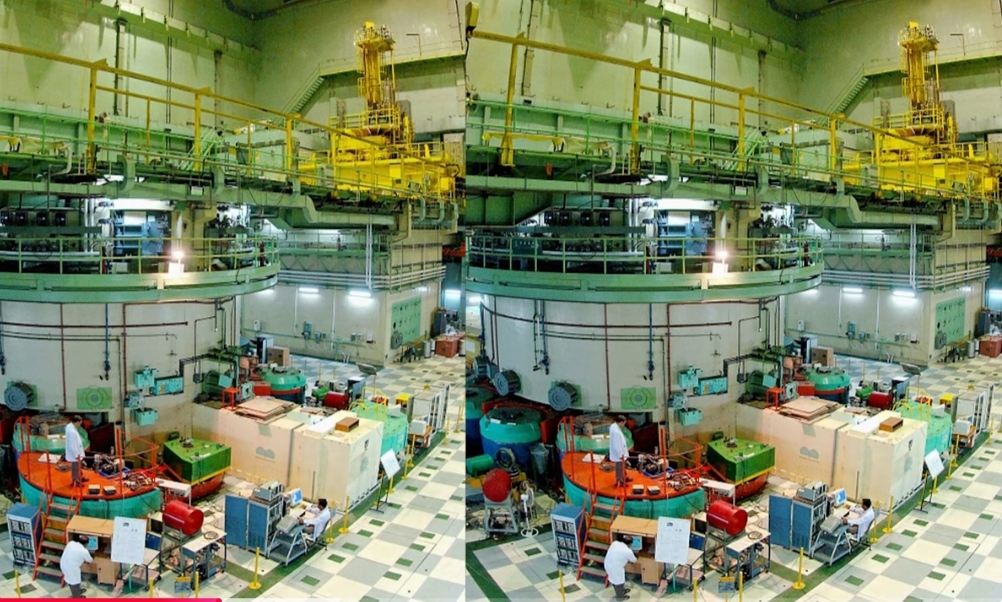
NEW DELHI,9 April 2026 : The Prototype Fast Breeder Reactor at Kalpakkam is for electricity generation that achieved criticality this month. It is celebrated as an energy milestone. It is more than about just energy as it can help India produce the nuclear bombs.
Its uranium blankets can produce 120–140 kg of weapons-grade plutonium a year — enough for 25 nuclear warheads. India’s current weapons reactor yields material for three or four. The PFBR is an eightfold increase, and India spent a decade ensuring no international inspector would ever verify how the output is used.
Put simply: if India ever wanted to go from a modest nuclear arsenal to a seriously large one, this is the reactor that makes it possible. The full piece lays out exactly how.
On the first Sunday of April, inside a containment building on the Coromandel Coast, sixty kilometres south of Chennai, a controlled nuclear chain reaction flickered into being for the first time. India’s Prototype Fast Breeder Reactor — a 500-megawatt sodium-cooled machine bathed in 1,750 tonnes of liquid metal that burns on contact with air or water — had achieved criticality. Prime Minister Narendra Modi called it “a defining step in India’s civil nuclear journey.” Television anchors spoke of thorium, of energy independence, of a seventy-year-old vision finally bearing fruit.
What the coverage largely missed is the PFBR’s strategic dimension: independent physicists at Princeton established nearly two decades ago that its uranium blankets can produce up to 140 kilograms of weapons-grade plutonium a year — “a nearly five-fold increase in the rate of production of weapon-grade plutonium in India”, enough fissile material for 25 to 35 additional warheads annually by some estimates. Or that the head of India’s atomic energy establishment fought a public battle during the US-India nuclear deal to ensure this reactor would never be placed under international safeguards.
Or that Prime Minister Modi later explained, with startling candour, that the reactor’s purpose was to signal to the world that India was “talking about at least a couple of tons of plutonium.”
“It sent the signals we wanted it to send, and brought about intended results,” he said.
The PFBR is celebrated in India as an energy milestone, and it is one. But its civilian economics alone have never justified the investment. The thorium future it is designed to enable remains seven decades away, and the real capability it delivers immediately — on the day it achieves criticality — is the capacity to produce weapons-grade fissile material at industrial scale, beyond the reach of any international inspector.
This is the story of how the world’s most elaborately justified civilian nuclear programme fought to ensure it would never be forced to choose between civilian and strategic objectives.
In 1954, Canada supplied the CIRUS research reactor to India under a bilateral agreement stipulating its use for “peaceful purposes.” Twenty years later, India used plutonium produced in CIRUS to detonate its first nuclear device at Pokhran — the so-called Peaceful Nuclear Explosion of 1974.
The underlying dual-use logic was established then. The PFBR operationalises it at industrial scale — but unlike CIRUS, within a framework India openly negotiated and the international community accepted. Where CIRUS produced enough plutonium for roughly one weapon every two years, the PFBR’s blankets could furnish material for two weapons a month.
The infrastructure for this is not hypothetical. It is already built. To understand what this means in practice, consider the PFBR’s fuel arithmetic.
The breeder’s core runs on plutonium. India has accumulated roughly ten tonnes of the stuff from decades of operating its unsafeguarded heavy-water power reactors — more than enough to keep the PFBR fuelled for its entire operational life. These eight unsafeguarded power reactors have themselves produced plutonium usable in weapons, though at lower grade than what the PFBR’s blankets deliver — the real value of this stockpile is as feedstock for the breeder.
The weapons-grade plutonium, meanwhile, is produced not in the core but in the uranium blankets surrounding it — a separate stream of material that the reactor generates as a byproduct of normal operation. India does not need this material to run the reactor. It is, from the perspective of the power programme, surplus. What it is not surplus to is a weapons programme.
The Kalpakkam complex includes a dedicated reprocessing facility designed to separate plutonium from irradiated fuel. The entire cycle — from neutron bombardment to separated weapons-usable material — takes place within a single complex, under exclusive DAE control. No international inspector has access at any point.
This was not always so.
When Homi Bhabha conceived the three-stage nuclear programme in 1954, it was a work of strategic genius shaped by geological fate. India held barely one or two per cent of global uranium but a quarter of the world’s thorium. Thorium cannot directly power a reactor. It must be transmuted into fissile uranium-233 through neutron bombardment.
Bhabha designed an elegant sequential pathway: heavy-water reactors would produce plutonium; fast breeders would burn that plutonium while breeding U-233 from thorium blankets; advanced thorium reactors would then run on U-233, tapping a fuel source that could power India for centuries.
Picture credit social media