

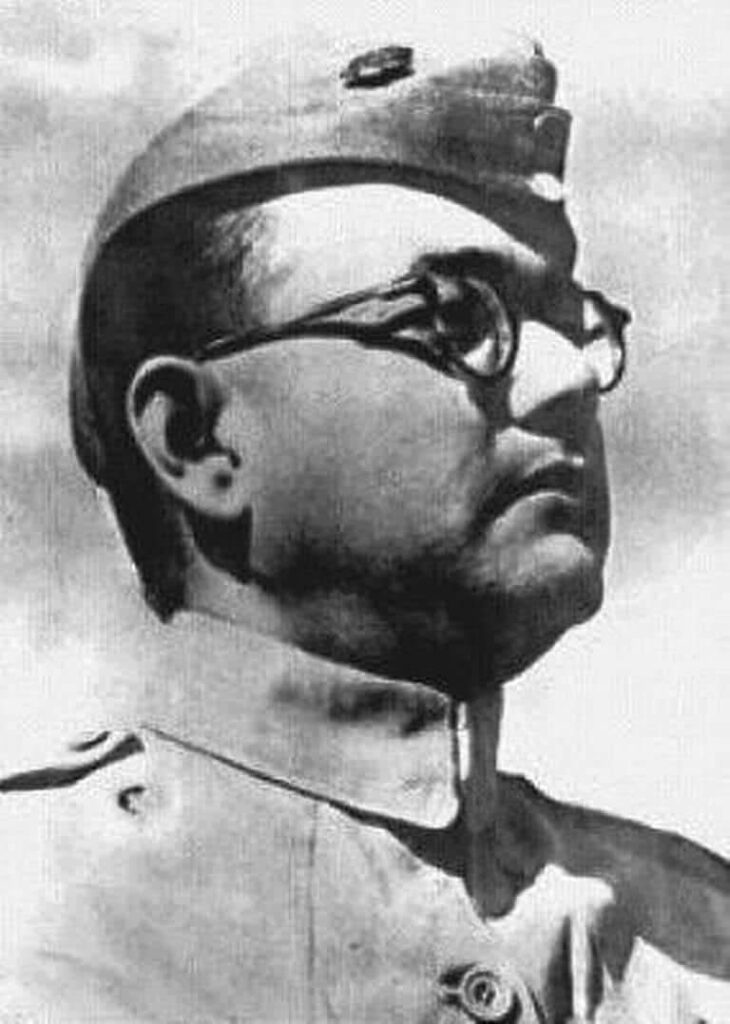
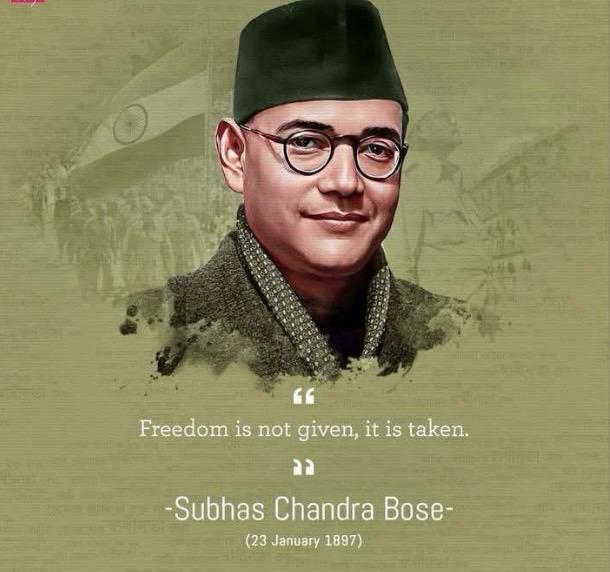
On his birth anniversary, remembering a leader whose life was defined by courage, discipline, and an unyielding commitment to India’s independence
A Revolutionary Born to Defy Empire
Subhas Chandra Bose, born on January 23, 1897, in Cuttack in present-day Odisha, remains one of the most formidable figures of India’s freedom struggle. A contemporary of Mahatma Gandhi, Bose occupied a distinctive and often contentious place within the national movement—at times a comrade, at others a critic. What set him apart was his unshakeable belief that freedom could not be negotiated indefinitely and that colonial rule must be confronted with decisive resolve. His political vision combined militant nationalism with a deep commitment to socialist democracy.
Education, Early Defiance, and the Call of Nationalism
The son of a prominent lawyer, Bose was educated at Presidency College in Calcutta, from where he was expelled in 1916 for nationalist activities, before completing his studies at Scottish Church College. Sent to England to prepare for the Indian Civil Service, he passed the competitive examination in 1920. Yet the rising tide of nationalist ferment in India proved irresistible. In April 1921, Bose renounced the prestige of the civil services and returned home, choosing the uncertainty of struggle over the comfort of imperial employment.
Throughout these early years, he drew steadfast support from his elder brother, Sarat Chandra Bose, a respected lawyer and Congress leader, who remained a crucial pillar in his political life.
Within the Congress: Militancy and Imprisonment
Bose soon joined the Non-Cooperation Movement led by Mahatma Gandhi and worked closely under the guidance of Chitranjan Das in Bengal. As a youth organiser, journalist, and commandant of Congress volunteers, he emerged as a dynamic leader, but his activities also attracted colonial repression. Arrested in 1921, he would spend many years in and out of prison.
In 1924, he was appointed Chief Executive Officer of the Calcutta Municipal Corporation, with Das as mayor, but was soon deported to Burma on suspicion of links with revolutionary groups. After his return in 1927, Bose reorganised a weakened Bengal Congress and was elected its president. Alongside Jawaharlal Nehru, he served as general secretary of the Indian National Congress, together representing its left-wing, radical current in opposition to more cautious Gandhian strategies.
Ideological Differences and a Vision of Industrial India
The 1930s marked a period of intensifying ideological divergence within the Congress. While Gandhi reasserted his leadership during the Civil Disobedience Movement, Bose remained imprisoned. Even from jail, he was elected Mayor of Calcutta. Recurrent arrests, declining health, and tuberculosis eventually led to his release and exile to Europe, where he wrote The Indian Struggle, 1920–1934 and lobbied European leaders on India’s cause.
Elected Congress president in 1938, Bose championed a programme of planned industrialisation through a National Planning Committee—an approach that clashed sharply with Gandhian emphasis on village industries. His re-election in 1939, defeating a Gandhian-backed candidate, underscored his popular support but also deepened internal rifts. Lacking Gandhi’s backing, Bose resigned and founded the Forward Bloc to mobilise radical nationalist forces.
Escape, Exile, and the Global Battlefield
Arrested again in 1940, Bose undertook a hunger strike that compelled the British to release him. In a daring escape in January 1941, he slipped out of his Calcutta home in disguise and travelled through Kabul and Moscow to Germany. There, he worked with a special bureau for Indian affairs and addressed Indians across the world through broadcasts from the Azad Hind Radio in multiple Indian languages.
Azad Hind and the Indian National Army
In 1943, Bose undertook a perilous journey by submarine and aircraft to East Asia, arriving in Tokyo and soon assuming leadership of the Indian independence movement there. With Japanese support, he reorganised the Indian National Army (Azad Hind Fauj), transforming it into a disciplined force of nearly 40,000 soldiers.
On October 21, 1943, Bose proclaimed a Provisional Government of Free India. Under his leadership, the INA advanced alongside Japanese forces into Burma and crossed into Indian territory in March 1944, reaching Kohima and Imphal. Although ultimately defeated due to strategic and logistical disadvantages, the INA left an indelible mark on the Indian psyche, challenging the moral authority of British rule and inspiring a generation with the possibility of armed resistance.
Death, Legacy, and the Battle Over Memory
Following Japan’s surrender in August 1945, Bose reportedly died in Taiwan from injuries sustained in a plane crash—though the circumstances of his death have remained a subject of debate. What is beyond dispute is the enduring power of his legacy.
Netaji Subhas Chandra Bose stood for a plural, inclusive, and uncompromising nationalism. He was a fierce opponent of communal politics and the divisive ideologies espoused by organisations such as the Hindu Mahasabha and the RSS during his lifetime. Any attempt today to appropriate his legacy while disregarding his opposition to sectarianism and his commitment to a secular, socialist India runs contrary to everything he represented.
On his birth anniversary, Netaji is remembered not merely as a symbol of defiance, but as a reminder that India’s freedom was won through diverse paths—among them, his own path of courage, sacrifice, and unwavering resolve to see India free at any cost.
~Hasnain Naqvi is a former member of the history faculty at St. Xavier’s College, Mumbai

~Hasnain Naqvi is a former member of the history faculty at St. Xavier’s College, Mumbai

