

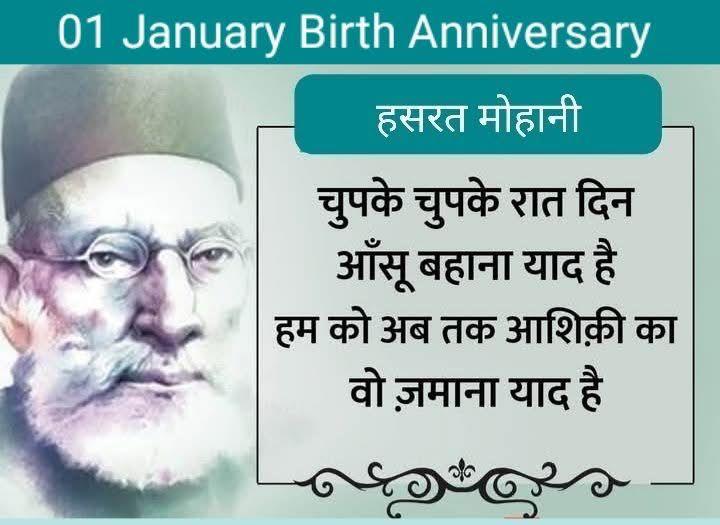
*Chupke chupke raat din aansoo bahaana yaad hai* (I remember shedding tears silently, day and night)*
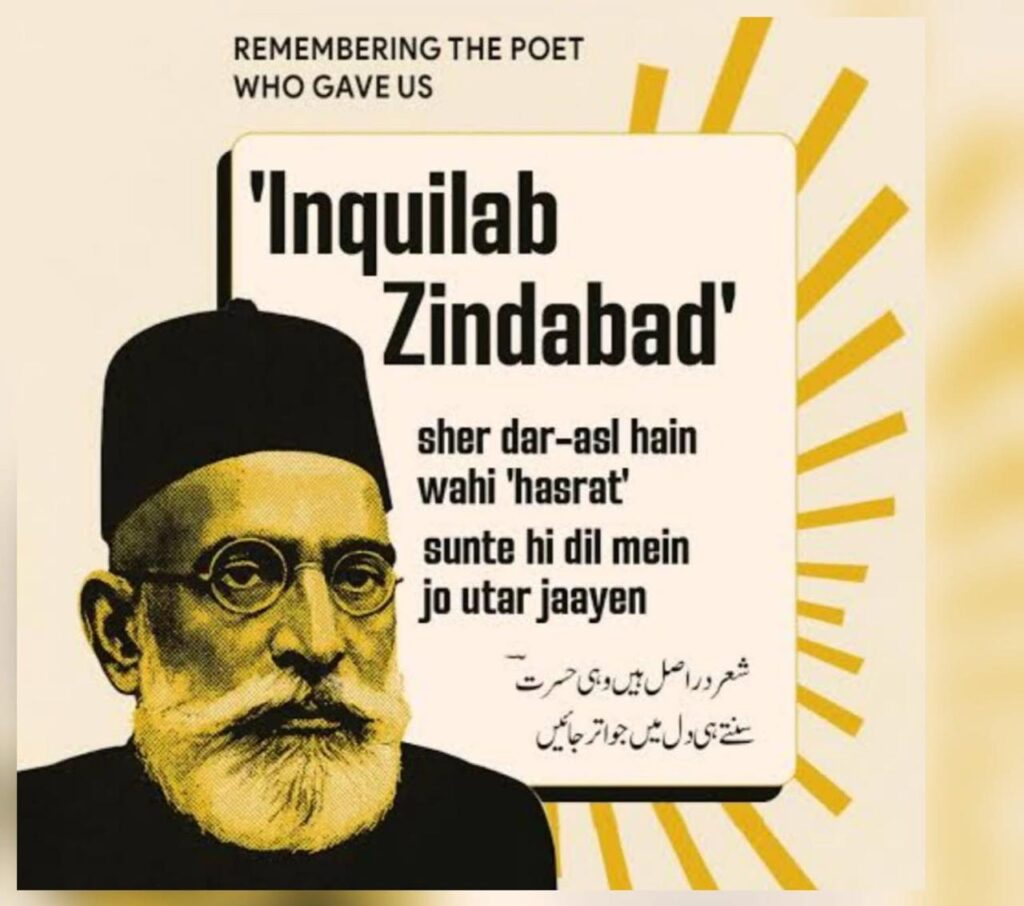
Maulana Hasrat Mohani, born Syed Fazl-ul-Hasan on January 1, 1875, in Mohan, Unnao, Uttar Pradesh, embodied the rare fusion of lyrical grace and unyielding rebellion. On his birth anniversary, we honor this pioneer who first thundered “Inquilab Zindabad” (Long Live the Revolution) in 1921, igniting India’s freedom struggle, and who, at the Ahmedabad Congress that same year, became the inaugural voice demanding *Purna Swaraj*—complete independence from British rule. Imprisoned multiple times, he ground wheat in Cellular Jail yet penned ghazals that blended the tenderness of romance with the fire of patriotism, all while embracing a life of principled poverty.
*Roshan jamaal-e-yaar se hai anjuman tamaam*
*(The entire assembly is illuminated by the radiant beauty of the beloved)*
Hasrat’s verses lit up Urdu poetry like a beloved’s glow transforming a gathering. A journalist who edited *Urdu-e-Mualla* and *Hasrat*, he challenged colonial censorship and communal divides. Elected to the Lucknow Assembly and later India’s Constituent Assembly, he advocated for Hindu-Muslim unity and linguistic pluralism. His simplicity shone through: refusing ministerial perks, he lived ascetically, once saying wealth corrupts the soul. Even in British lockups, his pen flowed undimmed, proving poetry’s defiance against tyranny.
*Hai mushq-e-sukhan jaaree chakkee kee mushaqqat bhee*
*(The fragrance of poetry flows despite the toil of the mill)*
From the grindstone of exile emerged Hasrat’s bold ethos, where love’s whispers met revolution’s roar. His ghazals, immortalized in renditions by maestros like Ghulam Ali, evoke stolen glances and defiant passions: *baar baar uthana usee jaanib nigaah-e-shauq ka* (repeatedly turning my gaze of longing towards that direction). Yet, he was no mere romantic; his takhallus “Hasrat” (desire) masked a hunger for justice. Opposing the Partition, he dreamed of a secular India, influencing peers like Jawaharlal Nehru and Mahatma Gandhi.
*Khirad ka naam junoon pad gaya junoon ka khirad*
*(Wisdom has been called madness, and madness, wisdom)*
Hasrat flipped convention, deeming revolutionary fervor true wisdom. Jailed over a dozen times for sedition, he forged the Communist Party of India in 1925 alongside Muzaffar Ahmed, blending Marxism with Muslim nationalism. His 1948 push for Urdu as a national language underscored cultural equity. Today, amid resurgent divides, his legacy urges us to reclaim that revolutionary poetry—where personal longing mirrors collective emancipation.
Hasrat Mohani departed in 1951, but his spirit endures in every cry for *Inquilab*. Urdu’s “King of Ghazals” reminds us: true freedom blooms when love and liberty entwine.
~Hasnain Naqvi is a former member of the history faculty at St. Xavier’s College, Mumbai