
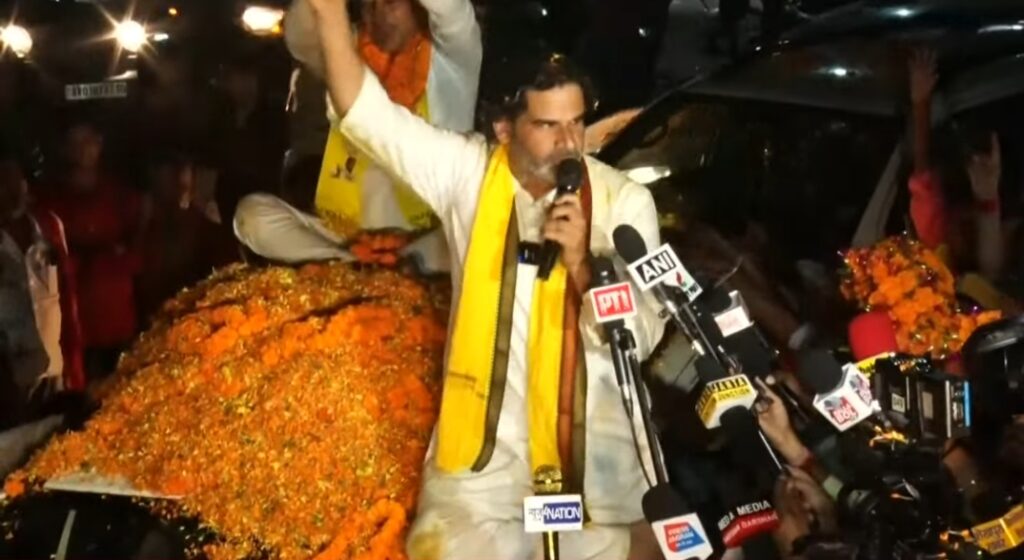

NEW DELHI: As Bihar inches closer to polling dates, political strategist-turned-activist Prashant Kishor (PK) is fast emerging as a formidable factor capable of upsetting traditional electoral calculations.
A series of recent ground reports suggests that Kishor’s grassroots mobilisation under his “Jan Suraaj” campaign is eating into the vote base of both the BJP and JDU, posing a substantial challenge to the ruling NDA alliance.
Field surveys from multiple districts indicate that Kishor’s persistent village-to-village outreach and cultivation of first-time voters have begun yielding traction, especially in constituencies where anti-incumbency against the state and central governments is palpable.
According to observers, a significant segment of voters—disillusioned with the performance of the central government and equally dissatisfied with the Nitish-led Bihar model—appears to be gravitating towards Kishor’s promise of a “new political culture.”
While Kishor has repeatedly maintained that his movement is driven by a long-term vision to rebuild Bihar, insiders note that his increasing organisational strength and growing cadre have positioned him as a key post-poll player. “If Kishor manages to secure even a limited number of seats, his bargaining power in government formation cannot be underestimated,” a senior poll analyst remarked.
For the BJP and JDU, Kishor’s rise is particularly concerning in constituencies where margins have historically been narrow. Party strategists fear that a split in core support bases—including youth, EBCs, and aspirational rural voters—could tilt tight contests in favour of the opposition or result in hung-house scenarios. Although the NDA remains confident of its organisational machinery, sections within it acknowledge that Kishor’s campaign has struck a chord in regions plagued by unemployment, migration, and concerns over law-and-order conditions.
Kishor’s refusal to align with any bloc ahead of the election has further fueled speculation that he could play kingmaker in a fractured mandate. Political watchers note that Kishor’s strongest card is unpredictability—both in terms of voter mobilisation and post-poll decision-making.
As Bihar braces for what could be one of its most competitive electoral battles in recent years, Kishor has positioned himself not merely as a challenger, but as a catalyst reshaping the state’s political terrain. His ability to translate public engagement into electoral dividends may well determine the balance of power in the next Bihar Assembly.
[Writer is Senior Journalist and Political Commentator]



Umakant Lakhera is a Senior Journalist and Political Commentator