

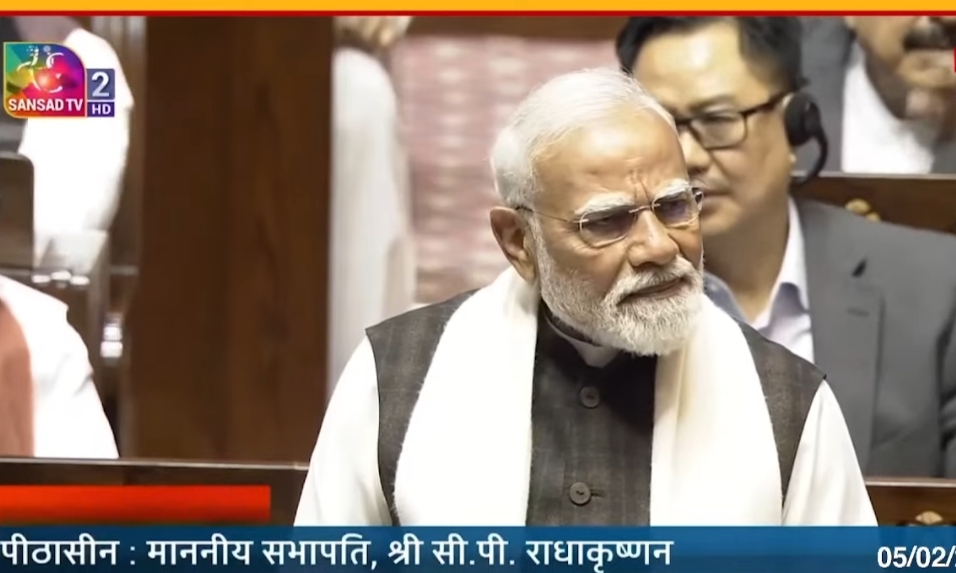
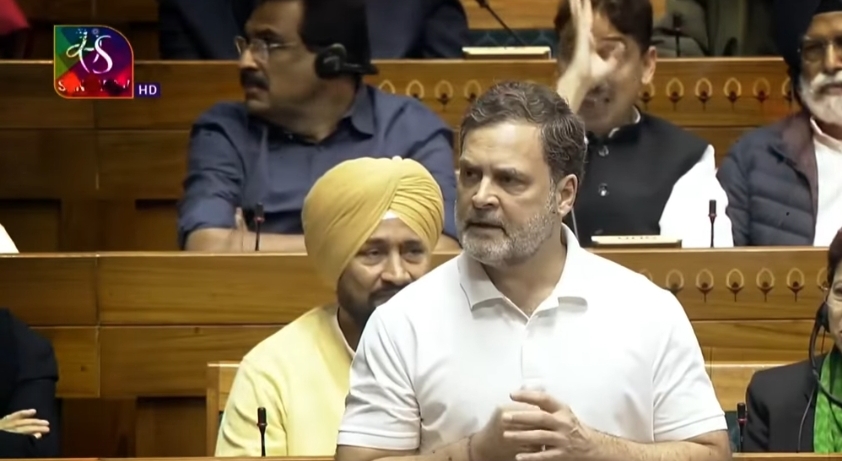
NEW DELHI: What began as a high-decibel political confrontation over a proposed privilege motion against Leader of Opposition Rahul Gandhi now appears to have fizzled out, with sources close to the Lok Sabha Secretariat indicating that no such proposal is under active consideration.
The development has triggered intense political speculation in the capital, especially after reports suggested that the Speaker’s office had distanced itself from any move to initiate proceedings.
The controversy erupted in the aftermath of Rahul Gandhi’s fiery intervention during the Budget reply discussion in the Lok Sabha.
In a speech that blended economic critique with sharp political attack, Gandhi reportedly raised references to the so-called “Epstein files” and alleged international linkages that, according to Treasury Bench members, bordered on sensitive national security territory.
Soon after, significant portions of his remarks were expunged from parliamentary records — a move that itself became a political flashpoint.
By Thursday morning, the political temperature had risen further when BJP MP Nishikant Dubey, known for his combative style, was reportedly tasked with submitting a proposal seeking termination of Gandhi’s membership.
The argument advanced by some ruling party members was that Gandhi’s statements had made sensitive information public and could adversely affect the morale of the armed forces — a serious charge in the parliamentary context.
However, by evening, the narrative appeared to shift. Sources within parliamentary circles suggested that the idea of moving a privilege motion — or any resolution aimed at disqualification — had not gained institutional traction.
The absence of a formal listing in parliamentary business reinforced the impression that the move had been reconsidered.
Political observers interpret this apparent backtracking as a strategic recalibration rather than a retreat born of weakness. The BJP, while dominant in national politics, does not command the kind of brute majority in the current Lok Sabha that would make controversial disciplinary action against the Leader of Opposition a straightforward exercise. Any such move would require careful floor management, coordination with allies, and above all, a political assessment of potential backlash.
Sources within the broader NDA ecosystem suggest that key allies such as the TDP and JD(U) could be uncomfortable with a high-stakes confrontation that risks being portrayed as stifling dissent. With crucial state elections on the horizon, coalition arithmetic matters as much as ideological positioning.
A perceived overreach against Rahul Gandhi might have provided the Opposition with a unifying rallying point — and perhaps elevated Gandhi’s stature nationally.
There is also a broader optics calculation at play. Expunging parts of a speech is a procedural tool available to the Chair, but when it intersects with contentious political allegations, it can amplify the very narrative it seeks to contain.
In an era of digital dissemination, expunged remarks often circulate widely outside official records, limiting the practical impact of censorship while intensifying political debate.
Additionally, speculation around future disclosures linked to international investigations has injected an element of unpredictability into the political climate.
While there is no official confirmation of any impending revelations implicating top Indian leadership, the mere circulation of such reports has heightened sensitivity within political circles. In this environment, escalating parliamentary confrontation may have been viewed as a “misadventure” with uncertain consequences.
For the Modi government, the challenge is to balance firmness with restraint. A direct attempt to terminate the Leader of Opposition’s membership — absent a judicial conviction or clear constitutional ground — would likely face procedural and legal hurdles. More importantly, it could risk reinforcing the Opposition’s narrative of democratic shrinkage.
For Rahul Gandhi, the episode underscores his evolving role as a confrontational parliamentary voice willing to push the envelope. Whether that strategy yields sustained political dividends remains to be seen. But for now, the privilege motion that seemed imminent has become a case study in how political brinkmanship can collide with parliamentary pragmatism.
In the end, the episode reflects a larger truth about contemporary Indian politics: battles are fought not only on the floor of the House, but in the realm of perception, coalition management, and electoral arithmetic. And sometimes, the most significant move is the one that is ultimately not made.
[Writer is Senior Journalist and Political Commentator]
Picture credit social media

