
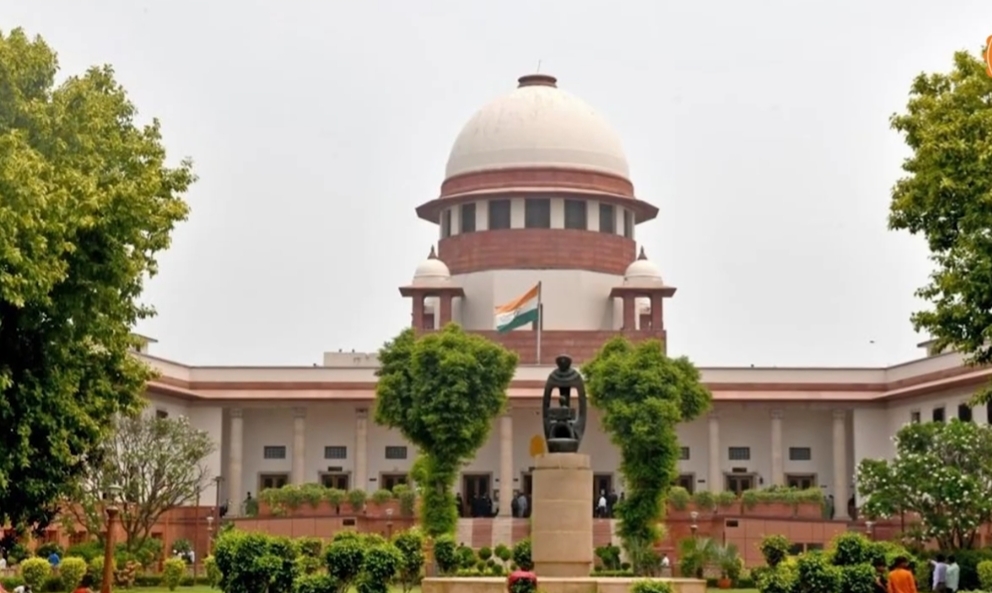

New Delhi,8Jan2026:The Supreme Court on Tuesday held that prolonged incarceration of an undertrial, without the commencement of trial or reasonable progress therein, has the effect of converting pre-trial detention into a form of punishment. The Court ordered the release on bail of Arvind Dham, former promoter and non-executive chairman of Amtek Auto Ltd (AAL) of the Amtek Group, who is accused along with others in alleged frauds amounting to ₹385.35 crore and ₹289 crore respectively.
Granting bail to Arvind Dham, a Bench comprising Justice Sanjay Kumar and Justice Alok Aradhe said, “The right to speedy trial, enshrined under Article 21 of the Constitution, is not eclipsed by the nature of the offence. Prolonged incarceration of an undertrial, without commencement or reasonable progress of trial, cannot be countenanced, as it has the effect of converting pretrial detention into form of punishment.”
The judgment was authored by Justice Alok Aradhe.
Observing that all economic offences cannot be placed in a single category, the Court noted that such offences may involve a wide range of activities and vary significantly from case to case. Referring to earlier decisions of the apex court, the judgment cautioned against mechanically grouping all economic offences together and denying bail solely on that basis.
The judgment reiterated that the right to a speedy trial under Article 21 of the Constitution applies irrespective of the nature of the crime alleged.
It further held that where the State or any prosecuting agency, including the court concerned, lacks the wherewithal to ensure or protect an accused’s fundamental right to a speedy trial, the State should not oppose a plea for bail merely on the ground that the alleged offence is serious in nature.
The judgment said, “The court, while dealing with the prayer for grant of bail has to consider the gravity of offence, which has to be ascertained in the facts and circumstances of each case. One of the circumstances to consider the gravity of offences is also the term of sentence i.e., prescribed for the offence, the accused is alleged to have committed.”
It added that the court must also take into account the object of the special statute involved, the gravity of the offence, the attending circumstances, and the prescribed period of sentence.
While granting bail to Dham, the Supreme Court set aside the Delhi High Court’s judgment of August 19, 2025, which had declined to grant him bail. Dham will remain on bail during the pendency of trial in the Enforcement Directorate cases, subject to terms and conditions to be fixed by the trial court.
Arvind Dham is facing prosecution pursuant to FIRs registered on December 21, 2022, at the instance of IDBI Bank and Bank of Maharashtra, alleging offences under Sections 120B, 420, 406 and 468 of the Indian Penal Code, along with Sections 13(2) and 13(1)(d) of the Prevention of Corruption Act, 1988. He has been arrayed as an accused along with twenty-seven others. The FIRs allege fraud to the extent of ₹385.35 crore and ₹289 crore respectively.

Pramod kumar is a Senior Journalist, Covering Supreem Court of India

