

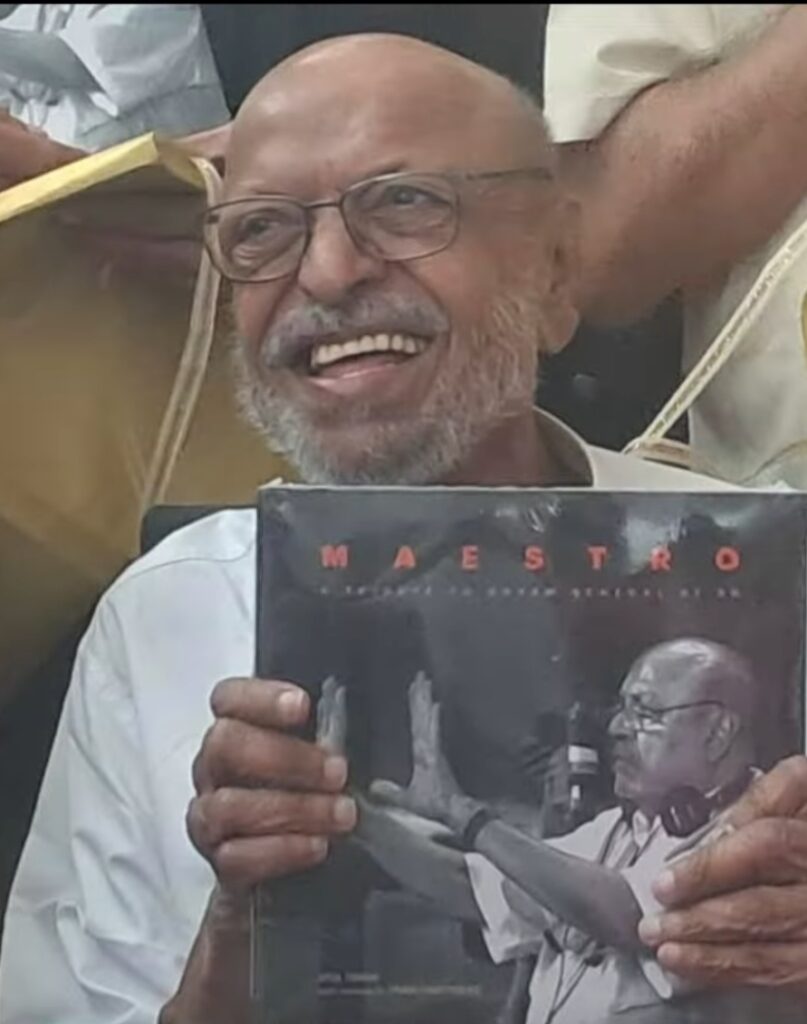
Remembering internationally renowned Filmmaker, Director and screenwriter # Shyam Benegal on his 91st birth anniversary (14 December)
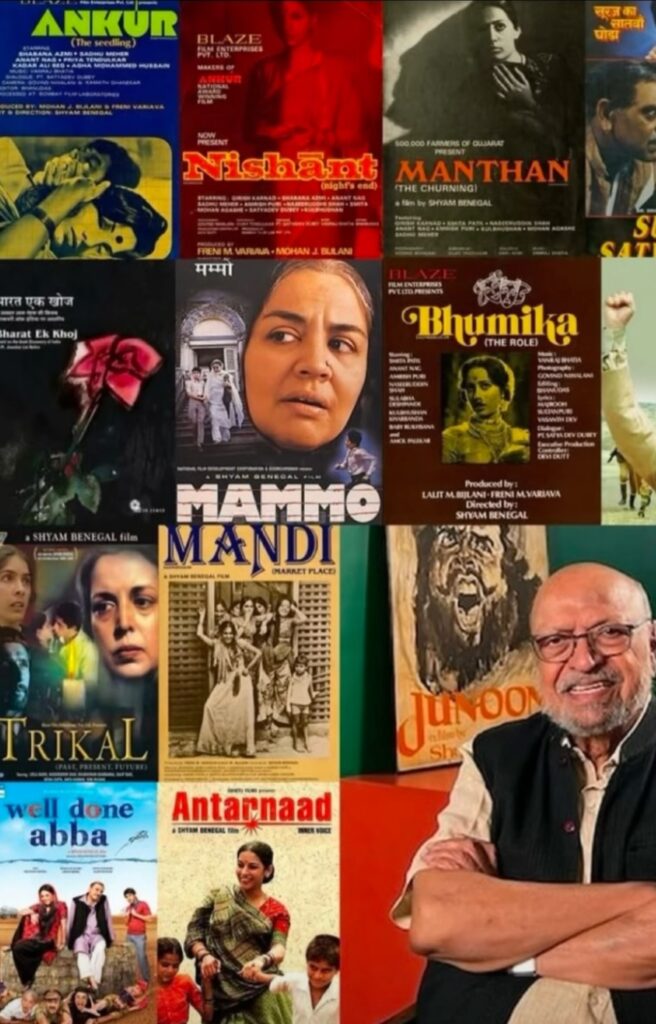
Probably one of the the greatest filmmakers from India Shyam Benegal was a legendary Indian film director, screenwriter, and documentary filmmaker. Often regarded as the pioneer of parallel cinema in India, Benegal’s career spans over five decades, during which he has made iconic films like Ankur Nishant, Manthan, Bhumika, Junoon, Mammo, Sardari Begum, Zubeidaa, and many more.
Shyam Benegal was born on December 14, 1934, in Tirumalagiri, Hyderabad, into a Konkani-speaking Chitrapur Saraswat Brahmin family. His father, Sridhar B. Benegal, was prominent in the field of photography. His paternal grandmother was the sister of Guru Dutt’s maternal grandmother.
From a young age, Benegal was exposed to the world of visual arts, which sparked his interest in filmmaking. At the age of twelve, he made his first film using a camera given to him by his father. Benegal pursued his education at Osmania University, Hyderabad, where he earned an M.A. in Economics. During his time at the university, he established the Hyderabad Film Society, which further fuelled his passion for cinema.
In 1959, Benegal started working as a copywriter at Lintas Advertising, a Mumbai-based advertising agency. He steadily rose to become the creative head of the agency. During this period, he made his first documentary film in Gujarati, “Gher Betha Ganga” (Ganges at the Doorstep), in 1962.
Between 1966 and 1973, Shyam taught at the Film and Television Institute of India (FTII) in Pune. It was the time when he made the acclaimed documentary A Child of the Streets (1967). In 1970, he was awarded the prestigious Homi J. Bhabha Fellowship, which enabled him to work with the Children’s Television Workshop in New York and Boston’s WGBH-TV, further honing his craft.
In 1974, “Ankur” marked Shyam Benegal’s directorial debut and is considered a landmark film in Indian cinema. The film stars Shabana Azmi and Anant Nag in lead roles and explores themes of feudalism, social injustice, and human relationships.
“Nishant” is another powerful film by Shyam Benegal that delves into the themes of power, corruption, and resistance. The film features an ensemble cast, including Girish Karnad, Shabana Azmi, Anant Nag, and Amrish Puri, was nominated for the Palme d’Or at the Cannes Film Festival, and won the National Film Award for Best Feature Film in Hindi.
Based on the life of Marathi actress Hansa Wadkar, “Bhumika” explores the complexities of an actress’s personal and professional life. The film, starring Smita Patil, Amol Palekar, and Anant Nag, won the Filmfare Best Movie Award and the National Film Award for Best Actress for Smita Patil.
Benegal’s films often tackle real-life events and social issues. To ensure accuracy and authenticity, he conducts thorough research and consults experts in the relevant fields. For instance, while working on “Manthan” (1976), he collaborated closely with the National Dairy Development Board and its chairman, Dr. Verghese Kurien, to understand the intricacies of the cooperative movement in India.
“Manthan” is a unique film that was crowdfunded by 500,000 farmers, each contributing a small amount to support its production. The film stars Girish Karnad, Smita Patil, and Naseeruddin Shah and is based on the White Revolution in India.
With his first four feature films, Ankur, Nishant Manthan, and Bhumika, he became the pioneer of a new genre of films known as “Parallel Cinema” in India. Benegal was on the forefront of the second wave of parallel cinema in the 70s when iconic directors like Gulzar, Mani Kaul, Rajinder Singh Bedi, Kantilal Rathod, Saeed Akhtar Mirza, and Govind Nihalani were active and making groundbreaking cinema.
In the late 1970s, Shashi Kapoor and Benegal had a fruitful collaboration of mainstream and parallel cinema, which resulted in films like “Junoon (1978),” an interracial love story set amidst the turbulent period of the Indian Rebellion of 1857, and “Kalyug (1981),” a modern retelling of the Mahabharata set in the corporate world.
Junoon’s exploration of love, loyalty, and cultural conflict earned it immense critical acclaim and several awards, including the Filmfare Award for Best Movie and the National Film Award for Best Feature Film in Hindi. Kalyug explores themes of power, greed, and moral dilemmas within a family-owned business.
Benegal’s next film, Mandi (1983), based on a short story “Aanandi” by Ghulam Abbas, was a satirical comedy about the double standard of society and politics. The film tells the story of a clan of prostitutes who were relocated from the heart of the city to the outskirts.
In the 1980s and 90s, he continued to make films like Arohan (1982), Trikaal (1985), Susman (1985), Antarnaad (1991), Suraj Ka Satvan Ghoda (1993), Samar (1999), and Hari-Bhari (2000). He also made a critically acclaimed documentary based on Satyajit Ray’s life, “Satyajit Ray,” in 1985.
Next comes the women-centric trilogy written by filmmaker and critic Khalid Mohamed on his own life. The first part of the trilogy was “Mammo (1994),” a heartwarming drama that delves into the emotional complexities of the Indo-Pak partition. The film follows the journey of a woman, played by Farida Jalal, and her relationships.
In 1996 came the second part, “Sardari Begum (1996),” which tells the life story of a classical singer, Sardari Begum, and her struggles in a patriarchal society. Starring Kirron Kher, Amrish Puri, and Rajit Kapur, it won the National Film Award for Best Feature Film in Urdu.
The final part of the trilogy was “Zubeidaa (2001),” a biographical drama that explores the tumultuous life of the lead character, played by Karisma Kapoor. The film delves into Zubeidaa’s complex relationships, personal desires, and her struggle for independence. Benegal’s nuanced storytelling and the cast’s compelling performances earned critical acclaim for this film. “Zubeidaa” won the National Film Award for Best Feature Film in Hindi.
Some of Benegal’s other films include The Making of the Mahatma (1996), Netaji Subhas Chandra Bose: The Forgotten Hero (2005), Welcome to Sajjanpur (2005), Well Done Abba (2008), and more recently Mujib: The Making of a Nation (2023).
He also directed iconic serials such as Yatra (1986) and the 53-episode television serial Bharat Ek Khoj (1988), based on Jawaharlal Nehru’s book, Discovery of India. In 2014, he made the television mini-series “Samvidhaan: The Making of the Constitution of India,” which chronicles the draughting of the Indian Constitution. The series received critical acclaim for its detailed and informative portrayal of a significant historical event.
Benegal’s films often address issues of patriarchy, power struggles, social justice, women’s empowerment, human rights, and caste-based exploitation, as well as rural and urban dichotomies.
His films, like “Ankur,” explore the exploitation of a Dalit woman by an upper-caste landlord, highlighting the deep-rooted caste inequalities in Indian society, while “Nishant” delves into the abuse of power by the rural elite and the struggle for justice. Benegal’s films frequently feature strong female protagonists who navigate challenging circumstances with resilience and determination.
“Suraj Ka Satvan Ghoda” (1992) is a Rashomon-like retelling of an Indian experimental novel by Dharamveer Bharti, exploring themes of love, betrayal, and the complexities of human relationships.
Benegal was a master storyteller who was as successful in making historical films as he was in making contemporary stories. “The Making of the Mahatma” (1996) chronicles Mahatma Gandhi’s early years in South Africa and his transformation into a leader of the Indian independence movement. “Bose: The Forgotten Hero” (2005) depicts the life of Netaji Subhas Chandra Bose and his contributions to India’s struggle for independence. He also showed this mastery in making period films like “Junoon,” “Mujib: The Making of a Nation,” and the series “Bharat Ek Khoj.”
Shyam Benegal’s films do not shy away from showing his commitment to social justice, human rights, and the empowerment of marginalised communities. Benegal’s work is informed by a rich political and philosophical sensibility, and he uses cinema as a tool to challenge dominant socio-political processes and hegemonic structures.
His work often critiques the existing social and political order and calls for greater equality and justice.
Benegal was not only a mere critic; he also showed the stories of transformation and positive change by grassroots movements and the efforts of ordinary people to bring about change. Be it “Manthan,” showing cooperative movement in rural India and the role of farmers in transforming their communities, or “Susman,” highlighting the struggles of traditional weavers in the face of industrialisation
Apart from the issues he tackles in his films, he is also known for his superb depictions of human life. He portrayed a range of issues and emotions with great nuance, helped by the powerhouse team of actors like Smita Patil, Shabana Azmi, Naseeruddin Shah, and Om Puri, all of whom were discovered for the screen by Benegal.
The winner of many national and international awards and accolades, Shyam Benegal has had many retrospectives of his films across the world and has been invited as a jury member for many international film festivals. A prolific writer and a sought-after speaker, Shyam Benegal is known as the voice of reason for the marginalized. He has won the National Film Award for Best Feature Film in Hindi seven times.
He was awarded the Padma Shri in 1976 and the Padma Bhushan in 1991. On 8 August 2007, he was awarded the highest award in Indian cinema for lifetime achievement, the Dadasaheb Phalke Award for the year 2005.
Shyam Benegal was married to Nira Benegal; the couple has a daughter, Pia Benegal, who is a costume designer.
~Hasnain Naqvi is a former member of the history faculty at St. Xavier’s College, Mumbai

~Hasnain Naqvi is a former member of the history faculty at St. Xavier’s College, Mumbai