

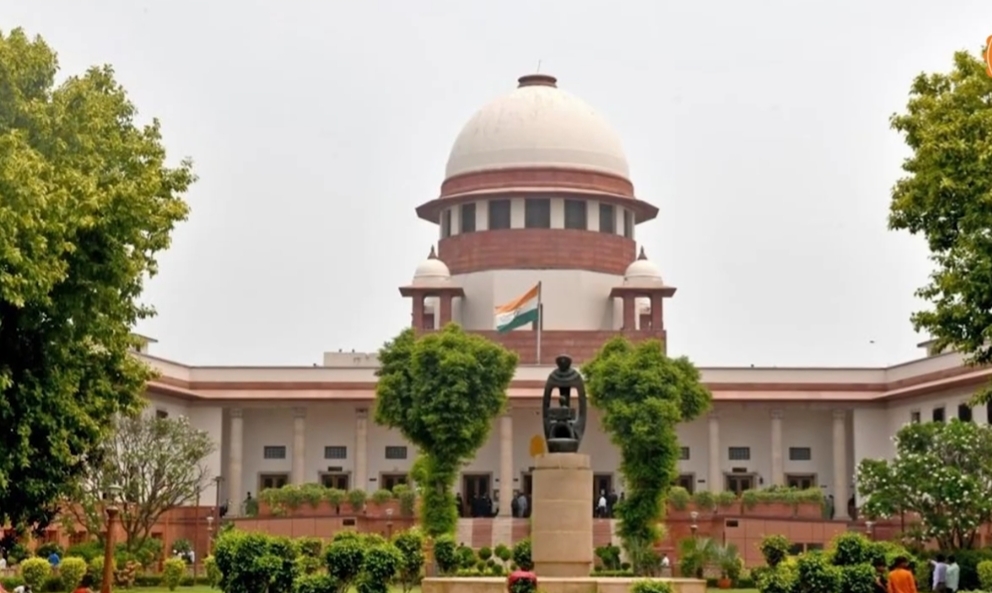


New Delhi, Jan. 5: The Supreme Court on Monday in the February 2020 Delhi riots larger conspiracy while denying bail to Umar Khalid and Sharjeel Imam, ordered the release of Gulfisha Fatima, Meeran Haider, Shifa Ur Rehman, Mohd Saleem Khan and Shadab Ahmed, holding that both Khalid and Imam stood on different footing compared to five others.
Deciding each of the bail pleas by the seven accused independently and holding that that the allegations against Umar Khalid and Sharjeel Imam stood on a separate footing as against the other five, a bench of Justice Aravind Kumar and Justice N.V. Anjaria in a judgment todays said, “This court is satisfied that the prosecution material disclosed a prima facie allegation against the appellants Umar Khalid and Sharjeel Imam. The statutory threshold stands attracted qua these appellants. This stage of proceedings does not justify their enlargement on bail.”
The court said that at the outset, Umar Khalid and Sharjeel Imam are prima facie attributed a central role and alleged to be ideological drivers of the alleged conspiracy.
“A cumulative and comparative reading of the FIR and the successive charge-sheets discloses a discernible differentiation in the nature, scope, and hierarchy of roles attributed to the accused persons. The prosecution narrative itself delineates Umar Khalid and Sharjeel Imam as occupying a position distinct from the remaining accused, both in terms of conceptual involvement and command over the alleged conspiracy”, says the judgment.
However, the court said that both Umar Khalid and Sharjeel Imam could renew their bail plea after the examination of the protected witnesses or one year, whichever is earlier.
“We are of the opinion that on the completion of the examination of the protected witnesses relied upon by the prosecution, or upon the expiry of a period of one year from the date of this order, whichever is earlier, these two appellants would be at liberty to renew their prayer for grant of bail before the jurisdictional Court”, the court said.
The order further said that in such an event, the prayer for bail shall be considered on its own merits, having regard to “the stage then reached in the proceedings before the Trial Court, and without being influenced by the impugned orders or the present order.
While granting bail to Gulfisha Fatima, Meeran Haider, Shifa Ur Rehman, Mohd Saleem Khan, and Shadab Ahmed with conditions, the court imposed 11 conditions, which it termed as a “substantive safeguards in the interest of national security, public order, and the integrity of the trial process.”
These conditions include each of them executing a personal bond of Rs. Two lakh each with two like sureties of like sum; surrender their passport, if any, and if no passport exists, file an affidavit to that effect; shall remain confined within the limits of NCT Delhi and not leave it without the permission of the trial court, and shall disclose reasons for going out.
They will furnish their current residential addresses, contact numbers, and e-mail addresses to the Investigating Officer as well as to the Trial Court. The appellants shall not change their place of residence or contact particulars without giving at least seven days’ prior written intimation to the Investigating Officer and the Trial Court.
The court directed the Delhi government – the respondent – to intimate all the immigration authorities in the country not to permit their exit from the country in any manner whatsoever, without express permission from the Trial Court.
They will personally appear twice a week, on Monday and Thursday, between 10:00 a.m. and 12:00 noon, before the Station House Officer, Police Station Crime Branch, Delhi Police, Office of the Commissioner of Police, Police Headquarters, Jai Singh Marg, New Delhi -110001 and mark their attendance.
The court barred them from making or publishing or disseminating any information, statement, article or post, whether in print, electronic or social media, concerning the present case or its participants till the conclusion of the trial. viii. They are also prohibited from participating in any programme or address or attend any gathering, rally, or meeting, whether physically or virtually till the conclusion of the trial.
Stating that a principle lies at the heart of constitutional adjudication in matters of this nature, Justice Aravind Kumar, speaking for the bench in conclusion, said, “The Constitution guarantees personal liberty, but it does not conceive liberty as an isolated or absolute entitlement, detached from the security of the society in which it operates. The sovereignty, integrity, and security of the nation, as well as the preservation of public order, are not abstract concerns rather, they are constitutional values which Parliament is entitled to protect through law. Where a special statutory framework has been enacted to address offences perceived to strike at these foundations, courts are duty-bound to give effect to that framework, subject always to constitutional discipline.”
Pictures Credit Social Media