
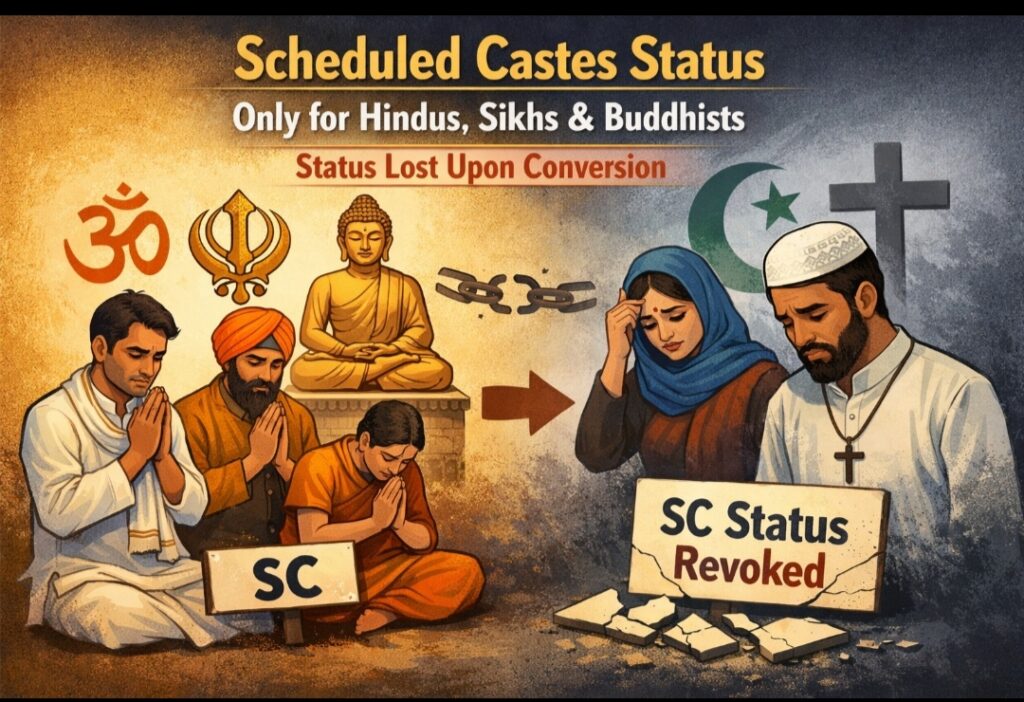
New Delhi,25 March2026 : The Supreme Court on Tuesday said that a Scheduled Caste person can only belong to the Hindu, Sikh or Buddhist faith, and that those who convert to other religions — Christianity in the present case — lose that constitutional and statutory protection.
A Bench of Justice Prashant Kumar Mishra and Justice Manmohan said, “… for a person to be recognised as a member of a Scheduled Caste, he must be professing the Hindu religion or such other religions (Sikh and Buddhism) as are expressly recognised under the Constitution (Scheduled Castes) Order, 1950.”
The Court made these observations while upholding the Andhra Pradesh High Court’s order quashing criminal proceedings initiated by one Chinthada Anand, who claimed to belong to the Scheduled Caste Madiga community despite having converted to Christianity and serving as a pastor. Anand had filed a complaint against six persons under the Scheduled Castes and Scheduled Tribes (Prevention of Atrocities) Act, 1989 and the Indian Penal Code.
The Court held that once the appellant converted to Christianity, the caste status he earlier enjoyed as a member of the Madiga community stood eclipsed in the eyes of law.
Noting that Anand had converted to Christianity and was functioning as a pastor, and that it was not his case that he had reconverted or been accepted back into the Madiga community, the judgment, authored by Justice Mishra, said, “Once the appellant (Chinthada Anand) converted to Christianity, the caste status, which he earlier enjoyed as a member of the Madiga community, stood eclipsed in the eyes of law.”
Rejecting Anand’s contention that caste status is determined solely by birth and continues despite conversion, the Court reiterated that recognition as a Scheduled Caste is contingent upon professing one of the religions specified under the 1950 Order.
The Court also observed that Christianity, by its theological foundation, does not recognise or incorporate caste distinctions. Referring to Christian doctrine, it noted that the New Testament emphasises equality among all believers.
Endorsing the High Court’s view, the Supreme Court further noted that the allegations of wrongful restraint, hurt and criminal intimidation were based solely on Anand’s statement, with no independent witness attributing any specific overt act to the accused persons.

Pramod kumar is a Senior Journalist, Covering Supreem Court of India