

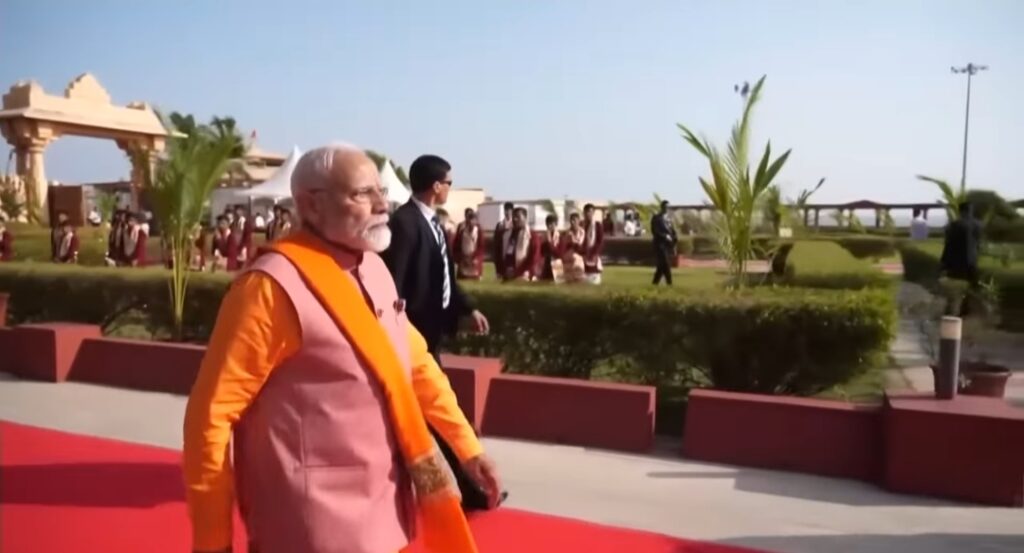
Mumbai,9Jan26: When Prime Minister Narendra Modi recently invoked the Somnath temple as a symbol of India’s civilisational endurance, marking a millennium since Mahmud of Ghazni’s raid, he was not merely recalling a historical event. He was articulating a particular way of remembering the past — one that treats Somnath as an emblem of uninterrupted Hindu suffering, repeated destruction, and ultimate national resurgence.
Such invocations carry emotional force and political resonance. But history, as the historian Romila Thapar reminds us in Somanatha: The Many Voices of History, is rarely so linear, unanimous or morally unambiguous. The problem is not that Somnath’s past is being remembered — it is how it is being remembered, and which voices are being amplified or silenced in the telling.
Thapar’s study does not deny Mahmud of Ghazni’s raid on Somnath in 1026 CE. Nor does it seek to diminish the religious significance of the temple. Instead, it asks a more unsettling question: how did a single episode, sparsely referenced in contemporary local sources, come to dominate the historical imagination as a defining civilisational trauma?
Many pasts, not one
At the heart of Thapar’s argument is a methodological caution. History is not a single story handed down intact through time; it is an accumulation of narratives shaped by who records them, for whom, and to what end. In the case of Somnath, the sources are diverse — Persian court chronicles, Sanskrit inscriptions, Jain texts, colonial debates, nationalist histories and modern political rhetoric — and they often speak in contradictory registers.
Persian chroniclers writing in Mahmud’s court projected the raid as a heroic act of iconoclasm, a victory that enhanced the sultan’s prestige in the Islamic world. Yet even these accounts differ in detail and emphasis. More strikingly, contemporaneous Sanskrit inscriptions from western India — the very region where one would expect trauma to be memorialised — are largely silent about repeated temple destruction by Muslim rulers. Some references point instead to decline due to neglect or natural causes, followed by restoration by local patrons.
Jain sources, merchants’ records and regional texts offer still another picture: one of commercial continuity, pilgrimage, and everyday coexistence between communities. These voices rarely conform to the dramatic arc of perpetual desecration and heroic rebuilding that dominates modern retellings.
Thapar’s insistence on placing these sources side by side destabilises the idea that Somnath’s meaning was fixed in the medieval period. It also reveals how later centuries — especially the colonial era — played a decisive role in shaping the narrative we now take for granted.
Colonial frames and nationalist afterlives
The elevation of Somnath into a civilisational wound owes much to 19th-century colonial historiography. British administrators and historians, keen to divide India’s past into Hindu and Muslim epochs, found in Somnath a convenient symbol. The infamous debate over the “Gates of Somnath”, removed from Ghazni and installed at Agra, transformed a regional shrine into an imperial talking point about conquest and revenge.
This colonial framing did not disappear with independence. Instead, it was reworked within nationalist and later Hindutva discourses, where Somnath became a metaphor for Hindu resilience against an external, Muslim “other”. In this process, the multiplicity of historical voices was flattened into a single moral narrative.
It is this inherited script that underlies the Prime Minister’s speech. By presenting Somnath as a site of repeated, religiously motivated destruction, followed by triumphant revival, the speech reinforces a binary view of history — invaders versus natives, humiliation versus resurgence — that Thapar’s scholarship directly challenges.
Mahmud of Ghazni: zealot or ruler?
Another simplification in contemporary political rhetoric concerns Mahmud of Ghazni himself. He is often portrayed solely as a religious fanatic bent on erasing Hindu civilisation. Yet medieval polities did not operate according to modern communal categories. Mahmud’s raids were shaped by multiple motives: the extraction of wealth, political consolidation, competition with rival Islamic rulers, and the performative assertion of sovereignty.
Even Persian sources, when read critically, reveal inconsistencies in how Mahmud’s actions were justified and remembered. To reduce him to a one-dimensional symbol of religious hatred is to read the past through the anxieties of the present.
Thapar’s point is not to exonerate medieval violence — destruction did occur, and temples were sometimes targeted — but to resist the temptation to treat such acts as timeless proof of an eternal civilisational conflict.
1951 and the politics of restraint
The Prime Minister’s contrast between Somnath’s modern reconstruction and Jawaharlal Nehru’s alleged indifference fits neatly into this narrative of historical wrongs corrected. Yet this framing ignores the political context of the early republic.
Nehru’s reluctance to officially endorse the temple’s reconstruction was not rooted in hostility to religion, but in anxiety about communal polarisation in a country still reeling from Partition. His caution reflected a constitutional vision that sought to keep the state equidistant from all faiths, precisely to prevent historical memory from becoming a tool of exclusion.
To retrospectively recast this restraint as national weakness is to read post-Partition secularism through the lens of contemporary majoritarian confidence.
History as inquiry, not indictment
What Somanatha: The Many Voices of History ultimately offers is not an alternative myth, but a discipline of doubt. It asks readers to distinguish between history as inquiry and history as indictment — between understanding the past and mobilising it for present political ends.
Somnath’s history is undeniably layered, charged, and meaningful. But it is also fragmented, contested, and resistant to singular conclusions. To honour that complexity is not to diminish civilisational pride; it is to refuse the reduction of the past into a moral fable of victims and villains.
When political leaders speak of history, they wield immense interpretive power. The danger lies not in remembering Somnath, but in remembering it as if it had only one voice — one that confirms what we already believe about ourselves and our adversaries.
Somnath deserves better. Not as a monument to perpetual grievance, but as a reminder that India’s past, like its present, has always been plural — unruly, argumentative, and far richer than any single story of destruction and triumph.
~Hasnain Naqvi is a former member of the history faculty at St. Xavier’s College, Mumbai
###

~Hasnain Naqvi is a former member of the history faculty at St. Xavier’s College, Mumbai

