


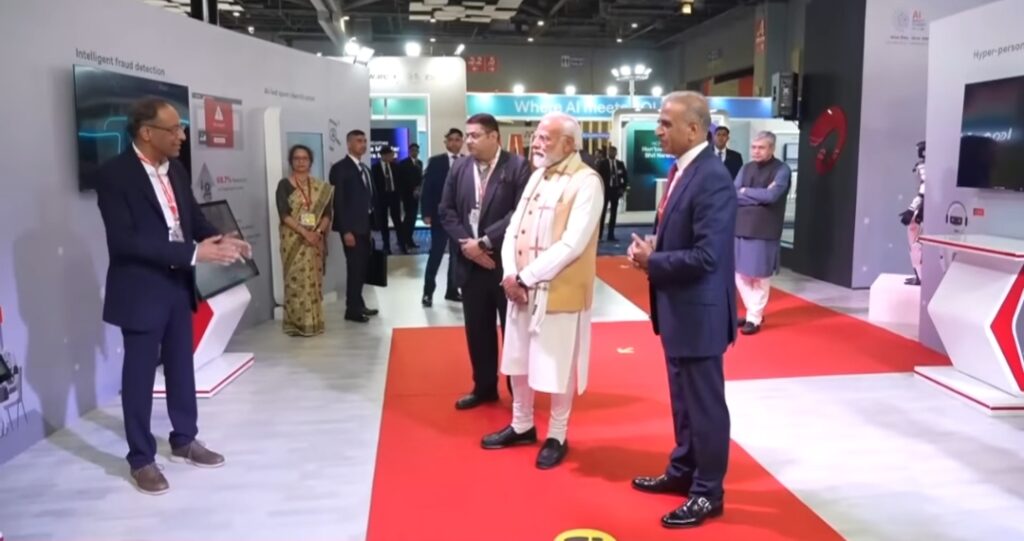
NEW DELHI,18 Feb 2026 : As New Delhi hosts the world’s first and largest AI summit, India is quietly rewriting the rules of who gets to build, use and benefit from artificial intelligence.
Artificial Intelligence is no longer a futuristic promise in India. It is becoming an everyday public utility, embedded in farming advisories, healthcare diagnostics, disaster warnings, governance systems and classroom learning. What sets India apart in the global AI race is not just scale but intent: a conscious push to democratise AI, ensuring that access to computing power, data, models and skills does not remain the preserve of a few corporations or elite institutions.
That philosophy, of inclusion before innovation, now defines India’s AI journey.
At the heart of this transformation is the idea that AI should follow the same trajectory as India’s earlier digital revolutions. Just as Aadhaar provided digital identity at population scale and UPI turned payments into a public good, India is now building what officials describe as a full AI stack for the nation, from data and compute to talent and regulation.
“We must democratise technology and create people‑centric applications,” Prime Minister Narendra Modi has repeatedly said, underlining that India’s approach to AI is rooted in access, trust and social impact rather than technological exclusivity.
India’s AI strategy is anchored in the belief that artificial intelligence delivers value only when it reaches citizens at scale. From crop health monitoring systems that help farmers anticipate pest attacks to AI‑powered weather and cyclone forecasting tools used by the India Meteorological Department, AI is being deployed as a public service, not just a commercial product.
In healthcare, AI is assisting doctors in reading medical images, enabling early detection of diseases and extending specialist care to remote districts through telemedicine. In governance, AI tools are improving service delivery, grievance redressal and policy planning. Language barriers are being dismantled through Bhashini, the national AI‑driven translation platform, which supports over two dozen Indian languages and has crossed more than a million downloads—bringing digital services to citizens who are not fluent in English.
This emphasis on usability and scale reflects a larger philosophy. “AI can help transform millions of lives by improving health, education, agriculture and so much more,” PM Modi said at the Paris AI Summit, adding that governance must ensure access to all, especially in the Global South.
Opening The Black Box: Data, Models And Compute For All
One of the biggest barriers to AI innovation globally is access to high‑quality data and affordable computing power. India has tackled this head‑on.
Through AIKosh, a national platform for datasets and AI models, the government has created a shared resource pool spanning thousands of datasets and hundreds of reusable models across sectors, from agriculture and healthcare to language and climate science. Instead of each startup or researcher reinventing the wheel, these assets can now be accessed, adapted and built upon.
More crucially, India has broken the cost barrier around high‑end AI computing. Under the IndiaAI Mission, more than 38,000 GPUs have been onboarded and made available at a subsidised rate of about Rs 65 per hour, roughly one‑third of global market prices. This single move has dramatically lowered entry barriers for start-ups, academic institutions and public research labs.
National supercomputing facilities such as PARAM Siddhi‑AI and AIRAWAT further extend high‑performance computing access to universities and research centres, supporting everything from language processing to drug discovery.
“Governance is not just about managing risks; it is also about promoting innovation and deploying it for the global good,” PM Modi notes, an approach reflected in how India is treating AI infrastructure as a shared national capability.
Building Sovereignty In Chips And Energy
Democratising AI also means ensuring long‑term resilience. India is therefore investing heavily in semiconductors and energy, two invisible but critical pillars of AI.
Through the India Semiconductor Mission, the country is building domestic capabilities in chip manufacturing, design and talent development, reducing dependence on global supply chains. At the same time, the expansion of data centres across Mumbai, Delhi‑NCR, Bengaluru, Hyderabad and Chennai is being supported by India’s accelerating clean‑energy transition.
By mid‑2025, India had achieved 50 per cent of installed electricity capacity from non‑fossil sources, years ahead of schedule. This matters because AI data centres are energy‑intensive, and sustainability is becoming a decisive factor in AI scalability.
“AI models must also be efficient and sustainable in size, data needs and energy requirements,” PM Modi has cautioned, arguing that the future of AI must be both powerful and responsible.
Skilling The Nation, Not Just Coders
Perhaps the most ambitious aspect of India’s AI democratisation is its focus on people.
From school classrooms to PhD programmes, AI education is being mainstreamed. National initiatives such as Skilling for AI Readiness, YUVAi, and new Centres of Excellence are introducing AI concepts to students as early as Class 6, while also retraining educators and government officials.
Under the IndiaAI Mission, thousands of undergraduate, postgraduate and doctoral students are receiving fellowships, while AI labs are being set up in Tier‑II and Tier‑III cities—deliberately moving talent development beyond metropolitan hubs.
The goal is not just to create AI engineers but an AI‑literate society, capable of understanding, questioning and responsibly using the technology.
“Loss of jobs is AI’s most feared disruption, but history has shown that work does not disappear due to technology; its nature changes,” Modi has said, stressing the importance of continuous skilling and reskilling.
As India hosts the India AI Impact Summit 2026 in New Delhi, the first such global gathering in the Global South, it is positioning its AI journey as a template for other developing nations.
A dedicated working group on democratising AI resources, co‑chaired by India, Egypt and Kenya, is pushing for AI infrastructure to be treated as a global public good—accessible, affordable and shared across borders.
“For India, AI stands for ‘All Inclusive’,” Modi has said, encapsulating a vision where technology compresses decades of development into years, without leaving societies fractured or excluded.
The Road Ahead
India’s AI story is still unfolding. But its direction is clear.
By lowering costs, opening access, investing in skills and embedding ethics into policy, India is attempting something few nations have tried at this scale: making artificial intelligence a tool of mass empowerment rather than elite advantage.
In a world increasingly defined by algorithmic power, India’s wager is bold: that democratised AI, rooted in public infrastructure and social purpose, can become a force not just for innovation but for equity.
And if it succeeds, the AI future may not just be built in India, it may be built for India and for much of the world beyond.
Pictures credit social media