

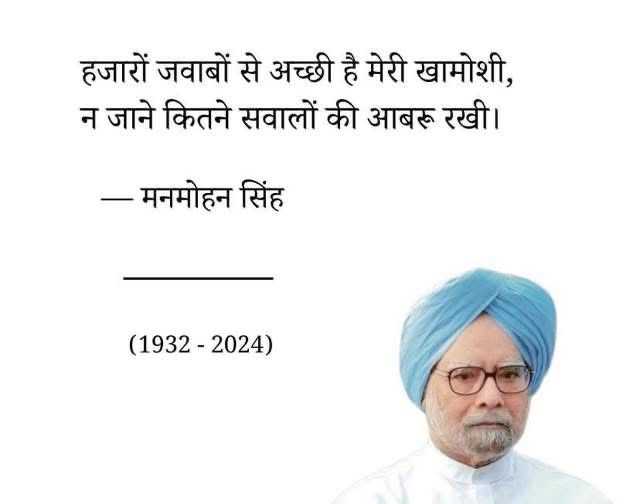
vo aasmaan tha magar sar jhuka ke chalta tha”!
“He was the sky
But he walked with his head bowed down”!
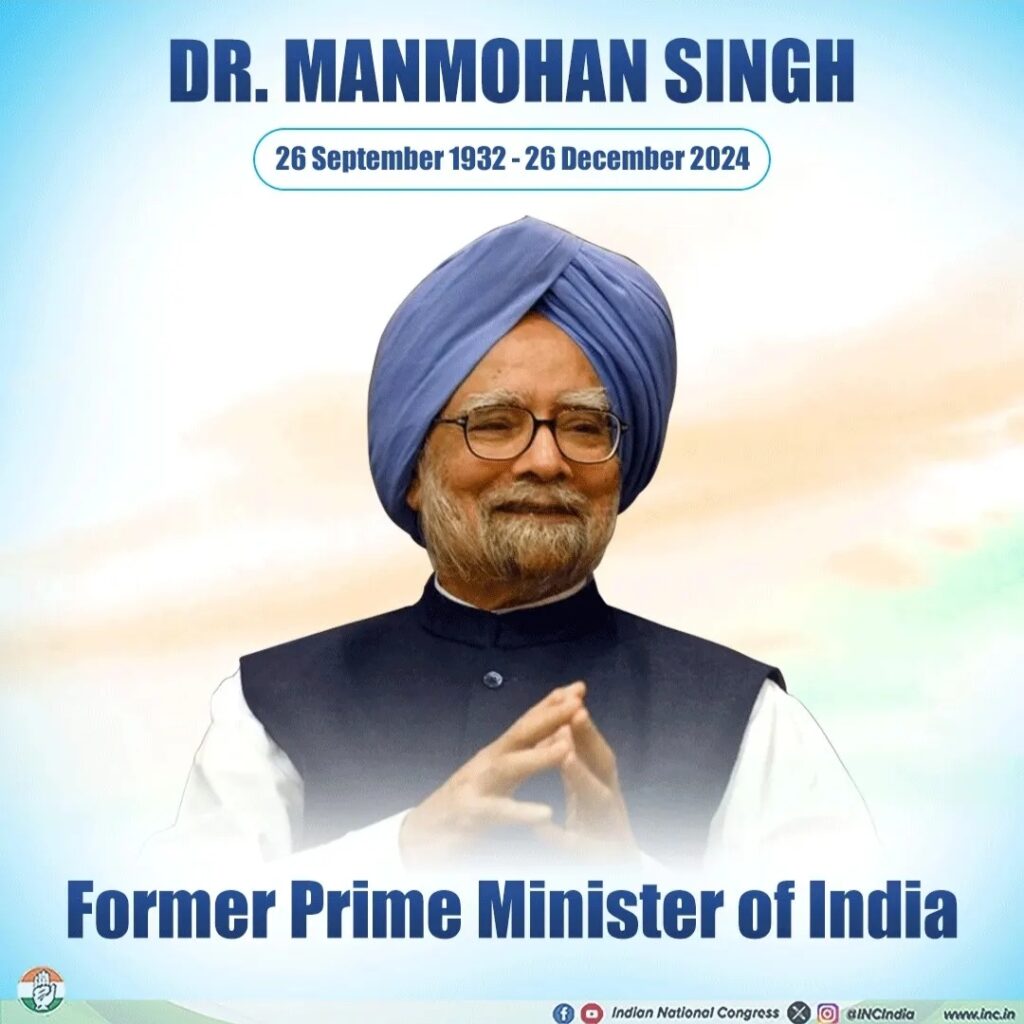
The Architect of Quiet Transformation:A Tribute to Dr. Manmohan Singh
One year ago, on December 26, India lost more than a former Prime Minister; it lost the personification of intellectual integrity and dignified statesmanship. Dr. Manmohan Singh was a man of few words, yet his legacy speaks with a resonance that grows louder with the passage of time. As we mark his first death anniversary, we remember a leader who proved that power does not need to shout to be effective, and that the “sky” can indeed walk with its head bowed.
The Scholar as Statesman
Dr. Singh’s journey was a testament to the power of meritocracy. From the humble surroundings of Gah (now in Pakistan) to the hallowed halls of Cambridge and Oxford, his life was defined by a relentless pursuit of academic excellence. Long before he entered the political fray, he was a decorated economist and a respected teacher.
His tenure as the Governor of the Reserve Bank of India and Deputy Chairman of the Planning Commission provided the technical foundation for what would become his greatest contribution to the Indian story: the 1991 reforms. As Finance Minister, his “Budget of 1991” dismantled the License Raj, ending decades of economic stagnation and opening India to the global stage. He famously quoted Victor Hugo, noting that no power on earth could stop an idea whose time had come.
Leadership Through Consensus
In 2004, when Dr. Singh assumed the office of Prime Minister under the UPA-1 coalition, skeptics questioned his political longevity. Yet, he steered a complex multi-party alliance for a full decade. His first term was a golden era of growth, where India saw the steady expansion of the middle class and a historic rise in GDP.
His vision was not merely about numbers but about inclusive growth. This led to the institutionalization of rights-based governance through landmark legislations:
* MGNREGA: A safety net for the rural poor that redefined social security.
* Right to Information (RTI): A revolutionary tool for transparency and citizen empowerment.
* Right to Education (RTE): Ensuring that the promise of India reached its youngest citizens.
* Aadhaar: The digital backbone that transformed direct benefit transfers and eliminated middle-men.
Courage Under Pressure
Perhaps the defining moment of his premiership was the Indo-US Civil Nuclear Deal. In a rare display of political risk-taking, Dr. Singh staked his government’s survival on a deal that ended India’s nuclear isolation. He looked beyond the immediate horizon of the next election toward the energy security of the next generation.
Even during the global financial crisis of 2008, when the world’s leading economies were crumbling, Dr. Singh’s steady hand and deep understanding of fiscal policy shielded India from the worst of the recession. While the latter half of his second term faced the turbulence of media-driven controversies and coalition pressures, his personal integrity remained an unassailable bastion.
The Verdict of History
Dr. Singh once famously said, “I believe that history will be kinder to me than the contemporary media.” Today, that prophecy feels increasingly accurate.
In an era often dominated by performative politics and high-decibel rhetoric, the memory of a Prime Minister who worked in silence, prioritized substance over style, and treated his opponents with unwavering courtesy is deeply cherished.
He was a “Great Gentleman” in the truest sense—a man whose erudition was matched only by his humility. As we reflect on his life today, we honour the architect of modern India’s economy and a leader who reminded us that the true measure of a statesman is not the volume of his voice, but the depth of his contribution.
~Hasnain Naqvi is a former member of the history faculty at St. Xavier’s College, Mumbai

~Hasnain Naqvi is a former member of the history faculty at St. Xavier’s College, Mumbai

