
The foundational promise of the Indian Republic—a pluralistic sanctuary for all faiths—is currently weathering its most severe storm since Independence. What was once a series of isolated communal skirmishes has evolved into a systematic, widespread campaign of intimidation against religious minorities. As the world watches, the “world’s largest democracy” is increasingly being defined not by its constitutional protections, but by the unchecked rise of mob justice and inflammatory rhetoric flowing from the highest echelons of state power.
The Architecture of Intimidation
The recent surge in violence is not a series of random accidents; it is the manifestation of a deepening atmosphere of impunity. In January 2026, the sheer brutality of targeted attacks shocked international monitors. In Odisha, the horrific assault on Pastor Bipin Bihari Naik—who was dragged from a prayer service and forced to consume cow dung—serves as a grim metaphor for the dehumanization of the “other.”
This pattern of violence extends across the map:
* Maharashtra: Four Christian families saw their homes reduced to rubble after refusing to renounce their faith.
* Andhra Pradesh: Evangelical Christians were ambushed in a minibus, subjected to beatings with cricket bats while their vehicle was torched.
* Chhattisgarh: Half a dozen Muslim homes were set ablaze following unverified allegations of temple desecration.
From the Pulpit to the Street:
The Rhetoric of Hate
While vigilante mobs act on the ground, the ideological fuel is increasingly being supplied by state leadership. Recent reports, including a 2025 analysis by the India Hate Lab, identified Uttarakhand Chief Minister Pushkar Singh Dhami as one of the country’s most prolific “hate speech actors,” citing dozens of instances of inflammatory rhetoric concerning “Land Jihad” and “Love Jihad.”
Not far behind, Assam Chief Minister Himanta Biswa Sarma has drawn severe criticism—and legal challenges in the Supreme Court—for his dehumanizing comments regarding the “Miya” (Bengali-origin Muslim) community. By threatening the mass removal of voters from electoral rolls and using derogatory slurs, such leaders signal to vigilante groups that minorities are not only “others” but existential threats to the nation.
The Case of “Mohammad Deepak”: A Symbol of Defiance
Nowhere is the tension more palpable than in Uttarakhand. In a late January 2026 incident in kotdwar a, local gym owner named Deepak Kumar stood up to a mob harassing an elderly Muslim shopkeeper over the word “Baba” in his shop’s name. In a moment of defiant solidarity, Kumar told the mob his name was “Mohammad Deepak,” asserting that in a secular India, everyone is equal.
The state’s response was telling: while Kumar faced protests and police cases for “disturbing the peace,” the vigilantes—identified by rights groups as members of far-right outfits—initially faced little more than “unknown person” filings. This selective enforcement of the law reinforces a dangerous double standard: those who defend pluralism are prosecuted, while those who threaten it are protected.
Legislation as a Weapon
Perhaps more concerning than the mobs is the legislative framework now fueling them. States like Uttar Pradesh and Uttarakhand have aggressively tightened Anti-Conversion Laws, lowering the evidentiary bar to a point where “intent” is defined by the accuser.
In Uttar Pradesh, the recent arrest of 12 Muslim men for the “crime” of praying inside a private residence underscores a chilling reality: the state is increasingly policing the private conscience of its citizens. These laws are frequently used as a tool for arbitrary detention, with some states now proposing life sentences for “offenses” that involve nothing more than private worship.
The Global Verdict: A “Country of Particular Concern”
The international community’s patience is wearing thin. For the sixth consecutive year, the U.S. Commission on International Religious Freedom (USCIRF) has recommended that the U.S. State Department designate India as a Country of Particular Concern (CPC). This designation is reserved for nations that engage in “systematic, ongoing, and egregious” violations of religious liberty.
The 2025 Annual Report and subsequent hearings highlight a sobering consensus: India’s downward spiral is no longer a domestic matter; it is a human rights crisis. When the state fails to prosecute those who incite violence, and instead creates laws that mirror the mob’s demands, it signals a quiet endorsement of majoritarian hegemony.
The Breaking Point
India stands at a critical juncture. The erosion of secularism is not merely a threat to Christians and Muslims; it is a threat to the democratic fabric that holds a billion people together. If the Indian government continues to allow constitutional office-holders to vitiate the communal atmosphere and vigilante groups to dictate the terms of citizenship, it risks losing its moral standing on the world stage. The question is no longer whether religious freedom is under attack—the question is whether there is enough political will left to save the soul of the Republic.
~Hasnain Naqvi is a former member of the history faculty at St. Xavier’s College, Mumbai
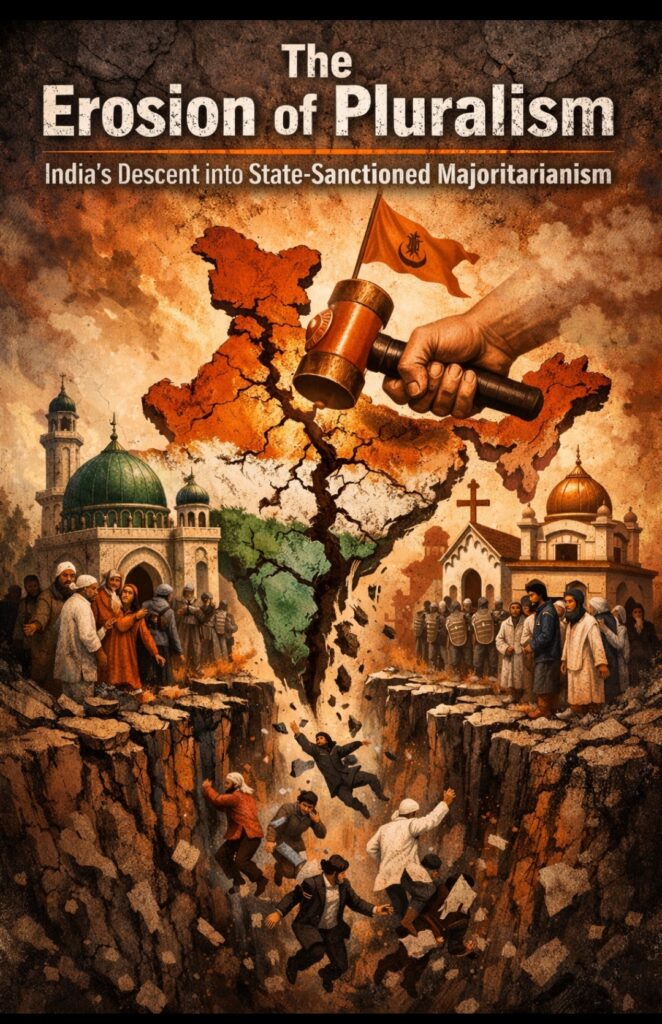
Symbolic picture used

~Hasnain Naqvi is a former member of the history faculty at St. Xavier’s College, Mumbai