

Echoes of Revolution: Waqt ne kiya kya haseen sitam (What a beautiful tyranny time has wrought)
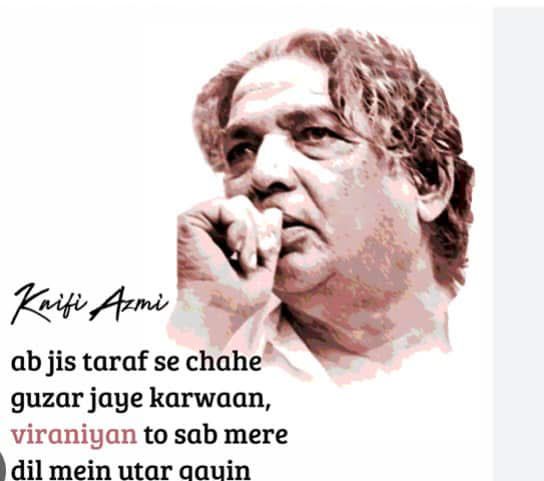
On this January 14, as the world marks the 107th birth anniversary of Kaifi Azmi, the air seems laced with the quiet rebellion of his words.
Born in 1919 amid the rustic folds of Mijwan village in Azamgarh, Uttar Pradesh, Azmi—originally Syed Athar Hussain Rizvi—emerged from a Shia Muslim zamindar family to become a beacon of progressive Urdu poetry. His verses, sharp as a sickle yet tender as dawn, wove the threads of social justice into the fabric of Indian literature and cinema. In an era where words could ignite revolutions, Azmi’s legacy endures, reminding us that poetry is not mere ornament but a call to conscience.
Aurat, uth meri jaan, mere saath hi chalna hai tujhe (Woman, arise my love, you must walk with me)
From the tender age of eleven, when he penned his first ghazal and recited it at a mushaira to thunderous applause, Azmi’s voice resonated with the undercurrents of change. Influenced by the Progressive Writers’ Movement, he joined the Communist Party of India at 19, channeling his youthful fervor into verses that championed the marginalized. His early collections, like Jhankar (1943) and Aakhir-e-Shab (1947), pulsed with themes of equality and resistance, drawing from the socio-political upheavals of pre-Independence India. Azmi’s marriage to theatre artist Shaukat Khanum in 1947 further enriched his worldview, as they navigated Mumbai’s burgeoning cultural scene together. Even a debilitating stroke in 1973, which paralyzed one side of his body, could not silence him; he continued to write, embodying the resilience he so often evoked in his poetry.
Kar chale hum fida jaan-o-tan sathiyon (We have sacrificed our lives and bodies, comrades)
Azmi’s cinematic odyssey transformed Hindi film lyrics from saccharine escapism to profound social commentary. Debuting as a lyricist with Buzdil in 1951, he infused songs with Urdu’s lyrical depth, collaborating with maestros like S.D. Burman and Madan Mohan. Films such as Kaagaz Ke Phool (1959) and Haqeeqat (1964)—India’s poignant war epic—bore his indelible mark, where melodies like Zara si aahat hoti hai captured the fragility of human bonds. His crowning achievement came with Heer Ranjha (1970), scripting an entire film in verse, a feat unmatched in Bollywood’s annals. Azmi’s dialogues in Garm Hawa (1973), adapted from Ismat Chughtai’s story, dissected the Partition’s scars with unflinching honesty, earning him National Film Awards for best story, screenplay, and dialogue. Later works, including Arth (1982) with its introspective Tum itna jo muskura rahe ho, explored modern relationships, proving his relevance across decades. As an actor, his portrayal of a grandfather in Naseem (1995) added a layer of quiet gravitas to tales of communal tension.
Makaan bhi ek din banega, intezar kar (A house will be built one day, just wait)
Beyond the silver screen, Azmi’s activism painted him as a true comrade-poet. Returning to Mijwan in his later years, he spearheaded initiatives for rural upliftment, focusing on women’s education and empowerment—efforts that continue through the Kaifi Azmi Foundation today. His honours, including the Sahitya Akademi Award for Awara Sajde (1974), the Soviet Land Nehru Award, and a posthumous Sahitya Akademi Fellowship in 2002, reflect a life dedicated to bridging art and action. Notably, he returned his Padma Shri in the 1980s to protest a derogatory remark by a Uttar Pradesh chief minister likening Urdu poets to donkeys, underscoring his unyielding integrity.
In times of rising polarization, Azmi’s words urge unity, as seen in his funeral song from Naunihal (1967), Meri awaaz suno, which consoled even his daughter Shabana during national mourning for Jawaharlal Nehru.
As we reflect on Azmi’s enduring spirit, his poetry whispers a timeless truth: in the face of tyranny—be it time’s or society’s—the human voice rises, unbowed. On this anniversary, let us not merely remember him but revive the fire of his verses, for in them lies the blueprint for a more just tomorrow.
~Hasnain Naqvi is a former member of the history faculty at St.Xavier’s College, Mumbai

~Hasnain Naqvi is a former member of the history faculty at St. Xavier’s College, Mumbai