
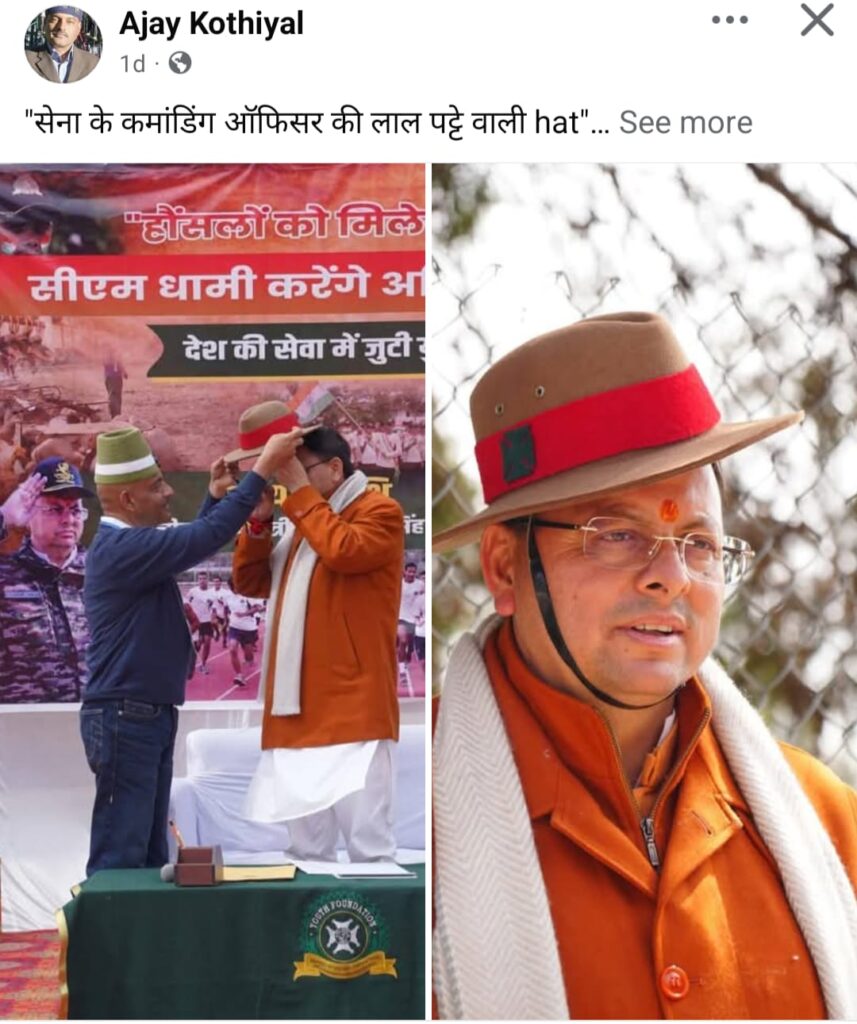
NEW DELHI, 13 March 2026: Uttarakhand’s political landscape witnessed a scene on 10 March 2026 that created deep unease not only in social circles but also among the military community and conscious citizens. This was not merely an event; it symbolized a moment when the dignity of military traditions appeared to be placed upon a political stage in a manner that raised questions rather than evoking respect.
The most painful aspect of this entire episode is that it was not carried out by an ordinary individual, but by a retired military officer who once commanded the 4th Battalion of the Garhwal Rifles (Nuranang) and who has been decorated with gallantry and distinguished service awards Kirti Chakra, Shaurya Chakra, and Vishisht Seva Medal (VSM). In military life, such honours are never merely personal achievements; they represent the tradition, discipline, and moral code upon which the prestige of the entire armed forces rests.
Therefore, when the same officer publicly places the commanding officer’s hat of that battalion on the head of the state’s Chief Minister, it ceases to remain a simple ceremonial gesture. It becomes a symbolic statement—and it is precisely at this point that questions begin to arise.
The irony lies in the fact that the individual upon whom this honour was bestowed remains politically associated with the Ankita Bhandari murder case, an incident that continues to remain a deep wound in the collective consciousness of Uttarakhand. Allegations have repeatedly surfaced that crucial evidence related to this case was destroyed on 22 September 2022 under his watch. When such accusations form part of public discourse, honouring that individual with the symbols of military tradition, appears not only insensitive but also unjust to the very spirit of those traditions.
From a legal standpoint as well, it is natural to ask why discussions of investigation and accountability do not arise when allegations of destruction of evidence are mentioned in the public domain. Under the provisions of the Bharatiya Nyaya Sanhita (BNS), particularly Section 178, such matters warrant scrutiny. The rule of law holds meaning only when both power and honour are subjected to the test of justice.
The most fundamental question, however, is whether an experienced military officer should not have exercised greater discretion and restraint in such a situation.
Within military tradition, there exists a basic principle—honour must first be protected before it is bestowed.
The uniform, symbols, and traditions of soldiers are not decorative objects. They represent the memory of thousands of soldiers who laid down their lives defending the nation’s borders. If these traditions are used on a political platform in a manner that transforms them into instruments of political display, then it ceases to be a mere individual lapse; it becomes a symbol of the insensitivity of an entire system.
Uttarakhand is often referred to as the “Land of Soldiers.” Almost every village in the state has a family connected with the armed forces. In such a region, sensitivity towards military traditions is expected to be even higher than elsewhere. That is precisely why this incident has compelled many people to say that what appeared to be an act of honour was, in reality, a political spectacle.
And it is here that the public’s satire finds expression in a simple phrase:
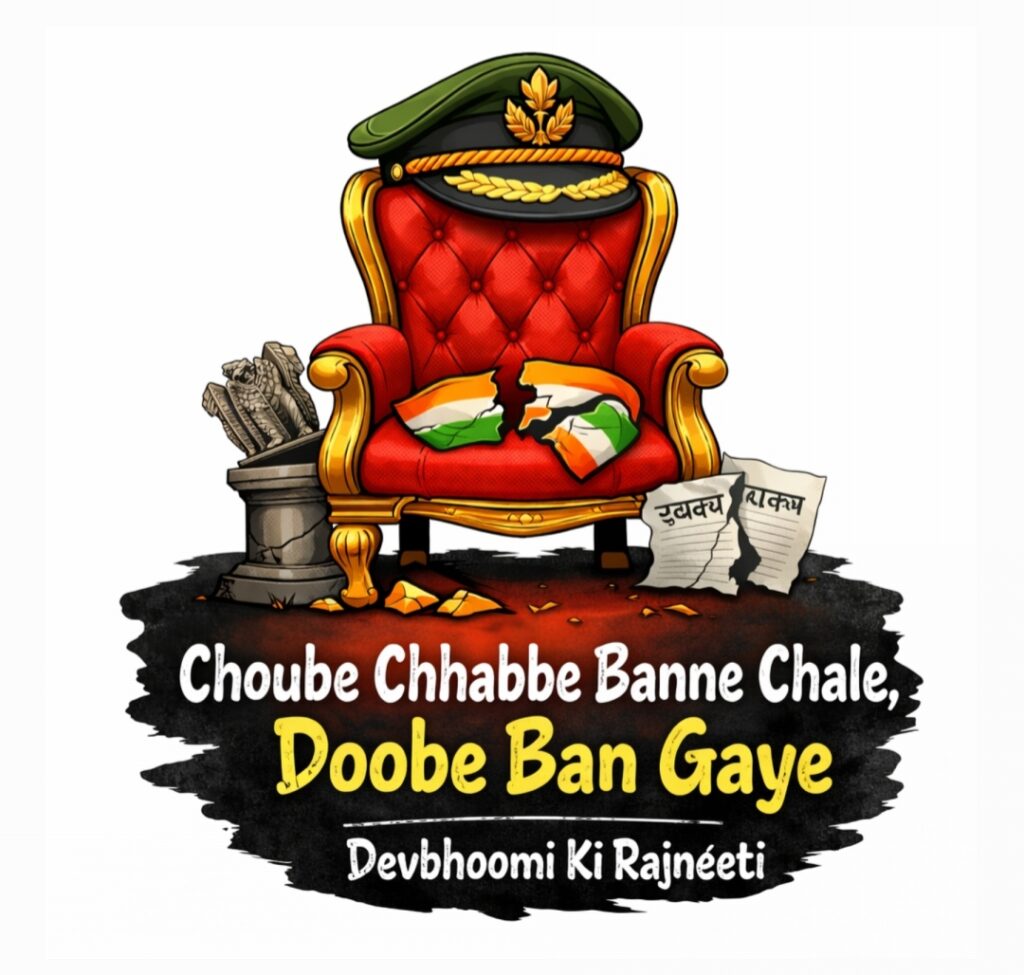
“Choubey ji tried to become Chhabey, but ended up as Dubey.” In trying to improve his lot, he made it worse.
Perhaps the intention was to honour someone, but the outcome turned out to be exactly the opposite. A step that should have elevated the dignity of military tradition has instead become a subject of discomfort and criticism within the military community.
It must also be remembered that military honour is never bestowed on the basis of position or power. In military tradition, honour rests upon only one foundation—character, integrity, and devotion to duty. When that foundation weakens, even the most glittering symbols begin to appear hollow.
The significance of the events of 10 March 2026 lies in the uncomfortable question they have raised between Uttarakhand’s political establishment and the military community:
Is it appropriate to use military traditions and symbols in such a manner on a political stage?
If this question is not examined with seriousness, military symbols and traditions may gradually be reduced to mere ceremonial gestures in the future.
And that would be the greatest irony for any society shaped by the ethos of soldiers.
For military traditions survive on honour—
and when honour is lost in the glare of politics, history delivers its judgment with unforgiving clarity.
Jai Hind
Brigadier Sarvesh Dutt Dangwal (Pahadi) The writer is a social activist and a Retired Breg from Indian Army