
Released this month, Imtiaz Ali’s Main Wapas Aaunga, a story of love, loss, and nostalgia, and of humans killing, or being killed, during India’s 1947 Partition, has won critical and popular acclaim.
It is located in Sargodha, now in Pakistan. Journalist-writer Nona Walia, who traces her roots there but has not seen it, says of this film: “No film can fully capture the enormity of that rupture. Partition-inspired cinema does not always overplay an emotional storm.”
The Partition nostalgia is not gift-wrapped in soft colours, given the blood-letting and the massive displacement, considered history’s largest, followed by a perennially hostile relationship.
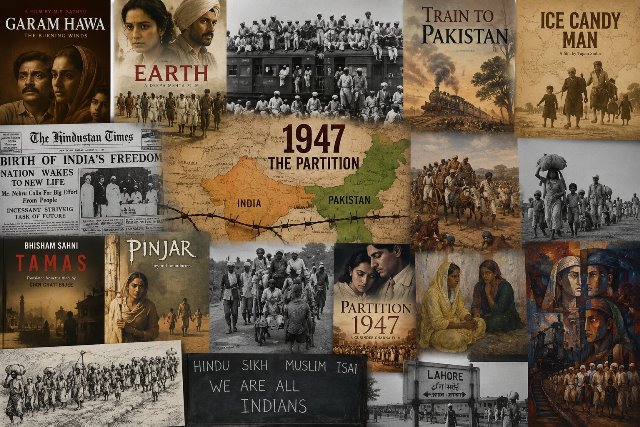
It is not always a Pinjar (2003) or a Tamas (1988), cinema that dwells on human misery caused by circumstances, also greed, but without pointing fingers.
The discourse in Rakeysh Omprakash Mehra’s Bhag Milkha Bhag (2013), wraps famed Indian athlete Milkha Singh’s tragic childhood experiences with his later winning a race in Pakistan. It marks a brief homecoming and a declaration of triumph.
August this year marks 79 years. Come August, Batwara 1947, co-written and directed by Rajkumar Santoshi and produced by actor-filmmaker Aamir Khan, is set to release. It is based on Asghar Wajahat’s drama Jin Lahore Nai Vekhya, O Jamya E Nai – a title that borrows an old Punjabi adage that means not experiencing Lahore is basic to a fulfilling life. Not seeing it is like not truly living or even being born.
Batwara’s chief protagonist, Sunny Deol, led the Indian defence of Longewala in Border (1997), based on a real campaign during the 1971 conflict. He also starred in Anil Sharma’s Gadar 25 years ago. Their success triggered more Indian films on Partition, and its unending aftermath, with the birth of Kashmir and Bangladesh becoming flashpoints with Pakistan.
From Gadar to the Salman Khan-helmed Tiger series, many films have India storming into Pakistan. Pakistan’s response has been relatively modest. Multiple themes are bound to recur, ensuring a lasting process that the Partition set in motion.
With the turn of the century, with terrorism as the new factor, aggressive blaming of Pakistan has partially eclipsed the nostalgia narrative in India. Dhurandhar and its sequel are among the recent blockbusters.
Unlike Dhurandhar, in what is now known as Bollywood, who can forget poet-lyricist Shailendra’s anguished cry, Jalta Hai Punjab? In Nastik (The Atheist – 1954), poet Pradeep laments the Partition, complaining to God: Dekh tere sansar ki halat kya ho gayi, Bhagwan (see what has happened to your world). Dhamaputra (1964) demands from the political leaders and those of different faiths: Yeh kis ka lahoo hai, kaun maraa?” (whose blood is spilt?)
There is definitely a surge in the Partition story in other written and visual arts as well. Limited space compels confining this to cinema, touching upon other parts only briefly in a general narrative, to ask: why Partition now?
The reasons are many, but the top-most is the race against time. The generation that witnessed the Partition in childhood is leaving. Soon, only second-hand accounts, written and visual records, will remain. They are prone to official interpretations heavy on prejudices and politics.
Simultaneously, through private efforts, digital archives, social media handles, and high-profile cinematic representations, such as Ms Marvel, a Disney streaming series on an international superhero, helmed by Pakistani actors, have democratised the history for younger generations.
The creative response in India to the 1947 Partition has evolved through three distinct waves. It began with immediate, raw trauma, moved into decades of institutional silence, and has now transformed into a digital, multi-perspective resurrection.
Partition literature is the most extensive archive of the subcontinent’s psychological fractures. It consciously moves away from political leaders to focus entirely on human suffering.
The pioneers were the immediate witnesses to the Partition. Saadat Hasan Manto’s short stories, particularly Toba Tek Singh and Khol Do, are masterclasses in dark satire. He exposes the absolute absurdity of the border and the breakdown of human morality. Khushwant Singh’s Train to Pakistan (1956) provides a raw, localised look at how a peaceful border village is systematically poisoned by communal hatred.
Scientist-writer Yashpal’s Hindi novel Jhootha Sach (This is Not That Dawn) is a definitive account of the urban displacement of refugees in Lahore and Delhi.
In this literary firmament, a distinct female perspective came to the fore. Amrita Pritam’s Punjabi poem Ajj Aakhaan Waris Shah Nu (I Say Unto Waris Shah) is a haunting invocation of the Sufi poet, mourning the mass rape and brutalisation of women in Punjab. Bapsi Sidhwa wrote from a Pakistani Parsi perspective. Her novel Ice-Candy-Man (Cracking India) highlights how communal madness fractured multicultural relationships.
Shaping public memory, India’s cinema has evolved from a medium that avoided the topic to protect state-mandated communal harmony, into a powerful tool for both empathy and political nationalist messaging.
Contributing to the oral history, Urvashi Butalia’s The Other Side of Silence (1998) fundamentally shifted Partition studies by documenting the suppressed voices of women, children, and lower castes.
Aanchal Malhotra’s Remnants of a Separation (2017) uses material memory—unearthing the stories behind physical objects (like locks, utensils, and shawls) carried across the border—to connect younger generations to the tragedy.
India’s cinema and television evolved through three phases: the 1950s-1970s were subdued/ allegorical. The 1980s-1990s marked their works as humanist/nuanced. In the new century, it stresses action, with Nationalist theme and has gone global and digital.
The Early Masterpieces include Ritwik Ghatak’s Partition Trilogy: (Meghe Dhaka Tara, Komal Gandhar, Subarnarekha). It offers the definitive cinematic look at the Bengal Partition. It captures the crushing economic and psychological toll on refugees displaced in Kolkata.
MS Sathyu’s Garm Hava (1973) remains the most poignant film on the post-Partition dilemma of Indian Muslims. It follows a Muslim family in Agra unsure whether to migrate to Pakistan or stay in a changing India, and it stays on.
Television’s turning point came in the 1980s as Doordarshan, the state television, expanded its footprint. Govind Nihalani’s Tamas, a miniseries based on Bhisham Sahni’s novel, showed with brutal honesty how minor provocations were manipulated by politicians to spark riots.
As for visual arts, capturing the “invisible wounds” the Partition caused, the Progressive Artists’ Group (PAG) was founded in late 1947 in Bombay; icons like MF Husain, SH Raza, and FN Souza reacted directly to the chaos of Partition. They broke away from traditional styles to forge a sharp, modern vocabulary for a fractured nation.
Satish Gujral, a survivor who personally helped evacuate refugees, showed in his paintings, such as Days of Glory and The Mourners, twisted, agonising, blanketed human forms to convey absolute despair.
Visual artists who survived Partition rejected the triumphant narratives of independence, choosing instead to paint the physical pain. Zarina Hashmi, a minimalist artist whose family migrated to Pakistan, uses abstract lines in her woodcuts and geometric maps, like Dividing Line, to explore the deep pain of borders, exile, and lost homes.
The Partition Museum (Amritsar/Delhi): This physical space acts as an interactive art installation. It uses soundscapes, hanging letters, clothes, and multimedia exhibits to turn historical data into an emotional, sensory experience.
The horrors of Partition shall continue to haunt this generation, as well as future ones. It directly fuels ongoing border disputes and religious and regional tensions. When and how will the people draw the right lessons? What will those lessons be? There is no clear answer.

Mahendra Ved is a veteran Journalist and an Expert on international affairs.