

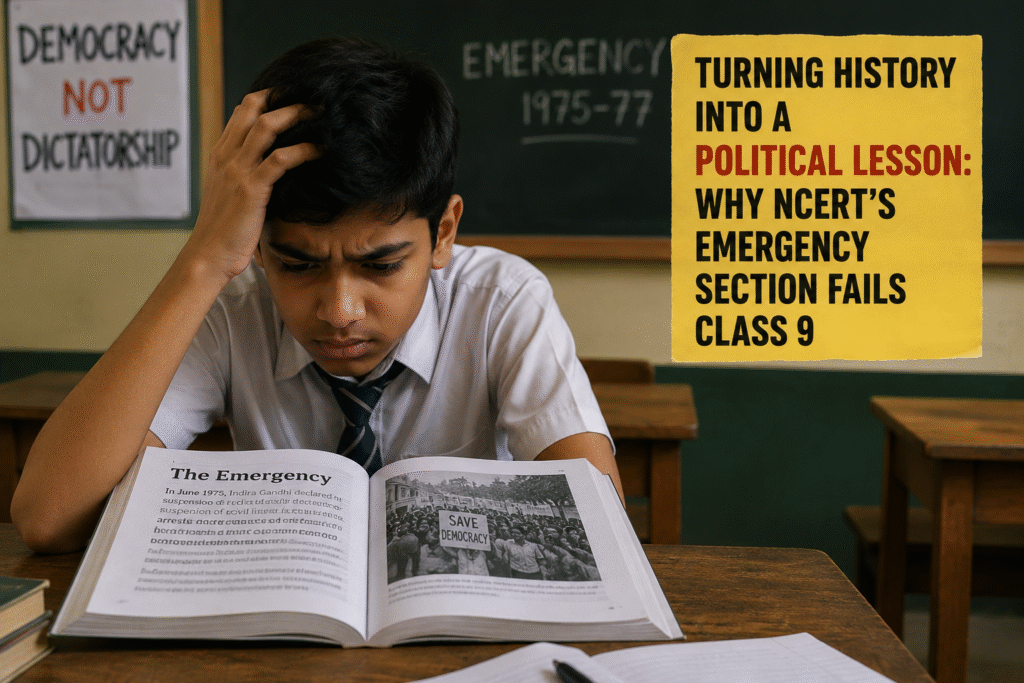
The National Council of Educational Research and Training (NCERT) recently released a revised Class IX social science textbook, Understanding Society, India and Beyond: Part 1 (25 June 2026). One of its most contested additions is a section on the Emergency (1975–77) under a chapter titled “Democracy,” framed as part of “Challenges to democratic practices in India.” The Union Education Minister’s public defence—that young people must learn the “dark deeds of the Emergency so that such a situation does not arise again”—gives away the problem: this is less a pedagogical decision and more a political one. The result is a textbook that risks weaponising history, misjudging students’ developmental readiness, and weakening educational integrity.
A political choice dressed as pedagogy
Textbooks should be portals to historical understanding, not platforms for immediate political messaging. By placing the Emergency squarely in a chapter labelled “Democracy” and juxtaposing it with contemporary critiques, NCERT has collapsed distinct tasks: teaching historical context and urging present-day political conclusions. The minister’s endorsement—framed in partisan terms by many commentators—adds pressure for a singular reading of a contested past.
That political valence is not neutral. The Emergency is an essential subject for civic education: it raises questions about constitutional safeguards, the rule of law, civil liberties, and the limits of executive power. But compressing a complex 21-month event—its legal pretexts, institutional failures, socio-economic consequences (forced sterilisations, displacements like Turkman Gate), and the subsequent constitutional reforms—into a short school module tied to a chapter on contemporary “challenges” flattens nuance. It invites students to accept a fixed moral-political framing instead of engaging in critical inquiry.
Age and maturity matter
Pedagogy must match learners’ cognitive and moral development. Class 9 students (typically 14–15 years old) are beginning to handle abstract thinking but still need concrete scaffolding to grasp layered historical causation and competing interpretations. Effective history education gradually builds source analysis skills, weighs evidence, and models deliberative debate.
The new inclusion risks two harms for this age group:
– Cognitive overload and simplification: Complex constitutional amendments, judicial decisions (like Kesavananda Bharati or the contentious ADM Jabalpur precedent), and the socio-political networks that enabled emergency powers require careful unpacking. Reducing them to moral exemplars or contemporary analogies encourages rote acceptance rather than analytical learning.
– Emotional and political precocity: Teaching emotionally charged events—mass detentions, coercive population control, state violence—without carefully designed pedagogical supports can produce anxiety, binary thinking, or partisan alignment rather than reflective citizenship.
Good civic education teaches students how to think about controversy, not what to think. That requires primary sources, competing narratives, classroom debate protocols, and assessment tasks that reward argumentation supported by evidence. The hurried insertion of the Emergency into a politically framed chapter does not guarantee these features.
Selective memory and the danger of instrumental history
A responsible textbook situates events in their full historical and institutional contexts and acknowledges disagreements among historians. It also models how to weigh sources—government orders, archival documents, contemporary newspaper reporting, personal memoirs—and to understand unintended consequences and contested legacies.
The recent NCERT presentation, however, reads as if the Emergency is being used instrumentally: an historical cudgel to advance present political critiques. Contemporary actors on all sides invoke 1975 selectively—often to delegitimise opponents and distract from current accountability failures. When state institutions or influential politicians amplify a narrowly framed historical account, students may internalise a politicised memory rather than learn critical historiography.
By contrast, a scholarly treatment would address:
– Legal mechanics: how Article 352 was invoked, the role of the President, and post-Emergency constitutional safeguards (notably the 44th Amendment).
– Institutional collapse: MISA detentions, censorship mechanisms, and the judiciary’s failures—alongside how these were corrected.
– Social consequences: forced sterilisation campaigns, urban demolitions, and their human costs—with testimonies and empirical evidence.
– Contested interpretations: why some intellectuals and industrialists initially welcomed “discipline,” and how democratic recovery occurred through electoral accountability in 1977.
Pedagogy over polemic: how this could have been done
If NCERT intended to teach the Emergency’s lessons without politicising classrooms, a better approach would have been:
– A standalone chapter or unit on the Emergency in the historical timeline, not buried as a policy critique inside a general chapter on democracy.
– Age-appropriate primary-source kits: excerpts from newspapers, court judgments, personal letters, and oral histories accompanied by guiding questions.
– Classroom activities that model deliberation: role-plays of constitutional debates, source-comparison exercises, and scaffolded essays that require students to assess competing claims.
– Teacher guides that warn against using the chapter for partisan campaigning and provide suggested responses to likely classroom controversies.
Textbook integrity and democratic schooling
A democratic polity depends on institutions that educate citizens with intellectual honesty. When central authorities or political leaders publicly validate textbook choices in partisan terms, teachers feel pressure. Schools are not immune political arenas; they shape civic identity. That is why textbook frameworks should be insulated from short-term political priorities and undergo transparent scholarly review. NCERT’s mandate is to support critical thinking, not to deliver politically convenient lessons that score rhetorical points in the public sphere.
There is also an accountability paradox. If the state uses history to warn against past abuses, it must also demonstrate contemporary fidelity to the norms it champions. Teaching the Emergency as a one-time “lesson” while present-day governance practices show signs of institutional weakening or polarising rhetoric risks producing cynical students who see moral instruction as hypocrisy.
Teach the Emergency, but teach it well
The Emergency belongs in school curricula; its lessons are indispensable for any education aimed at producing informed citizens. The flawed step NCERT has taken is not inclusion per se, but the framing, timing, and political coloration of that inclusion. For Class 9 students, the Emergency should be introduced through a careful, evidence-based, and pedagogically sound unit—separate, contextualised, and designed to develop critical skills rather than to deliver a political verdict.
If our textbooks are to cultivate active, discerning citizens, they must model intellectual rigor and impartiality. Otherwise, schools risk becoming conduits of partisan memory rather than crucibles of democratic resilience. Before history is taught as a weapon, it needs to be taught as a discipline. Would NCERT reconsider the structure and classroom supports so that students learn to analyse, not simply to accept? That is the test of whether education serves democracy—or politics.

~Hasnain Naqvi is a former member of the history faculty at St. Xavier’s College, Mumbai….
The opinions expressed here are solely those of the author.