
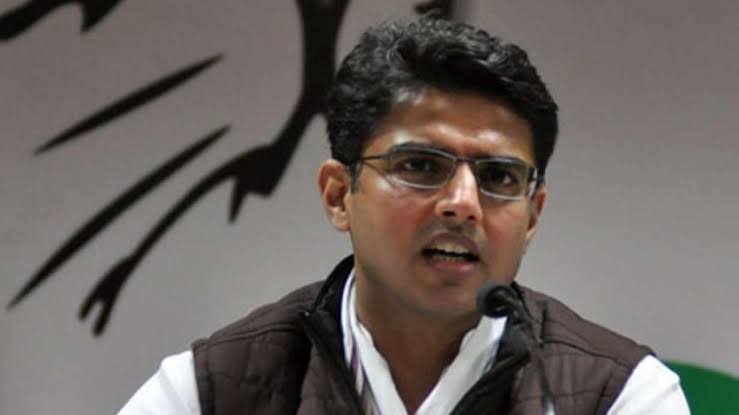
NEW DELHI: Even though the next Rajasthan Assembly election is still more than two years away, Congress leader Sachin Pilot’s two-day tour of the Mewar-Vagad tribal belt has triggered fresh political discussion.
Over two days, Pilot, who is one of the AICC general secretaries, travelled through Banswara, Dungarpur, Salumber and Udaipur, met Congress workers, attended tribal community programmes, visited the revered Tripura Sundari Temple, paid tribute at a memorial programme for late Hurting Khadia, the husband of Congress MLA Ramila Khadia, and addressed multiple public gatherings.
Wearing traditional tribal attire during several events, Pilot sought to project a message of cultural connect with one of Rajasthan’s most politically significant regions.
The visit comes at a time when the Congress is attempting to rebuild its organisation in Rajasthan after losing power in 2023, while simultaneously facing a growing challenge in its traditional tribal strongholds from the Bharat Adivasi Party (BAP) and an aggressive BJP campaign.
Political observers have linked the outreach to the Congress’s early preparations for the 2028 Assembly election, although the party has not officially described it as an election campaign.
The larger question now being asked is whether Pilot has emerged as the Congress’s most prominent face in Rajasthan, and whether the party is quietly positioning him to lead its next electoral battle.
The Mewar-Vagad region has historically been one of the Congress’s strongest support bases. However, the political landscape has changed rapidly over the last few years.
The emergence of the Bharat Adivasi Party has altered electoral equations in southern Rajasthan, particularly in the tribal-dominated districts of Banswara and Dungarpur, where the party has built considerable support among tribal voters. At the same time, the BJP has intensified its efforts to expand its footprint in the region.
The Banswara-Dungarpur belt alone accounts for nine Assembly constituencies*, making it a strategically important region in any state-wide electoral calculation. Pilot’s outreach is therefore being viewed as an attempt to reconnect the Congress with a voter base that has traditionally backed the party but has shown signs of fragmentation.
During the tour, Pilot also attacked the BJP over the alleged irregularities in the Ayodhya Ram Temple Trust and accused the Rajasthan government of delaying student union, panchayat and urban local body elections. On the possibility of an alliance with the Bharat Adivasi Party, he maintained that such decisions would be taken by the Congress leadership.
Any discussion about Pilot’s future in Rajasthan inevitably brings up his long-running political rivalry with former Chief Minister Ashok Gehlot.
The power struggle dates back to 2018, when the Congress returned to power after defeating the BJP. Pilot, who had served as Rajasthan Congress president and was widely credited with rebuilding the organisation after the party’s crushing defeat in 2013, was considered one of the contenders for the chief minister’s post. The Congress high command, however, chose the more experienced Ashok Gehlot as Chief Minister, while Pilot became Deputy Chief Minister.
Their rivalry continued in different forms over the following years. Gehlot publicly criticised Pilot on multiple occasions, famously calling him “nikamma” and “nakara”, while Pilot repeatedly raised issues such as alleged corruption during the previous BJP government, creating further friction within the state unit. The prolonged factionalism became one of the defining features of Rajasthan Congress politics.
The Congress has not declared a chief ministerial face for the next Assembly election, nor has it officially projected Pilot as its leader in Rajasthan. However, several developments have fuelled that perception.
Pilot remains one of the party’s most visible leaders in the state, enjoys direct access to the national leadership, has been entrusted with key organisational responsibilities at the national level, and continues to undertake politically significant outreach programmes in Rajasthan. His latest tribal tour also comes at a time when the Congress is trying to reclaim ground in regions where it has faced growing competition.

We are a multimedia news network. Website : www.7xnews.com Based in New Delhi (India)
Youtube : umakantlakheraspeaks@gmail.com