
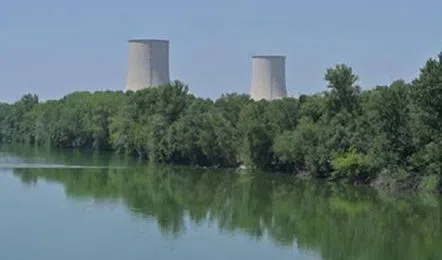
NEW DELHI: France switched off three nuclear reactors and cut output at several more this week, after rivers meant to cool them grew too warm to use safely. India’s coastal and inland reactors face a different risk.
Somewhere on the banks of the Garonne, the Rhone and the Meuse, three French nuclear reactors have gone quiet this week. Nothing broke inside them and there was no safety scare.
They were switched off deliberately, because the rivers meant to cool them had grown too warm to touch.
State energy giant EDF shut down three nuclear power units at the Golfech, Bugey and Chooz plants, while trimming output at eight more, taking roughly 6.3 gigawatts of nuclear capacity offline or below normal. That is enough electricity to power several Indian cities.
The trigger was not the reactor core. It was the heatwave that’s been scorching Western Europe for several days now, and an unwritten law of thermodynamics: a nuclear plant lives or dies by its cooling water.
A nuclear reactor is, at its heart, a very elaborate kettle. Splitting uranium atoms inside the core, a process called nuclear fission, releases heat. That heat boils water into high-pressure steam, and the steam spins a turbine connected to a generator, producing electricity.
Once the steam has done its job, it must be turned back into water, so that the cycle can repeat. This happens inside a condenser, a giant heat exchanger where cool water absorbs the leftover warmth from the spent steam.

We are a multimedia news network. Website : www.7xnews.com Based in New Delhi (India)
Youtube : umakantlakheraspeaks@gmail.com

