
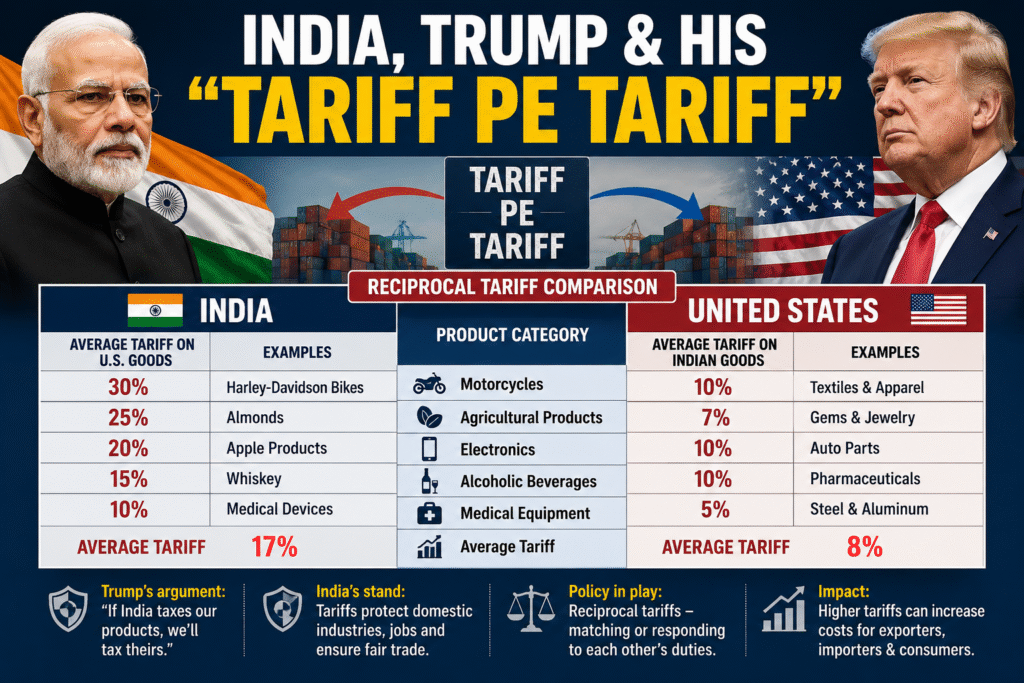
In the latest legislation passed by the United States Senate, India and four other countries risk imposition of 100% tariffs, to be ‘punished’ for purchasing Russian oil and gas.
This was connected to the visit of President Volodymyr Zelenskyi of Ukraine, who needed to be boosted in his war against Russia. President Donald Trump is yet again trying to intervene there, while the one in Iran, where the US is directly involved, continues to rage.
Tariff-ing has become synonymous with Donald Trump, when the global policeman also becomes the global businessman, giving a bad name to both tasks.
The famous Bollywood line “Tarikh pe Tarikh” (date after date in a court to seek justice) comes to mind, and I say “tariff pe tariff” when the Trump-led America imposes tariffs on the world.
To twist another well-known saying: Time and tide — and Trump’s tariffs — wait for none, nor forgive.
My Sunday Mood is ‘tariffic’!
Granting that tariffs are a legitimate trade practice to guard a nation’s economic interests, when the world’s richest nation, en masse, imposes them on 60 countries that account for 90% of its global trade, it is called making money, any which way.
The latest tariff tornado struck at midnight of July 23-24, immediately after the expiry of an earlier round of tariffs. The new ones are temporary, meant to hoodwink the United States Supreme Court, which threw away all tariffs imposed by the Trump administration in February.
A majority of the sixty ‘sufferers’ have been hit with a 12.5% tariff. India and Pakistan are among the few lucky ones with 10 per cent since they have enacted laws against forced labour.
Thank you, Mr Trump. In the past, both were among the countries targeted for child labour. Is merely having such laws enough? But why give you evil ideas?
Those hit for “forced labour” include some advanced economies. Analysts find it ridiculous that over 60 major trading partners, including countries in the European Union, are actually relying on forced labour.
Trump is tapping more durable tariffs under Section 301 of the Trade Act of 1974, which permits the president to impose import taxes and other sanctions against countries found to engage in “unjustifiable”, “unreasonable”, or “discriminatory” trade practices.
He argues that high tariffs will revive US manufacturing, and last year overturned decades of US policy that favoured lower tariffs and freer trade. He is looking for a new authority to replace the expiring tariffs and has decided to use Section 301.
Meanwhile, India is among the 16 countries likely to be hit for “excess capacity”. They account for 70% of US imports. They are found to have overproduced goods, pushing down prices and putting US companies at a disadvantage in global markets.
For India, tariff rates will eventually rise. By how much may be known in a month or so. Currently, it is facing a flat 10% over and above the standard rate. For instance, although the US applies a 5% tariff on cars, the effective rate will be 15% for India. For the EU and Taiwan, the rate is capped at 10%.
Between August last year and February 2026, India had 50% tariffs. Then, after the Supreme Court ruled against Trump, accepting pleas by Indian American Neil Katyal and other lawyers, the tariffs automatically reduced to 10%.
The worrying part is that the negative impact of tariffs is on goods; American importers purchased goods from elsewhere. India is probably not the only one.
Yet, India has survived the worst since April 2025. A significant decline in its merchandise exports was widely anticipated. But trade data from the Ministry of Commerce reveals that India’s exports to the US actually grew, from $86.5 billion to $87.3 billion, rising by 0.9% – an increase of $801.7 million, an Indian Council for Research on International Economic Research (ICRIER) report released last month said.
However, this was driven by exports of products in the “exclusion list”, including primarily pharmaceutical and electronic goods. “In 2025-26, exports of products covered under the exclusion list rose sharply by 24.5%, climbing from $29.4 billion to $36.6 billion. Exports of “non-excluded” products, by contrast, fell by 11.2% over the same period, declining from US$ 57.1 billion to US$ 50.7 billion – a contraction that reflects the true effect of the tariff measures imposed by the United States,” the ICRIER report said.
Amidst this state of concern and caution, there is no official word on whether the US has refunded some of the tariffs collected since April 2025, estimated at USD 1.3 billion, to Indian exporters.
It is a complicated process under which American importers of record are entitled, and the Indian exporters must negotiate with them. The confirmation has come from two such exporters, according to Moneycontrol.com.
Initially, the Textile Ministry and some other departments held a meeting to inform exporters about how to secure refunds, which only US importers get under the refund mechanism. They decide whether they want to reimburse the Indian exporters. The Indian exporters have no say. And the government also has no way to assess who has got the refund money and who has not.
Overall, the situation remains grim for India. Even as it aggressively scouts for newer markets through free trade agreements (FTAs), the report cautioned that the capacity of alternative markets to absorb India’s losses in American exports is “highly uneven — for some product categories, partial for others, and altogether absent for several”.
“This underscores a structural vulnerability in India’s export architecture: the limited ability of alternative markets to compensate for product-level losses in the US suggests that India’s export destination mix remains insufficiently diversified,” the ICRIER report said.
True. How does one diversify when economies are running scared, facing uncertainties imposed by two seemingly unending military conflicts?

Mahendra Ved is a veteran Journalist and an Expert on international affairs.