

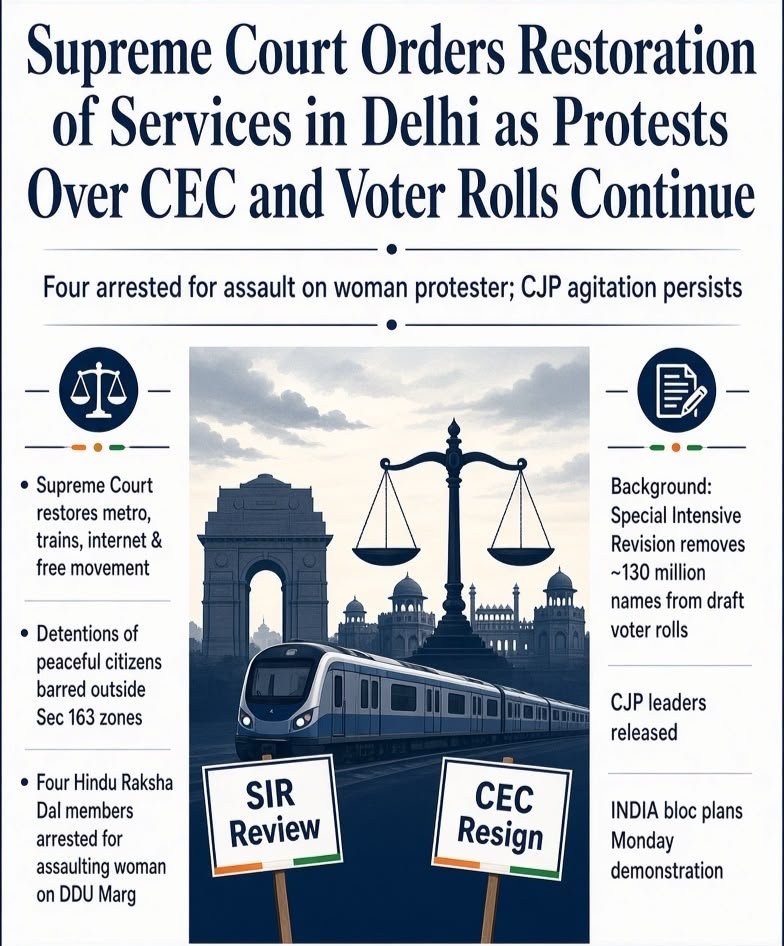
The Supreme Court on Sunday directed the restoration of metro and train services, internet connectivity and free movement of people in the national capital in accordance with law, while also barring detentions of peaceful and unarmed individuals outside areas covered by Section 163 of the Bharatiya Nagarik Suraksha Sanhita. The order came even as the youth-led Cockroach Janta Party (CJP) and supporting groups pressed ahead with their campaign seeking the resignation of Chief Election Commissioner Gyanesh Kumar and a review of the Special Intensive Revision (SIR) of electoral rolls.
A special bench of Justices J. Bagchi and V. Mohana, after hearing senior advocates for more than two hours on restrictions and alleged illegal detentions, issued the directions and also issued notice on a plea alleging contempt of the court’s earlier order, directing all contemnors to file responses.
Arrests over assault on woman protester
In a separate development linked to Saturday’s demonstrations, Delhi Police arrested four men for allegedly assaulting a young woman on DDU Marg. The accused have been identified as Raman Saini (50), Vivekanand alias Vivek (32), Kapil Kumar (27) and Ravinder Singh alias Govind Hindu (35). Police said all four are members of the Hindu Raksha Dal. The arrests followed the circulation of a viral video showing the assault.
Security measures and detentions on Saturday
Saturday’s planned gathering at Jantar Mantar had been effectively prevented by extensive preventive steps. Tens of thousands of police and Central Armed Police Forces personnel were deployed. Key entry points were sealed with multi-layer barricades, numerous trains into New Delhi and Hazrat Nizamuddin were cancelled, dozens of metro station gates remained closed, and mobile internet services were restricted in parts of central Delhi. Estimates of those detained across the city ranged from more than 2,000 to around 7,000; smaller numbers of detentions were also reported in Mumbai and other cities.
CJP founder Abhijeet Dipke and senior colleagues Saurav Das and Ashutosh Ranka were detained on arrival at the airport. Smaller flash protests later occurred at Connaught Place, Dilli Haat, Raj Ghat and other locations; police dispersed the groups and took participants into custody. West Bengal Chief Minister Mamata Banerjee was among the political figures detained during the day.
By early Sunday a court had directed the release of Dipke and the two other CJP leaders. Following the Supreme Court’s order later in the day, internet services, metro operations and train services were expected to return to normal functioning in accordance with law, though a significant security presence remained visible in central areas. CJP organisers said the campaign would continue and called for further mobilisation, including decentralised protests in other cities.
Background to the dispute
The Special Intensive Revision, which began in Bihar in 2025 and was later extended nationally, is described by the Election Commission as a necessary clean-up of the electoral rolls aimed at removing duplicate, deceased or otherwise ineligible entries. Official figures indicate that around 130 million names have been struck from draft lists. The Commission and the ruling Bharatiya Janata Party have rejected allegations of partisan bias, stating that the process is transparent and that draft rolls can be challenged.
Opposition parties, student groups and activists contend that the scale and method of the deletions have affected genuine voters, particularly from marginalised and minority communities. An investigative report published last month by The Indian Express stated that the two other Election Commissioners, Sukhbir Singh Sandhu and Vivek Joshi, formally recorded objections on at least 14 occasions over ten months to decisions taken under CEC Kumar concerning registration procedures, appeals and software systems. The Commission has characterised such internal differences as part of normal functioning.
On Friday, INDIA bloc leaders met President Droupadi Murmu and submitted a memorandum seeking Kumar’s resignation, suspension of the SIR, restoration of deleted names and a review of recent assembly elections. The alliance has indicated it will hold a further demonstration in Delhi on Monday.
On the ground
Around Jantar Mantar and Connaught Place on Saturday, police enforced restrictions under Section 163 of the Bharatiya Nagarik Suraksha Sanhita. Loudspeaker announcements, water cannons and Rapid Action Force units were deployed. Small groups of student activists briefly raised slogans before being detained. Journalists covering the events reported being moved away from certain zones.
The CJP, which originated earlier this year as a satirical Gen-Z response to a judicial remark about unemployed youth, has evolved into a broader platform for discontent over employment, examination integrity and now electoral rolls. Its earlier campaign contributed to the resignation of a Union education minister. Organisers maintain that the present agitation will proceed regardless of individual detentions.
As Sunday evening approached, the Supreme Court’s intervention offered a measure of relief on movement and services, though the underlying confrontation over the integrity of the electoral process, the state’s response to protest, and the demands of a mobilised youth movement remained unresolved.

~Hasnain Naqvi is a former member of the history faculty at St. Xavier’s College, Mumbai….
The opinions expressed here are solely those of the author.