

(Photo) Courtesy : Instagram
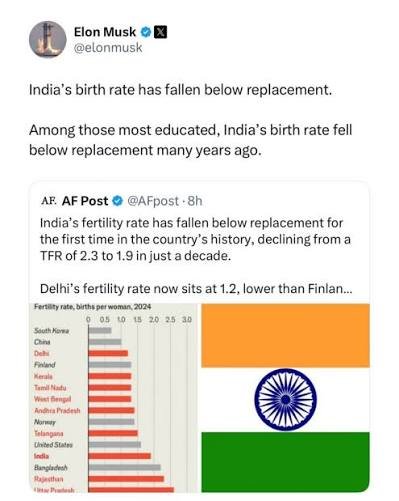
India’s fertility rate has dropped to 1.9 children per woman, with far-reaching consequences for its workforce, elders, and economy. The latest Sample Registration System (SRS) report indicates that while India has experienced a declining birth rate for years, the reproductive rate had previously remained high enough to sustain population growth. For the first time, however, the fertility rate has fallen below the replacement level of 2.1—the threshold needed to prevent population shrinkage—raising concerns about future labour shortages and an ageing population. The debate now centres on whether India can harness rapid ageing into a “silver dividend” before its demographic window closes.
Elon Musk tweeted about India’s declining birth rate on 6 June 2026, intensifying public discourse on the subject. The total fertility rate (TFR)—defined as the average number of children a woman would have in her lifetime—is a standard demographic tool for projecting population growth and generational replacement. In 2000, India’s TFR stood at around 3.3 births per woman. Consider Nidhi Agarwal from Bengaluru. Married and childless by choice, she and her partner deliberately prioritised their careers. “Before marriage, we never discussed kids,” says the 41-year-old, who runs a public relations company. “We spoke about finances and our career goals. Afterward, we felt we wanted to focus on building companies that would have a bigger impact on society rather than raising children.” Such choices are increasingly common across India. Experts attribute the broader trend to better access to education and contraceptives, alongside the rising costs of child-rearing.
Jyotsna Mirlay, a consultant gynaecologist in Bengaluru, told Al Jazeera that higher education and globalisation mean today’s young women are less likely to accept traditional narratives about marriage and childbearing. “I have seen couples question why they should have children when they are doing well in their careers,” she says. “They are often in a dilemma about whether having children will add value to their lives or if it is just a necessity to fit into society.” Many career-focused women are choosing to freeze their eggs, and India now has more than 2,000 fertility centres offering this option.
The familiar drivers of declining fertility—rising educational attainment, career ambitions, urban housing constraints, shifting gender roles, greater bodily autonomy, increased contraception use, and migration—all play a part. Beyond these individual choices, however, lie deeper systemic pressures. Traditionally, families controlled women’s fertility decisions, from marriage timing to childbearing and even stopping at the birth of a boy. This familial control has now been supplanted—or compounded—by workplaces that systematically make childbearing difficult. Some employers do not pay maternity benefits; others pressure women to quit. Some hiring practices remain overtly misogynistic, asking intrusive questions about marriage and family planning rather than judging candidates on merit.
Compounding these issues, medical evidence has documented how urban stress adversely affects reproductive systems, while a profit-driven healthcare industry commercialises this distress. Fertility treatments are prohibitively expensive, effectively limiting motherhood as a viable choice for upper-income groups. Reports also cite hospitals pushing for C-sections to manage bed turnover, which can impair women’s long-term reproductive health and further suppress fertility rates.
Women’s empowerment enables more autonomous decision-making, but its benefits must extend across socioeconomic classes and institutions to be truly equitable. Recognising maternity benefits without mandating paternal involvement reinforces patriarchal norms rather than asserting equality. Mothers on leave are out of sight and thus out of mind at work, often losing career momentum, while fathers face no such disadvantage. Bringing fathers under compulsory leave would encourage shared parenting. Similarly, making fertility treatment more accessible and affordable is essential to stabilising fertility rates. As Shilpi Roy Choudhury argues in her article on feminism and fertility, “It is time we recognised that feminism can foster more equitable societies.”
The consequences of a falling fertility rate are significant. Since the 1970s, Indian governments fought what they deemed overpopulation—too many people for a relatively poor nation’s resources. In 2005, India entered its “demographic dividend” phase, when the working-age population (15–64) outnumbered dependents. With the TFR now below replacement, that dividend is at risk, threatening a shrinking workforce and a rapidly ageing population in the coming decades. This demographic shift also carries political weight. Southern states, having implemented family planning more successfully, fear that a new delimitation act could reduce their parliamentary representation compared to northern states. In response, Andhra Pradesh—which has a TFR of just 1.4—has announced financial incentives of ₹30,000 for a third child and ₹40,000 for a fourth. Meanwhile, Goa, Puducherry, Karnataka, and Telangana have introduced state-funded IVF centres for first-time parents to encourage more births.
Beyond macroeconomics, declining births affect local communities. Drawing on England’s experience, Alice Bradbury and Eleanor Fagan noted that falling birth rates have led to school closures—as many as 100 urban closures in modern times, an unprecedented figure. Unlike in the 2000s, when falling pupil numbers were managed with increased funding and smaller class sizes, today’s closures carry profound psychological and social repercussions for children, affecting equity, diversity, and disadvantage. Schools are vital community anchors; losing them weakens neighbourhood cohesion and undermines support for vulnerable families. This is an issue for wider society, not just the education sector.

The writer holds a Master’s in Public Administration–Environmental Science and Policy from Columbia University, New York.

