
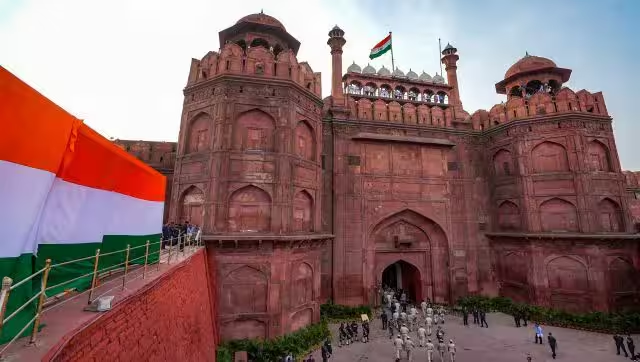
(Photo) Courtesy : Firstpost
As India celebrated the 80th anniversary of Independence, it is evident that the annual ceremony at Delhi’s Red Fort has become much more than a national ritual. It reflects India’s changing priorities, aspirations and identity.
When the Prime Minister Narendra Modi unfurled the Tricolour from the ramparts of Delhi’s Red Fort this year, it carried greater symbolism than ever before. It was a milestone that not only commemorated freedom from colonial rule but also offered an opportunity to reflect on the remarkable transformation of the Republic itself.
The 2026 celebrations unmistakably underscored that journey. For the first time, every military and ceremonial platform showcased during the event carried a distinctly indigenous imprint, reinforcing the government’s emphasis on self-reliance in defence production. The event also highlighted technological initiatives such as AI-powered real-time translation through ‘Bhashini’, ongoing 6G trials, the National Semiconductor Mission, the Green Hydrogen Mission and Mission LiFE, which promotes environmentally sustainable lifestyles. Together, these initiatives present an image of a nation seeking to combine technological innovation with inclusive development.
Independence Day also carried a few lesser-known curiosities. India shares August 15 as its national day with five other countries—South Korea, North Korea, the Republic of Congo, Bahrain and Liechtenstein. There was another cultural coincidence as well: It coincided with Navroz, the Parsi New Year, celebrated by India’s tiny Zoroastrian community whose ancestors arrived from Persia over fourteen centuries ago and made the subcontinent their home. Such intersections add another layer to the country’s extraordinary cultural mosaic.
The Speech That Came a Day Later
Among the many stories associated with Independence Day, one of the most fascinating is also among the least remembered.
Most Indians assume that Jawaharlal Nehru delivered his first Red Fort address on August 15, 1947. In reality, he did not.
His immortal Tryst with Destiny speech was delivered shortly before midnight on August 14 in the Constituent Assembly as India stepped into freedom. Official ceremonies, state functions and diplomatic engagements consumed August 15. It was only on August 16 that Nehru climbed the ramparts of the Red Fort, with the historic Jama Masjid at the other end, to deliver what became the first Independence Day address from the historic fort.
The ceremony itself began on a distinctly cultural note.
Nehru personally invited the legendary shehnai maestro Ustad Bismillah Khan to perform before the address. According to popular accounts, the musician asked what exactly he was expected to play. Nehru’s answer was simple: “You play the shehnai, and the nation will follow you.”
Bismillah Khan chose Raag Kafi—a raga associated with serenity and hope. Long before political speeches and military displays became synonymous with I-Day, the first celebration at the Red Fort thus opened with music that reflected the emotional release of an entire nation emerging from colonial rule.
That tradition of blending symbolism with statecraft has endured ever since.
Why the Red Fort?
The choice of the Red Fort was never merely ceremonial. Nor was it dictated simply by its imposing architecture. It was a profoundly political decision.
Only months before, the fort was the venue for the historic trials of officers of the Indian National Army (INA), who had fought under Netaji Subhas Chandra Bose against British rule. The proceedings electrified the country and transformed the accused officers into national heroes. Their defence team included Nehru, who appeared in his lawyer’s robes after many years.
The public outrage generated by the INA trials is widely regarded as one of the factors that weakened British authority during its final years in India. Memories of those trials were still fresh in the national consciousness.
Choosing the Red Fort as the venue for the Prime Minister’s address therefore represented a symbolic reclamation of a site that had witnessed both imperial authority and anti-colonial resistance.
The fort also carried an even older historical resonance.
Commissioned by Mughal emperor Shah Jahan in 1639, it had served as the symbolic seat of imperial power for over two centuries.
Viewed across eight decades, the ceremony has passed through four distinct phases.
The Era of Reclaiming Sovereignty (1947–1950s)
Newly independent and born with scars of the Partition, India needed symbolic healing. Early celebrations were marked by deep piety and simplicity. They focused heavily on national integration. The nation’s blueprint was set. Nehru established the core ritual of unfurling the Tricolour at the Lahori Gate, followed by a public address.
Institutionalising Tradition (1960s–1980s).
Media outreach was at the core. The ceremony expanded from local crowds to global waves. It moved first via live All India Radio (AIR) broadcasts, then via black-and-white television, and finally to Doordarshan’s live colour broadcast, which went colour in 1982.
Strategic Auditing & Global Ambition (1990s–2010s).
This meant geopolitical signalling. The Prime Minister’s speeches pivoted from inward-looking nation-building to emphasising India’s rising role as a global economic and technological hub.
Tightened Security: Following heightened global geopolitical tensions, the open public gatherings of the early decades transitioned to multi-layered security cordons. Bulletproof enclosures were introduced for the Prime Minister’s podium.
The present can be called the Digital & Self-Reliant Era (2020s–Present).
Traditional foreign-procured artillery was fully replaced. Ceremonial 21-gun salutes used the Advanced Towed Artillery Gun System (ATAGS), an entirely homegrown asset.
The Red Fort as India’s Policy Launchpad
Beyond symbolism, the Red Fort has also functioned as the nation’s most influential policy platform.
Successive Prime Ministers have used Independence Day to unveil ideas that later shaped India’s political and economic trajectory. While Parliament remains the constitutional arena for legislation, the address from the Red Fort often signals the government’s broader vision before specific policies take legislative form.
Nehru used his early speeches to articulate the blueprint for modern India, emphasising planned economic development, large public-sector enterprises and transformative infrastructure projects such as the Bhakra-Nangal Dam. These were presented not merely as engineering achievements but as symbols of a newly independent nation’s determination to shape its own destiny.
Lal Bahadur Shastri’s “Jai Jawan, Jai Kisan” became a lasting expression of India’s commitment to both national defence and agricultural self-sufficiency. The slogan would inspire generations and remains deeply embedded in the country’s political vocabulary.
Indira Gandhi employed the Red Fort platform to reinforce her government’s commitment to poverty alleviation through the “Garibi Hatao” programme. The slogan became one of the defining political narratives of the 1970s, reflecting an expanded role for the state in welfare and economic intervention.
The post-liberalisation era broadened the scope of Independence Day announcements. Atal Bihari Vajpayee highlighted landmark initiatives such as the Golden Quadrilateral highway network and the “Sarva Shiksha Abhiyan”, linking infrastructure with human development.
During Dr Manmohan Singh’s tenure, the Red Fort address underscored major welfare initiatives including the National Rural Health Mission and the conceptual groundwork for MGNREGA, reflecting a renewed emphasis on inclusive growth.
In recent years, Prime Minister Narendra Modi has expanded the role of the Independence Day speech into what many observers view as an annual policy roadmap. From “Jan Dhan Yojana” and “Swachh Bharat” to “Startup India”, the creation of the Chief of Defence Staff and the National Hydrogen Mission, the address has increasingly served as a platform for announcing large-scale governance, economic and strategic initiatives
Red Fort Rhetoric
The rhetoric from Red Fort has evolved across eras. It has highlighted India’s journey from a vulnerable post-colonial survivor to an assertive, tech-driven global superpower. A sectoral analysis is needed. The Defence Sector alone has moved from protection to indigenous domination.
The Early Shield Era (1947–1970s): Following the geopolitical shocks of the 1962 and 1965 conflicts, the focus on the ramparts was purely tactical defensive preservation. Shastri utilised the platform to rally troops at the border.
Strategic Deterrence (1990s–2000s): In the wake of the Pokhran-II nuclear tests, Vajpayee altered national security rhetoric to absolute deterrence, appending “Jai Vigyan” (Hail Science) to celebrate indigenous military engineering.
Offensive Shielding & Export Goals (2020s–Present): The narrative has firmly shifted to self-reliance. This evolution reached its peak with the 2025 announcement of Mission Sudarshan Chakra, introducing AI-backed protective grids alongside an absolute ban on foreign artillery elements during ceremonial salutes.
The Technology Sector: From Basic Literacy to Global Infrastructure.
The Agrarian Automation Era (1950s–1980s): Early mentions of technology were limited to mechanical farming aids, heavy machinery parts, and basic rural electrification efforts.
IT and Telecom Boom (1990s–2010s): Dr Manmohan Singh’s speeches shifted toward highlighting software export zones, local IT parks, and connecting rural outposts through pioneering fibre-optic cables.
Digital Public Infrastructure Hub (2020s–Present): Technology is no longer addressed as an auxiliary tool, but rather as governance itself.
Self-reliance has been a recurring theme. While the phrase “Atmanirbharta” has echoed from the Red Fort since 1947, its structural definition has undergone an absolute philosophical flip over the last eight decades.
The core difference lies between 20th-century isolationist survival and 21st-century global domination.
The Evolution of Self-Reliance at the Red Fort. During the 1950s- 1970s, the stress was on survival through import substitution. “We must stop buying from others to save precious foreign exchange.”
During the 1980s–2000s, the theme was growth through service-led export. “We will code for the world and manage global back-offices.” Since the 2020s–Present, it is value-chain control: “We will manufacture locally, create intellectual property, and export globally.”
The Tricolour that rises above the Lahori Gate each August has never represented only the achievements of the past. It also embodies the hopes of the years ahead.
Duration:
Longest speech: Narendra Modi (2024) — 150 minutes
2025: Modi — 103 minutes
2026: Modi — 75 minutes
I.K. Gujral (1997): 71 minutes
Dr Manmohan Singh (2012) : 32 minutes
Archives do not record the length of speeches by Morarji Desai in 1977 and 1978, and of Chaudhary Charan Singh in 1979.
Jawaharlal Nehru (1947) — 24 minutes
Shortest: Indira Gandhi (1966) — 14 minutes
Worldview of Red Fort
International coverage of India’s Independence Day has changed alongside the country’s global standing.
1947–1970s: The emphasis was on Partition, poverty, food shortages and whether Indian democracy would survive.
1980s–2010s: India came to be seen as an emerging software and outsourcing powerhouse, even as foreign commentators continued to highlight bureaucracy and rural deprivation.
2020s onwards: Global attention is increasingly focused on India’s manufacturing ambitions, defence capabilities, technological innovation and geopolitical influence, with the Prime Minister’s address closely watched for policy signals.

Mahendra Ved is a veteran Journalist and an Expert on international affairs.