

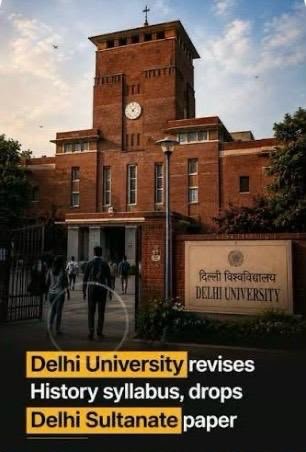
When a premier institution drops a course on state formation, authority, and cultural evolution, it is not curriculum reform—it is historical amnesia by design.
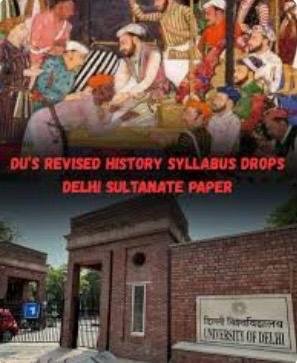
Delhi University’s recently revised postgraduate history syllabus has quietly excised a cornerstone course: The Delhi Sultanate: Structures of Authority in Medieval North India (13th–14th Centuries). Taught for decades in Semester III, the paper examined how the medieval state was formed, how authority was exercised, and how political, religious, and cultural life evolved during a transformative period of Indian history. Its removal is not an isolated administrative decision but part of a broader pattern of curricular sanitisation that privileges myth over method and ideology over inquiry.
The Academic Cost of Erasure
From a pedagogical standpoint, the deletion of the Delhi Sultanate paper represents a severe narrowing of historical understanding. The course was not merely about rulers and battles; it was a rigorous exploration of statecraft, administrative structures, revenue systems, and the interplay between religion and politics. Historian Irfan Habib’s seminal essay, Economic History of the Delhi Sultanate – an Essay in Interpretation, which formed part of the syllabus, offered students a nuanced understanding of the economic foundations of medieval power. Its removal deprives students of a critical lens through which to analyse how pre-colonial states functioned.
As historian Swapna Liddle has noted, the Delhi Sultanate was a period of significant political and cultural synthesis, where Persianate administrative practices merged with local traditions to create new forms of governance. To erase this from the curriculum is to deny students the opportunity to understand the complexity of India’s medieval past—a past that was neither monolithic nor static, but dynamic and contested.
Moreover, the decision disrupts the chronological and thematic continuity of the history programme. Students who previously studied the Delhi Sultanate in one semester and its transition into the Mughal Empire in another now face a fragmented narrative. This is not the first time such gaps have been introduced; in 2018, DU’s BA History syllabus quietly omitted the establishment of Mughal rule, leaving students with no formal engagement with Babur’s invasion or the Sur Empire. The cumulative effect is a syllabus that privileges ancient India while marginalising the medieval and early modern periods—a skewing that undermines the discipline’s integrity.
The Ideological Objective
The stated rationale for the revision—that it seeks to balance ancient, medieval, and modern history—does not withstand scrutiny. If the goal were genuine balance, one would expect a redistribution of content, not the outright deletion of key medieval courses. Instead, the pattern suggests a deliberate effort to downplay the political and cultural contributions of Muslim rulers in Indian history.
This aligns with a broader trend in Indian education, where the Delhi Sultanate and Mughal Empire have been systematically minimised or removed from school textbooks. The National Council of Educational Research and Training (NCERT) has already excised chapters on the Mughals and the Delhi Sultanate from Class 7, pushing them to higher classes or diluting their content. At the university level, the stakes are higher: this is where future historians, teachers, and policymakers are trained. To shape their understanding of the past by omission is to shape the future by design.
Historian Maya John, a member of Delhi University’s Academic Council, has termed such revisions “disturbing”, noting that they reflect a growing tendency to marginalise critical historical scholarship in favour of mythologised narratives. Her concern is echoed by other faculty members who have objected to the removal of works by scholars like Shireen Moosvi and Richard Eaton, whose research on labour, gender, and slavery in medieval India offers indispensable insights into social history.
The Methodological Flaw
History as a discipline thrives on debate, evidence, and multiple perspectives. The Delhi Sultanate course was valuable precisely because it encouraged students to engage with primary sources, archaeological evidence, and competing historiographical traditions. Its removal signals a shift away from critical inquiry toward a more sanitized, state-approved version of the past.
As historian Romila Thapar has long argued, the study of medieval India must confront the complexities of power, patronage, and cultural exchange—not shy away from them. To treat the Delhi Sultanate as a period to be glossed over or erased is to misunderstand the very nature of historical study. It is not the role of a university to protect students from uncomfortable truths but to equip them with the tools to analyse them.
The decision also raises questions about the governance of Delhi University’s syllabus-making process. Reports suggest that several of the omitted papers had already cleared multiple stages of approval before being quietly dropped. This lack of transparency undermines academic autonomy and sets a dangerous precedent for future revisions.
A Precedent of Resistance
This is not the first time Delhi University’s history syllabus has faced controversy. In 2019, the Academic Council referred back revised syllabi from the History department after objections from right-wing faculty groups. The following year, under pressure, the administration removed “controversial” content related to social movements and left-wing politics. Each iteration has seen a further narrowing of the curriculum, with medieval and modern India bearing the brunt of the cuts.
The resistance, too, has been consistent. Faculty members, students, and historians have repeatedly pushed back against attempts to rewrite history for ideological ends. Yet, the cumulative effect of these revisions is a syllabus that is increasingly out of step with global standards of historical scholarship.
The Way Forward
The removal of the Delhi Sultanate paper is not merely an academic loss; it is a political statement. It signals a preference for a version of history that is comfortable, unchallenging, and aligned with a particular ideological vision. But history, at its best, is none of these things. It is messy, contested, and often uncomfortable.
Delhi University must reverse this decision and restore the Delhi Sultanate course to its syllabus. More broadly, it must reaffirm its commitment to academic freedom, critical inquiry, and the pluralistic study of India’s past. To do otherwise is to betray the very purpose of a university.
As the historian E.H. Carr once wrote, “The study of history is a study of causes.” To erase the Delhi Sultanate is to erase a crucial set of causes that shaped the subcontinent’s political, cultural, and economic landscape. It is a loss not just for students of history, but for the nation’s collective understanding of itself.

~Hasnain Naqvi is a former member of the history faculty at St. Xavier’s College, Mumbai….
The opinions expressed here are solely those of the author.