

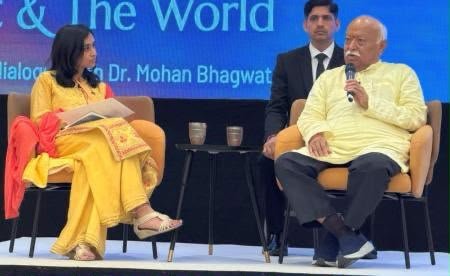
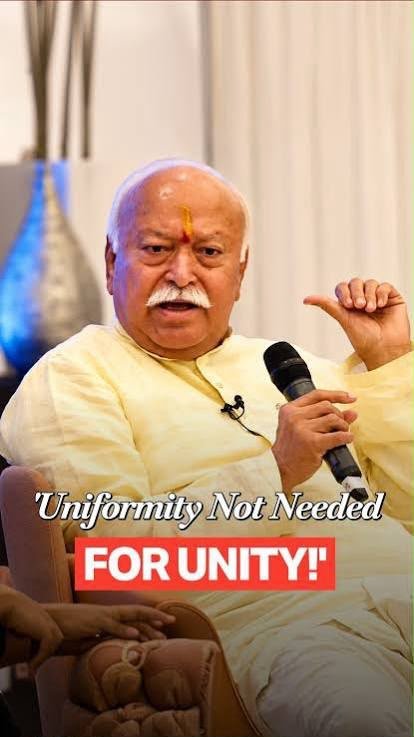
Speaking to the Indian diaspora in London, Rashtriya Swayamsevak Sangh (RSS) chief Mohan Bhagwat recently articulated a vision of “Hindu Rashtra” rooted in the acceptance of diversity, famously declaring that “uniformity is not necessary for unity.”; While such inclusive, philosophical formulations sound profoundly reassuring on an international stage, they stand in stark, irreconcilable contrast to the socio-political reality unfolding on the ground in India.
The fundamental flaw in Bhagwat’s thesis lies not in the philosophical ideal of unity in diversity—a founding principle of the modern Indian republic—but in the appropriation of this ideal to mask a majoritarian political project that systematically demands the very uniformity he claims to reject.
Strategic Rhetoric for a Global Stage
Bhagwat’s attempt to redefine “Hindu” as an all-encompassing “nature” that welcomes atheism, diversity, and varied paths to truth is a classic exercise in strategic semantic expansion. By framing Hindutva as a cultural disposition rather than a religious or political identity, the RSS seeks international legitimacy and a palatable narrative for a globalized diaspora.
However, this sophisticated rhetoric collapses when measured against the contemporary landscape of India. The lived experience of religious minorities, dissidents, and marginalized communities over the past decade reveals an aggressive push toward a monochromatic cultural nationalism. From state-sanctioned food policing and legislative overhauls targeting minority marital choices to the weaponization of citizenship laws, the apparatus of the state has increasingly been used to enforce a specific, idealized homogeneity.
The Fiction of the Inclusive ‘Rashtra’
Furthermore, Bhagwat’s distinction between a “nation-state”—which he claims enforces rules based on superficial similarities like language or religion—and a “rashtra” bound by a “common purpose” is a rhetorical sleight of hand. In practice, the “common purpose” envisioned by the project of a Hindu Rashtra is inherently exclusionary.
This model implicitly anchors national belonging within a civilizational framework where non-Indic faiths are perpetually viewed through a lens of assimilation or conditional tolerance. Real unity in diversity does not require minorities to accept a majoritarian umbrella identity to be deemed patriotic. True pluralism, as enshrined in the Indian Constitution, recognizes equal citizenship inherently, without demanding that diverse identities submerge themselves into a singular cultural nomenclature.
Exporting Tolerance, Importing Majoritarianism
If uniformity is indeed unnecessary for unity, then the domestic actions of the ideological fraternity Bhagwat leads must reflect this belief. Pluralism cannot be an export-only commodity, utilized to appease liberal sensibilities abroad while majoritarian consolidation remains the domestic political currency.
For unity to exist without uniformity, the right to look, pray, eat, and speak differently must be protected by law and social practice in India, not just defended in high-minded lectures in London. Until the rhetoric of diversity matches the reality of state policy and social harmony at home, declarations of inherent tolerance will remain nothing more than a profound contradiction.

~Hasnain Naqvi is a former member of the history faculty at St. Xavier’s College, Mumbai….
The opinions expressed here are solely those of the author.