

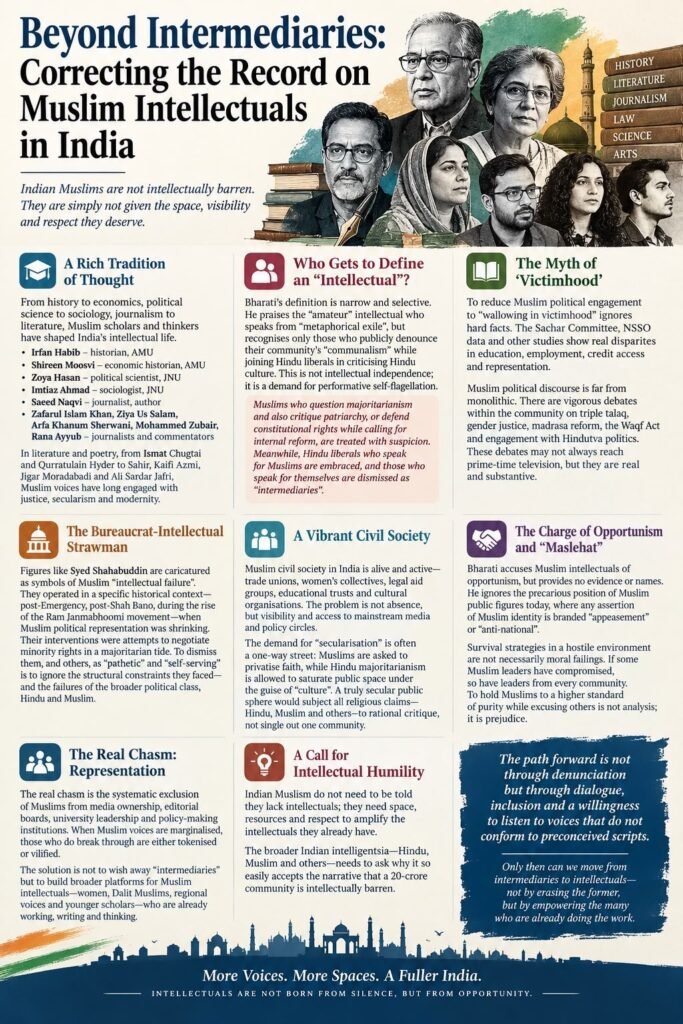
The claim that Indian Muslims lack an intelligentsia is not just sweeping; it is empirically unsustainable. Ibn Khaldun Bharati’s opinion piece in The Print mistakes the absence of a particular kind of loud, self-appointed “thought-leader” for the absence of thought itself. What it actually reveals is a narrow, elitist definition of who counts as an intellectual—and a refusal to see the rich, diverse, and often quiet work of Muslim thinkers, writers, scholars, and public citizens across India.
The fallacy of “no intellectuals”
Bharati claims that a community of 20 crore with a 79.5 per cent literacy rate has “no intelligentsia worth the name”. This ignores an entire ecosystem of Muslim intellectuals whose work spans academia, literature, journalism, law, science, and the arts.
In history, Irfan Habib—Professor Emeritus at Aligarh Muslim University and one of India’s foremost historians of medieval and Mughal India—has shaped generations of scholars through works such as The Agrarian System of Mughal India and Essays in Indian History. Shireen Moosvi, also of AMU, is a distinguished economic historian whose statistical studies of Mughal taxation and trade remain foundational.
In political science and sociology, Zoya Hasan—Professor Emerita at Jawaharlal Nehru University and Distinguished Professor at the Council for Social Development—has published extensively on Indian politics, democracy, minorities, and Muslim women, including Unequal Citizens: A Study of Muslim Women in India and In a Minority: Essays on Muslim Women in India. Imtiaz Ahmad (1940–2023), a pioneering Indian sociologist and former JNU professor, broke new ground in studying caste dynamics within Indian Muslim society and wrote on minority rights, communalism, and Muslim empowerment.
In journalism and commentary, Saeed Naqvi, a veteran journalist and author of The Muslim Vanishes, has analysed identity, democracy, and communal politics for over five decades. Zafarul Islam Khan, Ziya Us Salam (The Hindu), Arfa Khanum Sherwani, Mohammed Zubair (co-founder of Alt News), and Rana Ayyub (Washington Post columnist) are among contemporary Muslim journalists whose reporting and analysis shape national debates on rights, misinformation, and democracy.
In literature and criticism, while Intizar Husain migrated to Pakistan in 1947 and is more properly read as part of Urdu literature in both countries, his early formation was in undivided India, and his work continues to be taught and debated here. Within India, Muslim writers such as Ismat Chughtai and Qurratulain Hyder and poets like Jigar Moradabadi, Ali Sardar Jafri, Asrarul Haq Majaz, Sahir Ludhianvi, Kaifi Azmi, and Shahryar, and critics in Urdu, Hindi, Bengali, Malayalam, and other languages have long engaged with questions of secularism, justice, and modernity—even if they do not always occupy Delhi’s English-speaking drawing rooms.
To say there are “few intellectuals worth their salt” is to erase those who do not perform for prime-time television but whose work sustains public reason in classrooms, courtrooms, newsrooms, and neighbourhoods.
Who gets to define an “intellectual”?
Bharati’s definition of an intellectual draws heavily on Gramsci and Said, yet applies them selectively. He praises the “amateur” intellectual who stands in “metaphorical exile” from orthodoxy, yet seems to recognise only those who publicly denounce their own community’s “communalism” while joining Hindu liberals in criticising Hindu culture. This is not intellectual independence; it is a demand for performative self-flagellation as the price of entry into the “secular” conversation.
By this logic, a Muslim who questions majoritarianism but also critiques patriarchy within Muslim personal law, or who defends constitutional rights while calling for internal reform, is suspect. Meanwhile, Hindu liberals who speak for Muslims are treated as legitimate representatives, while Muslims who speak for themselves—like Zoya Hasan on Muslim women’s rights, or Imtiaz Ahmad on caste among Muslims—are dismissed as “intermediaries”. This reproduces the very dynamic Bharati claims to critique: the subaltern cannot speak, unless they speak in the accent approved by the dominant intelligentsia.
The myth of the “victimhood industry”
Bharati reduces decades of Muslim political engagement to “wallowing in victimhood” and an “ideology of disaffection”. This ignores the material realities documented by the Sachar Committee, NSSO data, and independent studies on education, employment, credit access, and representation in public institutions. To point to structural disadvantage is not to indulge in victimhood; it is to demand accountability in a constitutional democracy.
Moreover, Muslim political discourse is far from monolithic. There are robust debates within the community on triple talaq, gender justice, madrasa reform, the Waqf Act, and engagement with Hindutva politics. Scholars like Zoya Hasan, Nasreen Fazalbhoy, and Imtiaz Ahmad have documented internal pluralism and contestation among Indian Muslims. That these debates do not always make it to prime-time television does not mean they do not exist.
The bureaucrat-intellectual strawman
Bharati singles out former bureaucrats like Syed Shahabuddin as emblematic of Muslim “intellectual” failure, accusing them of reviving “Muslim League” discourse and institutionalising victimhood. This is a caricature. Shahabuddin and others operated in a specific historical context—post-Emergency, post-Shah Bano, during the rise of the Ram Janmabhoomi movement—when Muslim political representation was already shrinking. Their interventions, however controversial, were attempts to negotiate minority rights in a majoritarian tide.
To dismiss all such figures as “pathetic” and “self-serving” is to ignore the structural constraints within which they operated. It also lets off the hook the broader political class—Hindu and Muslim—that has consistently failed to build inclusive civic institutions.
Civil society and secularisation: A one-sided critique
Bharati argues that Muslims lack a civil society because they have not undergone “secularisation”, citing Ambedkar and Habermas. This is a profound misreading. Muslim civil society in India is vibrant: it includes trade unions, women’s collectives, legal aid groups, educational trusts, and cultural organisations. The problem is not absence, but visibility and access to mainstream media and policy circles.
Further, the demand for “secularisation” often functions as a one-way street: Muslims are asked to privatise faith, while Hindu majoritarianism is allowed to saturate public space under the guise of “culture”. A truly secular public sphere would subject all religious claims—Hindu, Muslim, and others—to rational critique, not single out one community for special scrutiny.
The charge of opportunism and “Maslehat”
Bharati accuses Muslim intellectuals of opportunism, of praising Hindutva in Delhi and condemning it in Aligarh, and of using “Maslehat” (public welfare) as a cover for deceit. This is a serious charge, but it is levelled without evidence or names. It also ignores the precarious position of Muslim public figures in today’s climate, where any assertion of Muslim identity is branded “appeasement” or “anti-national”.
Survival strategies in a hostile environment are not necessarily moral failings. If some Muslim leaders have compromised, so have leaders from every community. To hold Muslims to a higher standard of purity while excusing others is not analysis; it is prejudice.
The real chasm: Representation, not intermediaries
Bharati concludes that self-appointed intermediaries are the “real chasm” between Muslims and the nation. The real chasm is the systematic exclusion of Muslims from media ownership, editorial boards, university leadership, and policy-making institutions. When Muslim voices are marginalised, those who do break through are either tokenised or vilified.
The solution is not to wish away “intermediaries” but to build broader platforms for Muslim intellectuals—women, Dalit Muslims, regional voices, and younger scholars—who are already working, writing, and thinking. It is to recognise that intellectual life does not always wear the garb of polemic; sometimes it is the quiet work of teaching, researching, and organising.
A call for intellectual humility
Bharati’s piece is a mirror, but it reflects only one angle. Indian Muslims do not need to be told they lack intellectuals; they need space, resources, and respect to amplify the intellectuals they already have. And the broader Indian intelligentsia—Hindu, Muslim, and others—needs to ask why it so easily accepts the narrative that a 20-crore community is intellectually barren.
The path forward is not through denunciation but through dialogue, inclusion, and a willingness to listen to voices that do not conform to preconceived scripts. Only then can we move from intermediaries to intellectuals—not by erasing the former, but by empowering the many who are already doing the work.

