
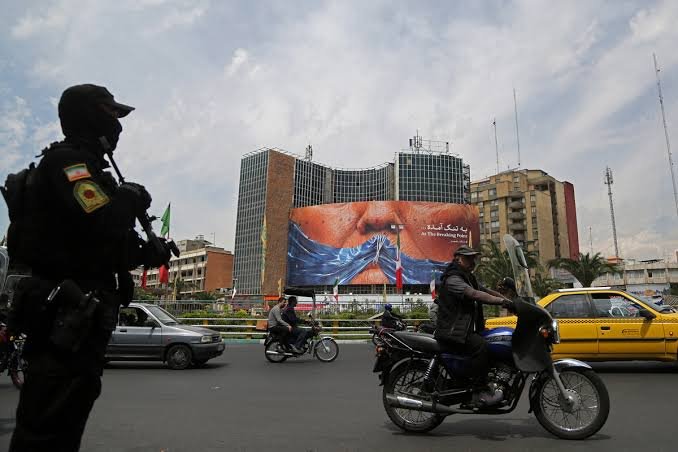
The window for peace in the Gulf opened briefly, but has shut abruptly, triggering prospects of unending violence and destruction. United States President Donald Trump rejected Iran’s 7-Day plan for cessation of hostilities and reopening of the Hormuz Strait.
He must have weighed what would help more: quitting a war unpopular at home and being accused of losing, or continuing with war-like speeches while campaigning for the mid-term polls due in November.
Diplomacy has stalled. Is the world closer to a full-scale war? And what will this “full-scale” look like?
How one wishes Trump had heeded his peer, Benjamin Franklin: “There was never a good war or a bad peace.”
Meanwhile, some thoughts on…..
TWO AMERICAN ANNIVERSARIES
The USA recently celebrated 250 years of Independence. India, with its wide-ranging relations and 5.4 million Indians living there, took note.
But India, and many other nations, also noted the event with some anxiety. Long regarded as the most powerful and a vibrant democracy that welcomed outsiders looking for opportunity, the Trump-led US has become both isolationist and interventionist.
Funding for several knowledge, health and welfare plans on which millions depended has been cut. Those deprived wonder whether these cuts have, as Trump’s slogan goes, “Made America Great Again”.
Along with aid, the US has also weaponised economic relations as never before. Arbitrarily imposed tariffs are hurting allies and adversaries alike.
How does India take it, being ‘punished’ for buying Russian oil and other ‘offences’, real or imagined? This is not the only wrinkle in overall bilateral relations where ‘friendly’ smiles have vanished.
Without passing judgment, let those who deal with it speak.
Prof. Stephen J. Farnsworth, Professor Emeritus at Mary Washington University, addressed an event in New Delhi marking the 250th anniversary of charting America’s worldview. With students and teachers listening, former Indian Foreign Secretary, Shyam Saran observed: “The last year has shown that the US can be an unreliable and coercive partner.”
Arun K. Singh, who dealt with the US for 30 years, including as India’s ambassador, said the relationship was seeing “one of the most difficult times.”
Shared democratic values have governed the ties. But America prescribes the “rule of law” more to others than to itself. The two Indians emphasised that whatever the US says or does impacts the whole world. Many countries have emulated the Homeland Security law to guard the US’s security after the 9/11 mayhem. With this, “the gap between American democracy and, say, China, has narrowed.”
Many other issues, like making study and work visas both difficult and the othering of migrants, dog the relationship. Even the lawmakers among the migrants are subjected to racist slurs.
However, the most worrying part is America’s many military interventions abroad. Twenty-five years since the 9/11 mayhem, the other anniversary observed this month, have created a timeline.
Trump is not the only one; nor is it likely to be the last. But his 19 months in office alone have seen physical intervention in Venezuela, threatened Cuba, secured Greenland under a pact and a desire to make Canada the US’s 51st state.
A military campaign in Iran, with or without Israel, is getting nowhere. These conflicts can be seen as a counter to Russia’s invasion of Ukraine, or to Israel’s in Gaza. The larger picture is not encouraging.
The 9/11 attack that killed nearly 3,000 people was launched from Taliban-ruled Afghanistan, hosting Osama bin Laden, America’s hero-turned-terrorist. On October 7, 2001, the US launched “Operation Enduring Freedom”.
Begun as the “global war on terror,” the longest conflict in US history spanned nearly 20 years across four US presidents. In the end, the US “replaced the Taliban with the Taliban”.
For a generation, these US-led wars have reshaped Washington’s foreign policy. Each year, “the US forces have bombed a country somewhere in the world, devastating the lives of millions,” says a study by Al Jazeera, the Qatar-based global news portal.
The Cost of War project at Brown University’s Watson Institute for International and Public Affairs estimates that “US-led wars since 2001 have directly or indirectly killed an estimated 4.5 to 4.7 million people – including approximately 940,000 direct deaths and 3.6 to 3.8 million indirect deaths from disease, malnutrition and health complications. An estimated 176,000 people died as a direct result of the war.”
Months later, on March 19, 2003, the US invaded Iraq, causing 315,000 deaths. It needs to be recalled that India, which had actively supported the US/NATO campaign in Afghanistan, having experienced Pakistan-based terror groups, tried hard to dissuade the US. Then External Affairs Minister Yashwant Sinha had vigorously engaged in this diplomatic effort.
No nuclear weapons were found in Iraq, which was, and remains, devastated. According to the Defense Casualty Analysis System, 3,481 US military personnel died in the Iraq War, and more than 31,000 were wounded.
Alongside the ground wars, the US conducted largely undeclared air and drone campaigns in Pakistan, Yemen, Somalia, Afghanistan and against Islamic State (ISIL) in Iraq and Syria. Since 2004, the London-based Bureau of Investigative Journalism has recorded 423 US strikes in Pakistan, killing an estimated 2,499–4,001 people, including 424–966 civilians.
In 2011, during a crackdown on protests in Libya under Muammar Gaddafi, the US and NATO led an air campaign under a UN mandate to protect civilians. Over seven months, there were nearly 9,700 strikes launched on the country before Gaddafi was captured and killed by rebel fighters, according to Amnesty International.
In 2014, the US-led campaign against ISIL in Iraq and Syria included a strong air and ground campaign using tens of thousands of bombs.
The Costs of War estimates that more than 38 million people across Afghanistan, Iraq, Pakistan, Yemen, Somalia, the Philippines, Libya and Syria have been displaced by the post-9/11 wars, either abroad or within their own countries. Over two decades on, thousands are still being forced from their homes.
As much as the countries were attacked, the impact on US/NATO soldiers has been devastating. Over 800,000 US troops served in Afghanistan, where approximately 2,500 were killed and 20,000 wounded. Across the US, UK, and allied nations’ forces, 3,500 coalition personnel were killed and more than 23,500 injured.
There are long-term psychological costs. Many veterans continue to face a mental-health crisis. “Four times as many US service members and veterans died by suicide as were killed in combat during the post-9/11 wars.” Stephanie Savell, the project’s director, says.
The US does not admit these losses. Nor does it admit a defeat in Afghanistan. US Defence Secretary Pete Hegseth this month said that these soldiers “fought for America.”
The Washington Post reported last week: “Al Qaeda and terrorist training camps are back in Afghanistan.”
Like in the Gulf, America’s “forever war” seems destined to continue.

Mahendra Ved is a veteran Journalist and an Expert on international affairs.