

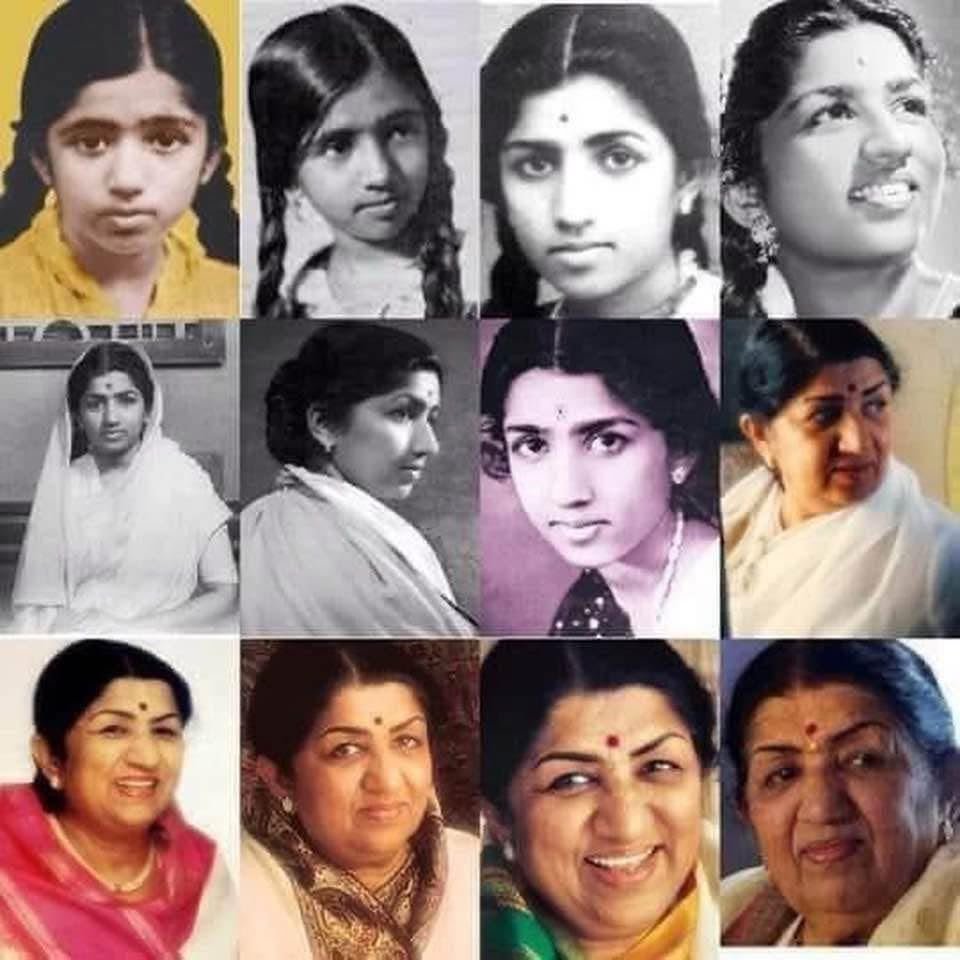
On her birth anniversary, we honour the unmatched artist whose voice became the acoustic fabric of a modern nation and defined the emotional landscape of Indian cinema for over seven decades.
September 28 marks the birth anniversary of a voice that did not merely sing songs, but articulated the soul of an evolving India. For more than seven decades, Lata Mangeshkar was far more than a preeminent playback singer; she was a living institution. From the delicate yearnings of romantic cinema to the solemn patriotic fervour of a post-independence republic, her pitch-perfect soprano captured every shade of the human experience. To speak of Indian cinema without Lata Mangeshkar is to imagine a loom operating without its golden thread. On this day, as music lovers across the globe pause to reflect on her monumental journey, we remember an artist whose vocal purity, relentless work ethic, and quiet strength built a musical legacy that remains entirely unparalleled.
From Indore to Bombay: The Forging of a Musical Titan
Born in Indore on September 28, 1929, as Hema Mangeshkar, she was the eldest child of Pandit Deenanath Mangeshkar, a classical vocalist and theatre personality, and his wife Shevanti (later renamed Shudhamati). Later renamed Lata after a character in one of her father’s stage plays (BhaawBandhan), her early childhood was steeped in the rich traditions of Hindustani classical music and Marathi Sangeet Natak. She received her first formal lessons from her father and stepped onto the theatrical stage at the age of five.
Tragedy reshaped her world in 1942 when Pandit Deenanath died of heart disease. At just thirteen, Lata assumed the mantle of primary breadwinner for her mother and four younger siblings—Meena, Asha, Usha, and Hridaynath—all of whom would eventually flourish into accomplished musicians in their own right.
Her early years in the film industry were marked by struggle and initial skepticism. Family friend and filmmaker Master Vinayak provided crucial early refuge, securing her small acting roles and Marathi singing assignments. Following Vinayak’s death in 1948, composer Ghulam Haider recognized her extraordinary latent talent and became her staunch mentor. When producer Sashadhar Mukherjee famously dismissed her voice as “too thin” for his film Shaheed, an incensed Haider prophetically warned that filmmakers would soon fall at her feet. Haider gave her a breakthrough with “Dil Mera Toda” in Majboor (1948)—a pivotal moment that led Lata to forever acknowledge him as her true musical godfather.
Crafting Perfection in the Golden Era
By the time Mahal (1949) was released, featuring the haunting masterpiece “Aayega Aanewaala” lip-synced on screen by Madhubala, Lata Mangeshkar’s identity had decisively broken free from the shadows of early influences like Noor Jehan. What followed was a golden epoch in Indian music. Her rapid rise was not built on talent alone, but on an uncompromising commitment to self-improvement. When actor Dilip Kumar once made a casual remark about her Maharashtrian accent in Hindi and Urdu songs, Lata did not take offense; instead, she immediately hired an Urdu tutor, Shafi, to master the nuances and diction of the language.
This meticulous artistic discipline allowed her to collaborate seamlessly with the iconic composers of the twentieth century. From Madan Mohan’s delicate ghazals (“Lag Jaa Gale”, “Aap Ki Nazron Ne Samjha”) and Naushad’s epic orchestrations in Mughal-e-Azam (“Pyar Kiya To Darna Kya”) to the vibrant melodies of S.D. Burman, R.D. Burman, and Laxmikant–Pyarelal—with whom she recorded more than 700 songs over three decades—Lata became the definitive screen voice for generations of leading ladies.
Her artistry expanded into the national consciousness on January 27, 1963, against the grim backdrop of the Sino-Indian War. Performing Kavi Pradeep’s “Aye Mere Watan Ke Logo”, composed by C. Ramchandra, in the presence of Prime Minister Jawaharlal Nehru, her poignant delivery famously brought the Prime Minister to tears, cementing the track as India’s definitive anthem of national remembrance.
Conviction, Resilience, and Unyielding Principles
Behind her soft-spoken, white-saree-clad persona lay a woman of extraordinary iron will. In early 1962, Lata survived a mysterious, life-threatening attempt on her life through slow poisoning, which left her bedridden for nearly three months. During this terrifying ordeal, lyricist Majrooh Sultanpuri demonstrated singular loyalty, visiting her daily at 6 PM to taste her food before she ate and keeping her spirits lifted with poetry until her complete recovery.
Lata was equally uncompromising when it came to professional dignity and standardizing the rights of musicians. She stood firm in demanding that playback singers receive a share of song royalties from producers. When fellow giant Mohammad Rafi held a contrasting view—believing a singer’s financial claim ended once the recording fee was paid—she accepted a temporary professional rift rather than compromise on principle, refusing to record duets with him for several years until S.D. Burman brokered a reconciliation. Furthermore, recognizing her immense dominance over the industry, she made the selfless gesture in 1969 of relinquishing her eligibility for the Filmfare Best Female Playback Award to give younger, rising singers an opportunity to win.
An Immortal Monument Across Generations
Lata Mangeshkar’s creative footprint extended far beyond the Hindi screen. She recorded prolifically in over 36 regional and foreign languages—including Marathi (where she also composed beloved classics under the pseudonym Anandghan), Bengali, Assamese, Gujarati, and Kannada. While debates surrounded early statistics in the Guinness Book of Records regarding her total discography, precise tallying pales in comparison to the qualitative scale of her impact. No record book could adequately measure the emotional depth she brought to the microphone.
Her genius drew reverence from the highest echelons of art. Classical maestro Ustad Bade Ghulam Ali Khan famously remarked, “Kambakht, kabhi besuri na hoti” (“The fortunate one is never off-key”), while Dilip Kumar described her voice as a “miracle of nature.”
The nation showered her with its highest honour: the Dadasaheb Phalke Award in 1989, the Padma Vibhushan in 1999, and the Bharat Ratna in 2001—making her only the second vocalist after M.S. Subbulakshmi to receive India’s highest civilian honour. Internationally, France conferred upon her the Officer of the Legion of Honour in 2007.
When Lata Mangeshkar passed away on February 6, 2022, at the age of 92, an epoch drew to a formal close. Yet, on her birth anniversary, her presence remains as immediate and vital as ever. In every corner of the country, whenever a radio plays “Ajeeb Dastaan Hai Yeh” or “Kahin Deep Jale Kahin Dil”, time stands still. She remains India’s eternal Nightingale—a timeless guardian of the nation’s soul.

~Hasnain Naqvi is a former member of the history faculty at St. Xavier’s College, Mumbai….
The opinions expressed here are solely those of the author.