

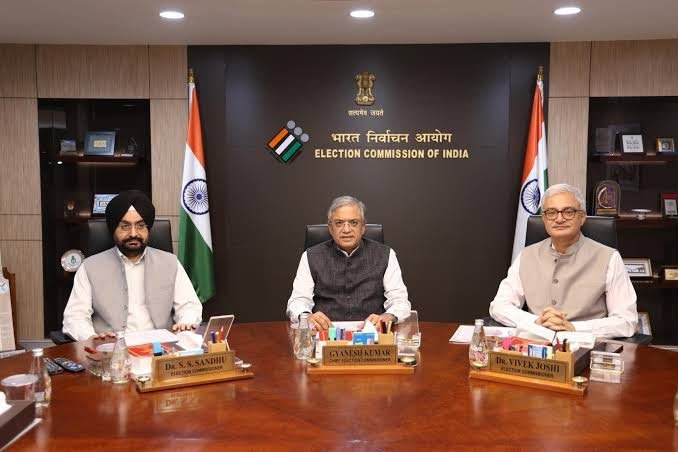
The Election Commission’s September 26 press note attempts to project full-bench unity and administrative benevolence. Yet, when placed alongside internal dissents and investigative revelations, its procedural rollbacks function as a tacit indictment of its own recent governance.
The Mirage of Unity at Nirvachan Sadan
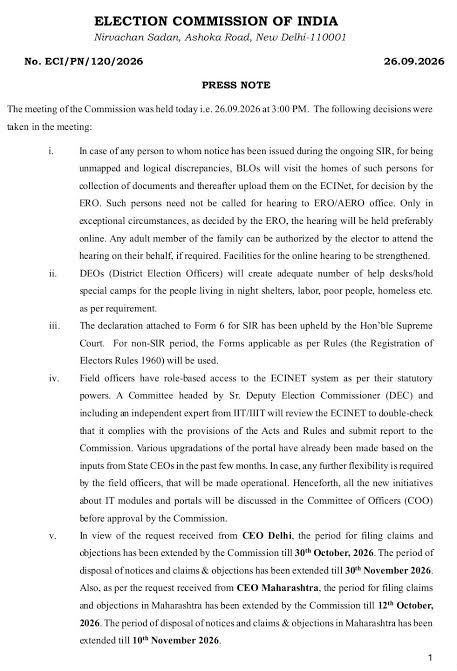
When the full bench of the Election Commission of India (ECI)—comprising Chief Election Commissioner Gyanesh Kumar and Election Commissioners Dr. Sukhbir Singh Sandhu and Dr. Vivek Joshi—convened at Nirvachan Sadan on September 26, 2026, the official objective was to project an image of seamless institutional cohesion. The outcome was a multi-point Press Note announcing major administrative updates, procedural relaxations for the ongoing Special Intensive Revision (SIR) of electoral rolls, digital portal reviews, and internal administrative resets.
However, this public show of unity cannot be read in a vacuum. Just three days prior, on September 23, an investigative report by The Indian Express sent shockwaves through India’s constitutional landscape. The report exposed a deep internal rift within the election management body, revealing that Commissioners Sandhu and Joshi had recorded written objections on at least 14 separate occasions over a ten-month period. Their dissents targeted arbitrary decision-making by the CEC, unilateral modifications to voter registration forms, unvetted software rollouts, and the systematic bypass of multimember Commission procedures.
Posed against this backdrop of escalating public outrage, political protests, and demands for judicial scrutiny, the September 26 Press Note demands critical decoding. Is this sudden flurry of reforms an exercise in strategic damage control, or does it represent an undeniable, albeit indirect, admission of guilt?
A closer examination of the ECI’s announcements reveals that it is irrevocably both.
Concessions as Confessions: Dissecting the SIR Rollbacks
The centerpiece of the ECI’s press note is a series of “relief measures” designed to mitigate public hardship during the ongoing Special Intensive Revision. Most notably, the Commission announced that the additional declaration attached to Form 6—which required new voter applicants to provide genealogical history regarding whether their parents or grandparents appeared in previous intensive revisions—would henceforth be restricted strictly to the active SIR window. Outside SIR, standard voter registration formats under the Registration of Electors Rules, 1960, would apply.
Furthermore, the ECI dismantled the onerous requirement forcing “unmapped” electors or those flagged for “logical discrepancies” to appear in person before Electoral Registration Officers (EROs). Instead, Booth Level Officers (BLOs) will conduct house-to-house visits to collect documents, and hearings will be conducted online only under exceptional circumstances. To round off these concessions, claims and objections deadlines were extended to October 12 in Maharashtra and October 30 in Delhi, alongside special enrollment camps for vulnerable and homeless populations.
While presented as citizen-centric flexibility, these measures serve as a silent retreat from draconian policies. By eliminating mandatory physical hearings and curtailing the scope of the Form 6 declaration, the Commission effectively acknowledged that its administrative framework was creating severe voter distress, administrative bottlenecks, and widespread risk of disenfranchisement. Every relief measure granted on September 26 directly addresses the very defects flagged by the two dissenting Commissioners over the preceding ten months.
The Tech Conundrum: Auditing an Unvetted Architecture
Equally telling is the Commission’s decision to constitute an independent expert committee—headed by a Senior Deputy Election Commissioner and featuring a technical specialist from an IIT/IIIT—to examine the ECINet portal. ECINet serves as the ECI’s centralized digital backbone, integrating the BLO App, ERONET, and 41 other operational modules.
The Indian Express investigation disclosed that ECINet had been rolled out without mandatory vulnerability testing, security certification, or explicit full-bench sanction, raising severe concerns about data integrity and statutory compliance. Instituting an expert audit after integrating millions of sensitive voter records onto an uncertified platform is not proactive digital governance; it is a reactive attempt to cover procedural flanks. By summoning external academic expertise post-facto, the ECI has implicitly conceded that its digital flagship was launched on fragile technological and legal foundations.
Institutional Governance: Codifying the Baseline
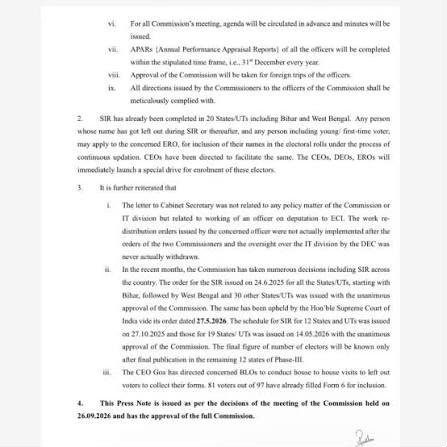
Perhaps the most damning aspect of the September 26 press note lies in its internal administrative “resolutions.” The full bench solemnly resolved that:
- Agendas for Commission meetings will be circulated in advance.
- Formal minutes of all meetings will be recorded and issued.
- Pending Annual Performance Appraisal Reports (APARs) of officers will be cleared by December 31, 2026.
- Foreign travel by ECI officials will require explicit Commission approval.
That a constitutional body feels compelled to issue a public press release promising to circulate meeting agendas, record minutes, evaluate staff, and regulate foreign travel is extraordinary. These are not grand institutional innovations; they are the absolute baseline requirements of statutory governance.
By committing to restore these basic norms, the ECI tacitly verified the investigative finding that Nirvachan Sadan had been functioning unilaterally. Agendas were indeed withheld, minutes were indeed unrecorded, staff appraisals were held hostage, and officers traveled abroad without full-bench sanction. The press note’s brief clarification—stating that recent letters to the Cabinet Secretary involved an officer on deputation rather than core policy divisions—appears as a defensive effort to contain the fallout from deeper administrative lapses.
Legal Friction and the Limits of Spin
To deflect charges of statutory overreach, the ECI press note repeatedly cited a Supreme Court order dated May 27, 2026, claiming the apex court had approved SIR procedures and online Form 6 modifications.
However, this legal defence crumbles under scrutiny. The modified Form 6 declaration was introduced in July 2026—six weeks after the Supreme Court’s May order. Furthermore, the May order pertained specifically to the pilot SIR conducted in Bihar in 2025, whereas petitions challenging the broader rollout in states like West Bengal remain pending. Under the Representation of the People Act, 1950, and the Registration of Electors Rules, 1960, statutory forms cannot be altered by executive decree without statutory amendments. Re-interpreting a judicial order to cover subsequent administrative changes reveals an institution struggling to retrofit legal legitimacy onto unilateral decisions.
Damage Control as Self-Indictment?
The Election Commission’s September 26 press note is a classic exercise in political and administrative damage control. Faced with internal mutiny and public exposure, the leadership sought to calm political waters by offering operational concessions and promising structural audits.
Yet, in its eagerness to repair its damaged image, the Commission created a document of self-indictment. Every policy rollback confirms that the original SIR implementation was flawed; every technical committee confirms that ECINet was prematurely deployed; and every pledge to record meeting minutes confirms that internal democratic norms were violated.
For an institution tasked with safeguarding the world’s largest democracy, credibility cannot be restored through evasive press notes. True restoration of public trust requires complete transparency, strict adherence to statutory boundaries, and an uncompromised commitment to internal collegiality. Until then, the ECI’s latest press note will stand not as a display of strength, but as a formal record of its own institutional retreat.

~Hasnain Naqvi is a former member of the history faculty at St. Xavier’s College, Mumbai….
The opinions expressed here are solely those of the author.