

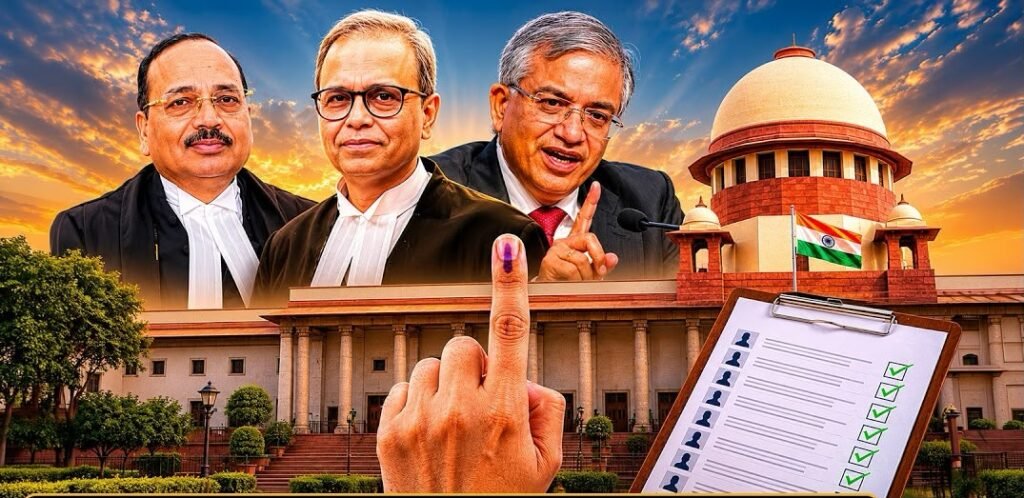
The Indian Express investigation of 23 September 2026 has laid bare deep fissures within the Election Commission of India. Two Election Commissioners formally recorded objections on at least 14 occasions over ten months to decisions taken under the Special Intensive Revision of electoral rolls. These concerns covered unilateral software modifications, alterations to Form 6 for new voter registration, centralisation of the ECINet database, and the management of mass deletions. The report has intensified long-standing questions about institutional integrity, collective decision-making under Article 324, and the scale of voter exclusions that have already affected tens of millions across multiple states.
Against this backdrop, two developments on 28 September placed the matter squarely before the Supreme Court. Petitions filed by advocates, including Rakesh Kumar Singh and Shailendra Mani Tripathi, challenge the alleged unilateral actions of Chief Election Commissioner Gyanesh Kumar. They seek interim suspension or inquiries, a declaration that Commission decisions require collective or majority concurrence, and a court-monitored forensic audit of the ERONet and ECINet systems. Simultaneously, more than 2,000 citizens—including former civil servants, military veterans, academics and lawyers—addressed an open letter to Chief Justice of India Surya Kant. The letter demands an immediate halt to the SIR nationwide, an independent probe into unauthorised software and form changes, penal action where warranted, a full legal and security audit of the central platform, and restoration of voters deleted through technical or procedural errors.
These interventions arrive after the Court has already engaged extensively with the SIR process. In May 2026, a bench led by the Chief Justice upheld the legality of the Bihar exercise, affirming the Commission’s powers under Article 324 and Section 21(3) of the Representation of the People Act while emphasising procedural safeguards and proportionality. Yet subsequent developments—particularly the volume of deletions in West Bengal, the high rate of successful appeals restoring names, and the mechanical issuance of notices in Delhi—have kept the issue alive. On 28 September, a CJI-led bench declined an urgent hearing for more than 18,000 pending appeals from West Bengal voters seeking inclusion before the 6 October bypolls in Nandigram and Rejinagar, observing that these were “only by-elections” and listing the matter for 5 October. Separately, a challenge to the 2023 law governing appointments of Election Commissioners was referred by a split two-judge bench to the Chief Justice for consideration by a larger Constitution Bench.
The cumulative effect is a perception of institutional caution bordering on intransigence. The Court has neither stayed the ongoing phases of the SIR nor ordered the kind of comprehensive, independent scrutiny that the Express findings and the citizens’ letter now demand. The question is whether it will continue on this trajectory or seize the opportunity for course correction.
The Constitutional Imperative and Article 142
Article 142 of the Constitution empowers the Supreme Court to pass any decree or order necessary for doing “complete justice” in any cause or matter pending before it. This is not an unbounded licence for judicial legislation, but a residual and extraordinary power designed for situations where ordinary remedies prove inadequate or where institutional failure threatens constitutional values. The Court has previously invoked it in electoral contexts—most relevantly in the West Bengal SIR litigation, where it directed the preparation of supplementary rolls for successful appellants before polling cut-off dates so that eligible voters would not be shut out of the franchise.
The present circumstances meet the threshold for careful exercise of that power. The right to vote, while not a fundamental right in the strict sense, is a constitutional entitlement that underpins the democratic process. When internal documents reveal that two of three co-equal Commissioners recorded formal objections to decisions executed in the Commission’s name, the multi-member character of the institution under Article 324 is placed in doubt. When software changes and form modifications appear to have been introduced without the statutory amendments required by the Registration of Electors Rules, procedural legality itself is implicated. And when the scale of deletions—estimated in the crores nationally—coincides with high rates of subsequent restoration on appeal, the presumption of administrative regularity weakens.
A Court-monitored independent inquiry or forensic audit of the centralised databases would not amount to substituting the Commission’s judgment. It would be an exercise in ensuring that the constitutional machinery functions as designed: collegially, transparently, and within the bounds of law. Directions restoring local Electoral Registration Officers’ operational autonomy, or requiring immediate processing of pending appeals with interim inclusion where justified, fall well within the Court’s established repertoire under Article 142. The same provision could support interim arrangements that prevent further irreversible disenfranchisement while the larger questions of appointment processes and decision-making protocols are examined by a Constitution Bench.
What Complete Justice Requires
Complete justice in this context does not require the Court to micro-manage every aspect of electoral administration. It does require the Court to recognise that public confidence in the electoral roll is foundational. When two Commissioners feel compelled to place written dissent on record repeatedly, and when thousands of citizens of standing petition the Court for intervention, the institution cannot treat the matter as routine administrative disagreement. The Commission’s assertion that all major SIR decisions were unanimous and that internal differences are normal does not dispose of the documentary record of objections. Nor does the prior upholding of the Bihar exercise immunise subsequent phases from scrutiny when new evidence of process irregularities emerges.
The Court has tools short of a full stay. It can order the publication of all internal notes and objections related to the contested decisions. It can direct that no further software or form changes occur without formal Commission resolution and, where necessary, statutory amendment. It can accelerate the disposal of appeals with clear timelines and interim voting rights where the balance of convenience so requires. It can constitute an independent technical committee to audit ECINet for integrity, access controls and audit trails. These measures would demonstrate that the Court remains the final guardian of electoral fairness without usurping the Commission’s primary role.
The alternative—continued deference in the face of accumulating evidence of internal rupture—risks reinforcing the perception that the judiciary is reluctant to confront institutional capture or procedural overreach within another constitutional body. That perception, once entrenched, is difficult to reverse. India’s democracy has weathered many storms because its apex court has, at critical junctures, chosen principle over institutional convenience. The petitions and the citizens’ letter of 28 September present precisely such a juncture.
Whether the Supreme Court will rise to the occasion will be measured not by the eloquence of its eventual judgment, but by the promptness and effectiveness with which it restores public confidence that the electoral roll remains a neutral register of citizens rather than an instrument susceptible to unilateral control. Article 142 exists for moments when ordinary processes threaten to fail the Constitution’s deeper purpose. This is one such moment.
Post Script
The Supreme Court on Tuesday (September 29) agreed to hear a plea seeking the suspension ofChief Election Commissioner (CEC) Gyanesh Kumar after a media report alleged that took decisions without considering suggestions of other two election commissioners on the ongoing special intensive revision (SIR) of electoral roles.

~Hasnain Naqvi is a former member of the history faculty at St. Xavier’s College, Mumbai….
The opinions expressed here are solely those of the author.

