

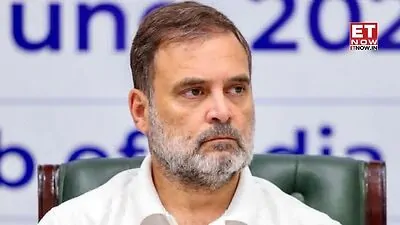
New Delhi, 29 September— In a determined attempt to touch hearts of country’s female population, Leader of the Opposition in the Lok Sabha today said that the solution to c rimes against women is not to restrict their freedom or keep them indoors but to make our roads safe and secure.
His words assume significance as the Supreme Court has taken suo motu cognisance of recent rape and sexual assault cases in Delhi-NCR and has decided to take them up.
“Stop punishing women for the crimes committed against them,” Rahul Gandhi said in a post on X, urging young people, particularly women from Gen Z, to join protests demanding greater safety.
“The solution is not to lock women inside. It is to make our streets safe, to confront the mindset of men who mistreat women, and to punish those who attack them, swiftly and without exception,” he said.
Pursuing a well thought and well researched issue of female empowerment, Rahul Gandhi has raised the Delhi rape cases issue touching an emotional chord with the country’s women particularly the Gen Z.
Rahul Gandhi’s remarks came a day after the Supreme Court took suo motu cognisance of recent cases, including the alleged gang rape of a 17-year-old girl at Aastha Kunj Park near Delhi’s Lady Shri Ram College and the alleged gang rape of a 16-year-old girl on a moving sleeper bus.
The court said public spaces such as parks and buses could not be allowed to become “zones of high risk” because of inadequate lighting, poor surveillance and other administrative shortcomings.
A bench of Justices J.B. Pardiwala and K. Vinod Chandran said the recent incidents pointed to a “systematic failure” by law-enforcement and public administrative authorities to ensure basic public safety. The court also drew “painful parallels” with the 2012 Nirbhaya case.
In a video accompanying his post, Rahul Gandhi said women were not responsible for crimes committed against them and that perpetrators should be punished.
“A woman has nothing to do with an attack on her. A woman has nothing to do with rape. The perpetrator is the criminal. Please, punish the criminal, leave women alone,” he said.
Referring to the recent cases, Rahul Gandhi said women were afraid to walk the streets and questioned why their movements were restricted after such crimes.
“Get this out of your mind that women are to be punished, penalised when someone is attacking them or raping,” he said.
He called for changes in the attitudes of those who commit such crimes and said people protesting against them should be supported.
“Start punishing the people who are doing the crime. Start changing the mentality of the people who do the crime. Start changing the mentality of the men who mistreat women,” Rahul Gandhi said.
He also urged more young women to join the protests.
“Thousands of students and young people are on the streets demanding safety for women. I urge even more young women, especially Gen Z across India, to come out in stronger numbers,” he said in his post. Rahul Gandhi added that peaceful protest was a democratic right and said he stood with those protesting.
The Supreme Court’s intervention came against the backdrop of student protests in Delhi over the recent cases. Reuters reported that hundreds of students, most of them women, took to the streets demanding better safety and the freedom to move without fear.
The court’s reference to Nirbhaya also brought the political context of the 2012 case back into focus. The gang rape occurred when the Congress-led United Progressive Alliance was in power at the Centre and Sheila Dikshit’s Congress government was in office in Delhi. Dikshit had maintained that policing and law and order in the capital were under the Union government.
The case was subsequently assigned to a fast-track court. The UPA government also constituted the Justice J.S. Verma committee to recommend changes to laws dealing with sexual violence and set up a commission headed by former Delhi High Court judge Usha Mehra to examine the incident and identify lapses.
The Supreme Court has now sought scrutiny of the present safety mechanisms in Delhi-NCR, including the conditions in public spaces where such crimes have occurred.
Veteran Journalist and Political Commentator