

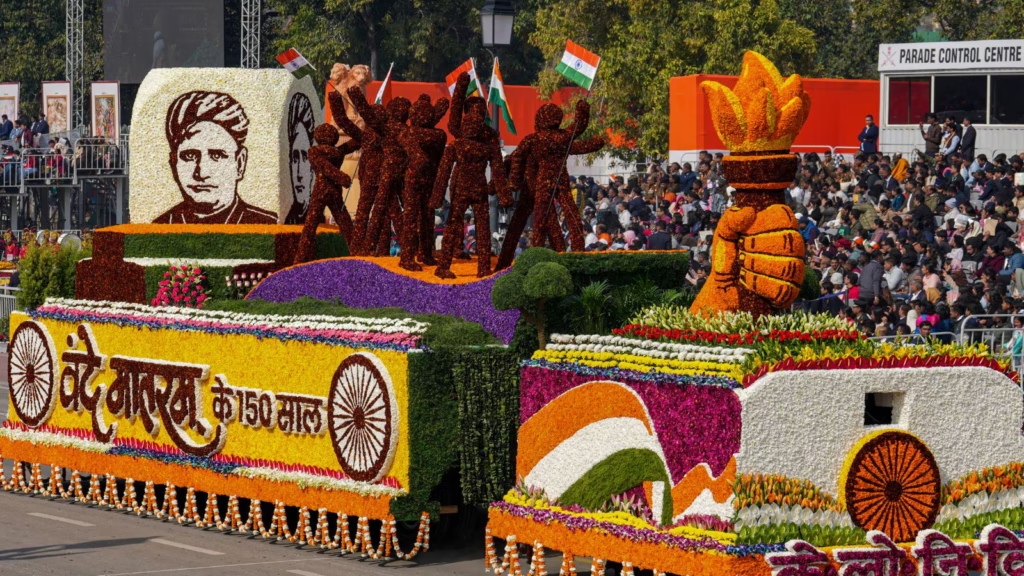
In 2026, the Indian Parliament passed a strange ‘Prevention of Insults to National Honour’ (Amendment) Bill. This amendment brought the two-stanza national song ‘Vande Mataram’ under the same legal protections reserved only for the National Anthem and the National Flag. That very measure by the outnumbering ruling party members in the Parliament, triggered a fierce constitutional debate for the illogical decision of expanding the song to a six-stanza version that are overtly nonsecular in text and tone. Following the Ministry of Home Affairs orders, the government mandated the lengthy original six-stanza version of ‘Vande Mataram’ is now required at all official functions and school assemblies, carrying penal consequences of up to a three-year imprisonment for intentionally preventing or disturbing its rendition.
To mindless supporters, this is a long-overdue celebration of national heritage. But to critics, legal scholars, and civil rights advocates, it represents a dangerous crossing of a highly critical threshold. Opponents argue this mandate is a forced participation in a song with explicitly religious, Hindu deity-invoking stanzas. They warn that the Modi administration’s ideological drift toward a ‘Hindu state’ risks a patriotic disaster, one that could disintegrate the social fabric of a great nation by alienating its massive minority populations, particularly the Muslim community.
The Shift from Inclusion to Compelled Religion
The controversy comes down to the song’s lyrics. The first two stanzas just describe the beauty of the land, which is why they were very thoughtfully chosen in 1937 by the freedom fighter Congress leaders. The words in the first two stanzas are perfectly secular, which people of all religions can respectfully sing them. But the last four stanzas change the tone by turning the nation into a Hindu goddess and invoking deities like ‘Durga, Lakshmi, and Saraswati’.
For nearly eight decades, the inclusive two-stanza version was sung by citizens of all faiths without coercion. Critics point out that the 2026 act deliberately discards that careful compromise. Forcing a believing Muslim, Christian, or Parsee to chant verses that worship Hindu deities is evidently a demand for a public act of idolatry against their faith.
As India is home to hundreds of millions of minorities, political analysts warn that this majoritarian push is deeply destabilising. A nation cannot remain united if a massive segment of its citizenry is legally coerced into violating their religious conscience to prove their loyalty to the nation.
Court Rulings: The Shield of Secularism
Legal experts argue that this mandate is constitutionally indefensible. The Constitution of India does not permit a religious state. Article 25 guarantees freedom of conscience, and Article 14 ensures equality before the law. Furthermore, the Supreme Court, in the landmark S.R. Bommai v. Union of India (1994) ruling, declared secularism to be a part of the Constitution’s ‘basic structure’- meaning it is sacrosanct and cannot be altered by any government.
When the state demands that citizens recite prayers to specific deities, it abandons its constitutional neutrality. The courts have long protected citizens from such compelled speech. In the defining case of Bijoe Emmanuel v. State of Kerala (1986), three Jehovah’s Witness children were expelled for respectfully standing in silence but refusing to sing the National Anthem on religious grounds. The Supreme Court ruled that no one can be compelled to sing against their conscience, noting that standing in silence shows sufficient respect.
Constitutional lawyers argue the same logic applies even more strongly to Vande Mataram. If a secular anthem cannot be forced upon a religious objector, a song containing explicit prayers to Hindu goddesses certainly cannot. While the 2026 amendment technically criminalises the ‘disturbance’ of the song, mandating it in schools and public offices creates intense pressure. Critics argue that exposing conscientious objectors to potential penal consequences turns the fundamental right of free speech into empty rhetoric.
A History of Public Outrage
History shows that moves perceived as unconstitutional spark massive public outrage. The most prominent recent example was the nationwide movement against the Citizenship Amendment Act (CAA) in 2019 and 2020. When religion was explicitly used as a criterion for citizenship, millions of Indians- led by minorities, students, and secular activists- took to the streets, reading the Constitution’s preamble aloud to remind the state of its secular duties.
Today, the forced singing of the full ‘Vande Mataram’ is triggering similar alarms. Public intellectuals and activists warn that when a government repeatedly tests the limits of the Constitution to appease a fundamentalist base, it breeds deep internal resentment. Elevating a religious text and criminalising non-participation creates two classes of citizens: those who can sing the song with conviction, and those who cannot. The latter are immediately stigmatised as less patriotic.
The Danger of a Patriotic Disaster
Critics argue that patriotism enforced by criminal law is horrifically hollow. A secure republic does not need to criminalise silence or test loyalty by forcing minority schoolchildren to mouth the prayers of the majority.
When classrooms and public squares cease to be spaces of equal citizenship and become arenas of coerced conformity, it damages the country from the inside out. True patriotism is rooted in the welfare of all citizens and the upholding of the Constitution.
India’s historic strength has never been uniformity of prayer, but rather its immense diversity. Opponents of the 2026 mandate argue that replacing constitutional patriotism with majoritarian ritual must be resisted- not out of hostility to ‘Vande Mataram’, but out of fidelity to the Republic. The inclusive, two-stanza version preserved dignity for everyone. So, forcing the six-stanza religious song sacrifices people’s dignity for political symbolism. It is a dangerous trade-off that threatens to divide and destroy a secular democracy.
The writer is a Socio-Political thinker and Commentator.

