
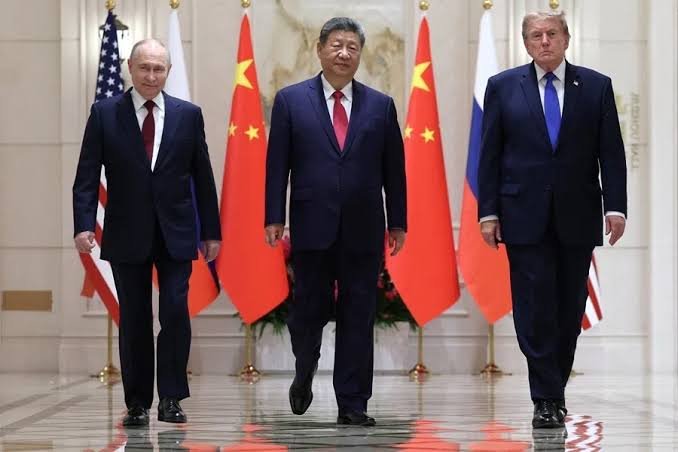
The first-ever summit of the world’s three largest nuclear powers reminded of the 1945 conference at Yalta, attended by Winston Churchill, Franklin Roosevelt, and Joseph Stalin. Last week, in Shenzhen, it was Donald Trump, Xi Jinping and Vladimir Putin.
Why Trump did not insist on meeting the other two leaders in Manila alongside the East Asia Summit, thus conceding diplomatic space to Xi, remains a mystery.
Shenzhen has confirmed that, with Russia by its side and sitting as an equal to the US, China is the superpower that holds the world in awe — and fear.
Britain, which once ruled the waves, was not there. It seems confined to a Europe buffeted by climate change and increasing spending on arms, struggling to stop Putin’s advance into Ukraine. An emboldened Russia hits Poland, Sunday reports say.
Is the world a better place to live in between the two summits eight decades apart? Since the two World Wars, it has certainly ‘graduated’ to multiple conflicts that have caused faster and greater devastation. Amid the nuclear bogey, oil is the current target.
Self-generated crises confront the world. Putin will not quit Ukraine after 5 years. Losing in midterm elections has made Trump more aggressive on Iran. And, likely to lose power, Israel’s Benjamin Netanyahu wants to ravage Gaza further and egg on Trump to renew attacks on Iran.
A Hindi saying sums up the futility of saying all this.
भैंसों के सामने भागवत — reciting holy scriptures before buffaloes — means giving profound advice, wisdom, or knowledge to someone who cannot understand or appreciate.
In our case, to those unwilling to listen, dragging the world to its precipice.
Meanwhile…….
Profiling someone young, hoping his generation might show the way to a better future…..
As the Democratic Party notched victories in the November 3 midterm elections, one of the most sought-after faces on American television networks, including conservative Fox News, was that of New York City Mayor Zohran Mamdani.
Neither a winning candidate nor a party stalwart, he emerged as a mascot of a burgeoning progressive movement of Democratic Socialists of America (DSA), working within the Democratic Party. Media reports said eight DSA-backed candidates succeeded in the midterm elections.
Being mayor of America’s largest city matters, and Mamdani’s backing helped Kerala-born, Indian-bred Nithya Raman become mayor of Los Angeles, the second-largest city. Democratic socialists also triumphed in mayoral elections from Washington, DC, to Providence, Rhode Island, and Los Angeles, California. Elsewhere, progressives captured key races around the country, including key Senate contests in Maine and Michigan.
What seems to have worked is that Mamdani’s work in New York in the last year has been well-received. Even President Trump, who earlier attacked Mamdani and threatened to withhold funds if he were elected, visited the mayoral home rather than inviting him to the White House.
Appearances matter as much as perceptions in America. Before he moved from one TV network to another, Mamdani, just 34, shaved off his beard and let his moustache stand out on his youthful face. His smiling, energetic presence on the streets and his forthright stance on issues he speaks on have made a difference.
In between, he was seen joining the traditional Gujarati Garba to mark the Navratri festivities and using his knowledge of Hindi, Urdu, and Bengali to mix with the South Asians.
He is also known to mix with the Chinese, speaking Mandarin, with the Arabs in Arabic, in Spanish with the Latinos, and with Africans in Swahili. He is also fluent in Luganda since he was born in Uganda, and in Punjabi with his Indian mother, the renowned filmmaker Meera Nair.
He has come very far in a short period. At the start of 2025, he was a relatively unknown state legislator. His mayoral bid was widely regarded as a long shot. But his grassroots organising, social media operation and economic message quickly turned his campaign into a national phenomenon. That message – focused largely on affordability – resonated with the people.
Many, including Raman and Pia Dandia, elected from Florida, adopted Mamdani’s ‘affordability’ platform, which has caught the imagination of the ethnic minorities, migrants and those who live in large cities for work and live at the subsistence level.
Why are Mamdani and his movement, which has stalwarts like Bernie Sanders, important in today’s United States? The Democratic Party is deeply divided, witnessing internal tension between its well-established centrist wing and its rising progressive-socialist faction. Few in the American ‘establishment’ love them. They are seen as disrupters and losers.
But things are seen as changing – how far, only time can tell. Political insiders say Mamdani’s victory in last year’s mayoral elections offered a lesson for mid-term poll candidates: that the political establishment is not invincible, and candidates willing to challenge it can win.
To the extent that it poses a serious political challenge to the deeply capitalistic system of the United States, the world’s most powerful nation, Mamdani, his peers and camp followers can be credited with charting a different course for democracies elsewhere that are desperately fighting off forces of the political right and far-right elsewhere in the world.
Supporters of the progressive movement see this year’s midterms as a turning point for Democratic politics overall. They credit Mamdani with setting the landslide in motion.
“On the candidate and campaign side, we now have a path – cleared by Zohran and now being paved by others – for this kind of authentic, populist and competent progressive leadership,” says Adin Lenchner, founder of New York-based political consultancy “Carroll Street Campaigns”.
On the other hand, Critics have said the November 3 victories were thanks to President Donald Trump’s policies, including the unpopular war on Iran that has hit America’s economy. They think the conditions may change in time for the 2028 presidential polls.
Even so, there is no escape from rising adversities like rising housing rents, transport costs, and the prices of essential commodities and overall inequalities in American cities.
Mamdani’s mayoral campaign had underscored the appeal of small-dollar fundraising. Most of the contributions were under $250. Emulating him in the mid-term polls, more DSA candidates in New York banked on small donors.
“We have begun the work of transforming our party and making it belong to working people once again,” Mamdani told a roaring crowd.
Whether Mamdani’s influence can translate into a larger and lasting national movement remains to be seen.
The United States remains deeply capitalistic, and Trump’s current spell may be temporary. For now, only time will tell if campaigns like Mamdani’s – that focus on the “crushing weight of this monopoly-driven crony capitalism” – will continue to be relevant, just as they were this year, in 2028, and beyond.

Mahendra Ved is a veteran Journalist and an Expert on international affairs.