
Advocates of India-United States relations will silently wince. But they will agree that the latest US move to suspend tech firms from a key programme that lets them sponsor skilled foreign workers for permanent residency is primarily aimed at India and Indians.
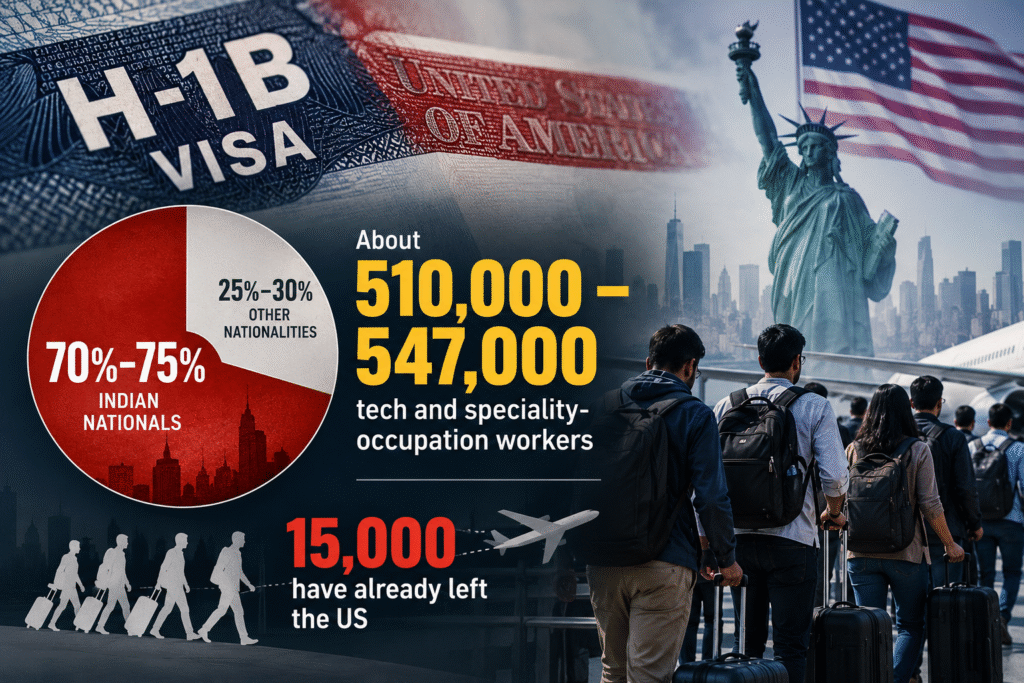
Indian nationals account for about 70% to 75% of all approved H-1B visas, which is roughly 510,000 to 547,000 tech and speciality-occupation workers. Some 15,000 have already left the US.
Justifying it, alleging fraud and misuse, Vice President J. D. Vance has used the term “indentured servants”. A dismayed India has protested the use of this “colonial-era term”.
Over a million Indians were recruited by the British and other European nations who needed cheap labour to work in the countries they had colonised. They needed to replace the mostly West African blacks who were captured and enslaved.
Colonial rule and slavery went together. History records that the working and living conditions of those recruited from India were no better. They did sign agreements, or simply put their thumb marks, to work in distant lands for five years or more. They were called ‘girmitiya’, a corruption of the word ‘agreement’.
Records say that although they formally volunteered, many were misled about their destinations, wages or working conditions by licensed recruiters operating out of ports like Calcutta, Bombay, and Madras. Thousands were simply kidnapped. Though legally distinct from chattel slavery, the system was widely criticised as “neo-slavery” due to brutal plantation discipline, low wages, physical floggings, poor housing, restriction of movement, and penal laws that criminalised contract breaches.
Mounting political resistance and campaigns within India (led by figures like Mahatma Gandhi) eventually forced the British government to abolish the system in 1917. Many did not return, forming the bulk of the 37 million Indian diaspora.
Has anything changed with the American H-1B visa system from this sordid past? Yes, one thing: the misuse and fraud Vance alleges are by American nationals licensed for the task.
Granted, that possibly means fewer jobs for Americans. But is it part of the Trump administration’s blow-hot-blow-cold policy towards India?
Meanwhile, have a look at the slavery of the past, when Europe was the exploiter, and America, the ‘liberator’.
Long after Europe ceased to be a continent of colonial powers, slavery that many of them engaged in continues to be a shameful reminder.
European initiatives to address past wrongs are directed through a Western lens. It is European actors who ultimately decide which colonial abuses are to be redressed and how, while longstanding Asian and African demands for reparations, which have been voiced for 60 years, continue to be ignored.
But it also needs to be noted that the slave trade, in some cases, was driven by local cooperation and participation.
Only Germany has apologised and compensated for a specific colonial genocide (the 1904–1908 Herero and Nama genocide) in Namibia.
Some have apologised or regretted in varying terms, but refused to compensate. If they repaid honestly, perhaps they would go bankrupt. We saw how Britain prevaricated when Shashi Tharoor made a case in his 2015 speech at Oxford University.
Yet, the past of slavery carries a sting. Once a major coloniser, Holland apologised in 2022. But now a report released on October 2 by an expert committee that King Willem-Alexander appointed himself confirms that the Dutch royal family encouraged the slave trade as part of its colonial conquests from the year 1600 onwards.
The royal House of Orange-Nassau profited from it, but could never control it. In the 19th century, their profits accumulated to about $650m in modern terms. But the report says the royal family earned “almost nothing.”
“The involvement of the House of Orange-Nassau was wholehearted and without any real reservations,” Dutch historians and human rights experts concluded after a three-year study by Leiden University’s historian Gert Oostindie. The king says the ‘explicit’ findings have ‘personally’ impacted him.
Like the Dutch, the Portuguese also used Daman and Diu to engage in slavery. Unlike other European slave traders who mostly focused on Africa and trans-Atlantic trade with the United States, the Dutch made peninsular India their playground. They succeeded because local kings and traders cooperated.
That included Gujarat. The Dutch colonisers and slave traders were called ‘Valanda’. Derived from Holland or Hollanders, it is part of the history and literature of Gujarat and other parts of India. Valanda Kothi, the warehouse/ factory established in 1618 in Bharuch, now a high school; Valanda ni Kacheri in Nadiad and Dutch Gardens in Surat, Ahmedabad and Bharuch are strong reminders. The Dutch operated a prominent trading factory in Surat (known historically as Dutch Suratte).
Opulent, European-style mausoleums constructed for Dutch traders can still be visited at the Dutch Gardens in Surat, as well as in Ahmedabad and Bharuch.
As the Dutch East India Company (VOC) established major trading posts across coastal Gujarat during the 17th and 18th centuries, local merchants and residents integrated this term into the Gujarati language. Novelist Gunvantray Acharya (1900-1965) mentions ‘Valanda’ and their slavery in ‘Dariyalal’.
The Dutch exploited Gujarat’s famines. The most notable instances occurred during the catastrophic Western India Famine of 1630–1632 (also known as the Satiyo Famine). As millions died or faced extreme starvation across Gujarat, particularly around Surat and Ahmedabad, the Dutch East India Company capitalised on the desperation.
“Massive numbers of starving locals sold themselves or their children into slavery to survive, while local raiders captured vulnerable individuals to sell to Dutch factories,” says one account.
Gujarati merchants also engaged in the wider regional slave trade. Records say that while they acted as financiers or buyers of African slaves (Sidis) brought to places like Diu and Daman, “their vulnerable compatriots simultaneously fell victim to the aggressive transoceanic slave trafficking operations orchestrated by European companies like the Dutch East India Company.”
Coastal India, stretching from Coromandel to Kochi to Khambhat (Cambay), and Bengal and Bihar were major areas from which slaves were captured. The VOC was heavily involved in slave trading and coerced labour across its Asian empire, including Cochin (Kochi), where enslaved people and kidnapped children were traded, utilised, or shipped to nodes like Ceylon (Sri Lanka), Batavia (Indonesia), Cape Town (South Africa) and Dutch Guiana (now Suriname) in South America.
The Dutch had a powerful commercial presence in Gujarat, focusing heavily on textiles, indigo, and cotton. They did not conquer large territorial empires in India like other Europeans, the later British; instead, they established fortified trading ports along both coasts to dominate the spice, textile, and opium trades.
The Dutch presence in India lasted from 1605 to 1825. VOC systematically pushed the Portuguese out of major Asian trade hubs in the 17th century, seizing monopolies on cinnamon from Ceylon (Sri Lanka) and pepper from the Malabar Coast.
Eventually, British naval and economic dominance eclipsed Dutch power in India in the late 18th century. It culminated in the formal transfer of remaining possessions to the British in the early 19th century.
“We know the effects of colonialism and slavery are still being felt today, ” the Dutch monarch said. He made a significant addition: “Discrimination and economic exploitation unfortunately happen every day.”

Mahendra Ved is a veteran Journalist and an Expert on international affairs.